
On This Day
April 11 in History
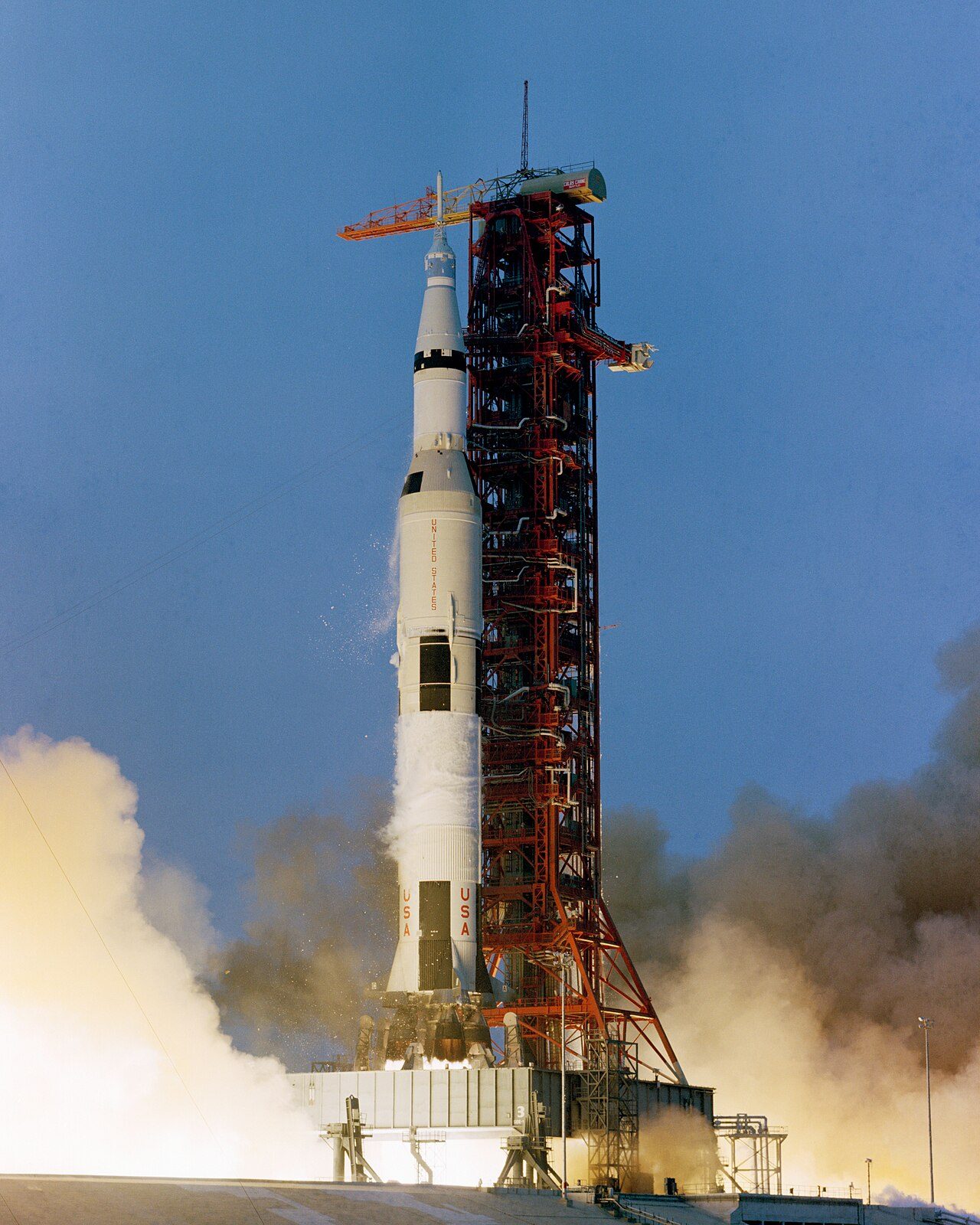
On 11 April 1970 Apollo 13 lifted off from Cape Kennedy in Florida, bound for the Fra Mauro highlands of the Moon. Nothing about the launch suggested what was coming: two days later an oxygen tank would explode, the landing would be abandoned, and the flight would become the most famous rescue in the history of space travel. April 11 is also the day Napoleon was exiled to Elba, Truman sacked MacArthur, and Eichmann went on trial in Jerusalem.
Choose another date: open the On This Day calendar to browse events, births and deaths for any day of the year.
At a Glance
- Launch
- 11 April 1970, 19:13 UTC, from Kennedy Space Center, Florida, aboard a Saturn V
- The crew
- Commander James A. Lovell, command module pilot John L. Swigert and lunar module pilot Fred W. Haise
- The plan
- The third crewed lunar landing, targeting the Fra Mauro highlands
- The late change
- Swigert replaced Ken Mattingly only days before launch, after Mattingly was exposed to German measles
- What went wrong
- An oxygen tank exploded two days into the flight, on 13 April, crippling the service module
- The outcome
- The crew looped around the Moon and splashed down safely in the Pacific on 17 April
Events on this day
- 1814The Treaty of Fontainebleau is signed and Napoleon Bonaparte, having abdicated, is exiled to the island of Elba.
- 1831Nearly 80 newly discovered Lewis Chessmen, medieval walrus-ivory pieces found in a sand bank on the Isle of Lewis, are exhibited in Edinburgh.
- 1865Abraham Lincoln gives his last public address, speaking from the White House in support of limited Black suffrage in Louisiana.
- 1895Cuban patriot José Martí lands in Cuba to join the war of independence against Spain; he is killed in battle five weeks later.
- 1909Families from Jaffa hold a lottery for plots of sand north of the city — the founding moment of Tel Aviv.
- 1951President Harry S. Truman relieves General Douglas MacArthur of his commands in Korea, asserting civilian control of the military.
- 1961The trial of Adolf Eichmann, the Nazi official who organised the deportation of Jews to the death camps, opens in Jerusalem.
- 1968President Lyndon B. Johnson signs the Civil Rights Act of 1968, outlawing discrimination in the sale and rental of housing.
- 1970Apollo 13 lifts off for the Moon — the featured story above.
- 1979Ugandan dictator Idi Amin flees Kampala as Tanzanian-led forces close in, ending eight years of brutal rule.
Born on this day
- 1793Ferdinand I — emperor of Austria whose long, reactionary reign ended in abdication during the revolutions of 1848.
- 1825Ferdinand Lassalle — German socialist thinker and founder of the first German workers' political organisation.
- 1862Charles Evans Hughes — jurist and statesman, secretary of state and 11th chief justice of the United States.
- 1893Dean Acheson — American secretary of state who helped design the Marshall Plan and the postwar Western alliance.
- 1953Andrew Wiles — English mathematician who proved Fermat's Last Theorem, a problem unsolved for more than 350 years.
Died on this day
- 1554Thomas Wyatt the Younger — English rebel executed after leading a rising against Queen Mary I and her Spanish marriage.
- 1987Primo Levi — Italian chemist and writer whose If This Is a Man is among the great testimonies of the Holocaust.
- 2007Kurt Vonnegut — American novelist of Slaughterhouse-Five and Cat's Cradle, dead in New York at 84.
- 2013Maria Tallchief — Osage prima ballerina who became America's first great native-born star of ballet.
- 2020John Horton Conway — English mathematician, inventor of the Game of Life, dead of COVID-19 at 82.
The featured story: Apollo 13 lifts off, 11 April 1970
Apollo 13 was meant to be routine — which, in April 1970, was itself remarkable. Two crews had already landed on the Moon, public attention was drifting, and the third landing, in the Fra Mauro highlands, was planned largely as a geological expedition. The crew was commanded by Jim Lovell, the most experienced space traveller alive, with Fred Haise as lunar module pilot. The command module pilot should have been Ken Mattingly, but days before launch Mattingly was exposed to German measles and had never had the disease; against his furious protests he was replaced by his backup, Jack Swigert.
The launch itself, at 13:13 Houston time on 11 April, was not flawless. During the second-stage burn the centre engine shut down about two minutes early, shaken by violent oscillations, and the remaining engines burned longer to compensate. The spacecraft reached orbit and set off for the Moon on schedule, and for two days the flight was so quiet that a television broadcast by the crew was not even carried live by the networks. The routine, everyone assumed, was holding.
The danger had in fact been loaded aboard years earlier. The number 2 oxygen tank in the service module had a damaged history: it had been dropped, its thermostatic switches were rated for a lower voltage than the ground equipment that later powered its heaters, and insulation on its internal wiring had been baked and frayed. When Swigert switched on the tank's stirring fans on 13 April, a short circuit ignited the insulation. The tank exploded, the panel covering its bay blew away, and the second tank began to leak. Within hours the command module Odyssey was dying — losing oxygen, power and water.
What followed turned a failed landing into NASA's defining story. The lunar module Aquarius, built for two men for two days, became a lifeboat for three men for four. Engineers on the ground improvised a way to fit square carbon-dioxide filters into round holes, rationed power so tightly that the cabin fell near freezing, and calculated a burn that swung the crippled ship around the Moon and home. On 17 April Odyssey splashed down in the Pacific, close to the recovery ship. Lovell called the flight a successful failure — a failure that, because everyone lived, became a triumph of improvisation over catastrophe.
Why this date matters
April 11 keeps staging contests between planning and accident. A treaty tidied Napoleon off the map in 1814, and within a year he was back. A president asserted the most careful principle of civil government in 1951 by sacking his most famous general. And in 1970 the most meticulously planned enterprise of the age — a Moon landing — was undone by a damaged wire inside a tank, and then saved by planning of a different kind: thousands of people improvising, calmly and in order, for four days. The day rewards whoever adapts fastest.
Sources
- Encyclopaedia Britannica — On This Day: April 11
- HISTORY — What Happened on April 11
- NASA — Apollo 13 Mission
- HISTORY — Apollo 13 launches
The facts on this page were checked against these sources on 19 November 2026. The History Trail's permanent pages are researched and written for this site; the live profiles elsewhere on The History Trail are assembled automatically from Wikipedia and Wikidata.
About the Author
Researched and written by the The History Trail Editorial Team — the accountable editorial function behind this site's permanent story pages. The team works from the published sources cited on each page; it does not invent historians, reviewers or credentials, and it corrects errors openly.
Fact Check
Every load-bearing fact on this page traces to one of the sources listed above, and significant claims link to their source in the text. Our checking method is described on the methodology page; errors can be reported via the corrections page.
Sources & Citations
Cite this page as: The History Trail Editorial Team, The History Trail — this article's title, publication and update dates are shown beneath its headline. The full source list appears under Sources above; the site's source standards are on the sources page.