
On This Day
December 27 in History
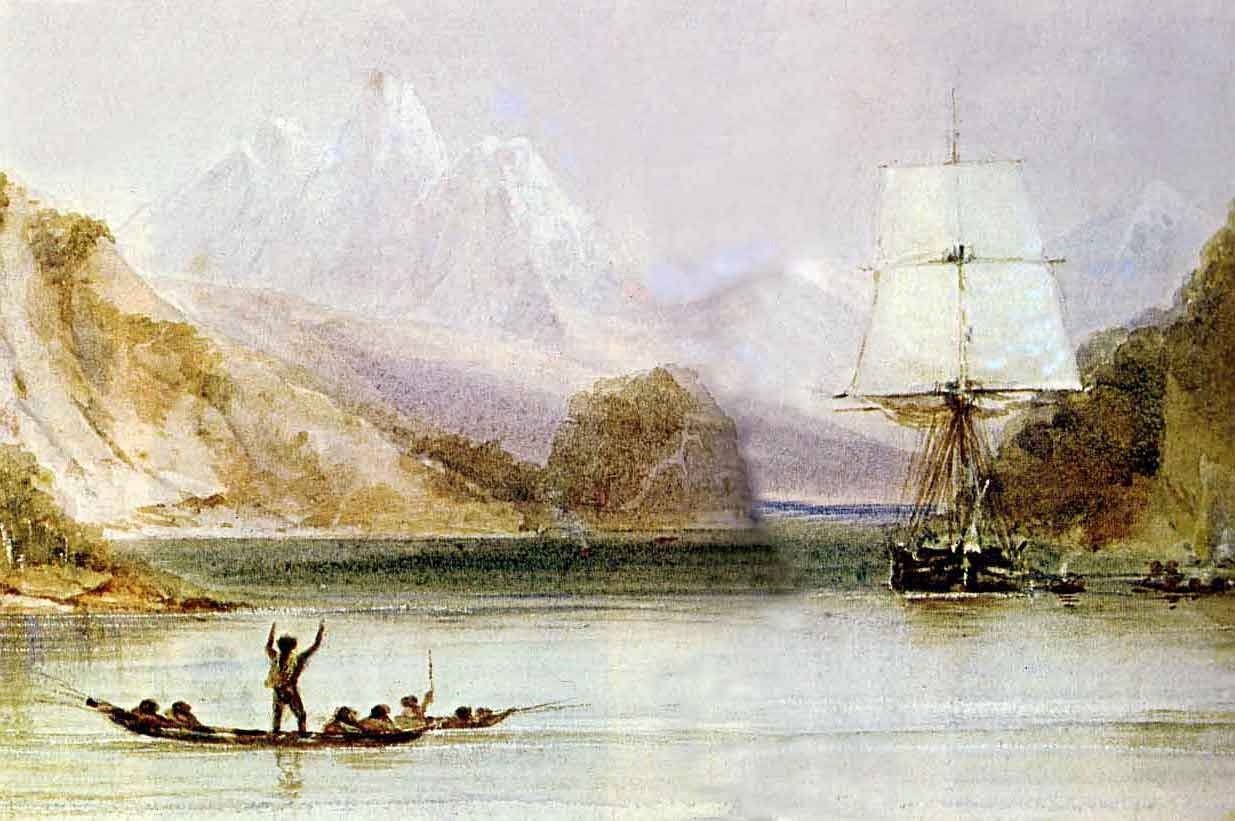
On 27 December 1831 HMS Beagle finally sailed from Plymouth on a surveying voyage around the world, carrying as its naturalist a 22-year-old Charles Darwin — the five-year journey whose fossils, finches and notebooks would grow into the theory of evolution by natural selection. December 27 is also the day Hagia Sophia was consecrated, Benazir Bhutto was assassinated, and Apollo 8 splashed down to end the first voyage to the Moon.
Choose another date: open the On This Day calendar to browse events, births and deaths for any day of the year.
At a Glance
- Departure
- 27 December 1831, from Plymouth, after two earlier attempts were driven back by bad weather
- The ship
- HMS Beagle, a 27-metre Royal Navy survey brig on her second surveying voyage, commanded by Captain Robert FitzRoy
- Darwin's post
- Unpaid naturalist and gentleman companion to the captain, recommended by his Cambridge mentor John Stevens Henslow
- The voyage
- Five years around South America, the Galápagos, Tahiti, New Zealand, Australia and South Africa
- Home
- Beagle returned to Falmouth on 2 October 1836; Darwin arrived with some 5,000 specimens and a transformed mind
- The harvest
- On the Origin of Species, published in 1859, twenty-three years after the ship came home
Events on this day
- 537The church of Hagia Sophia in Constantinople, the largest cathedral in the world, is consecrated under Emperor Justinian, five years after construction began.
- 1512Ferdinand II of Spain issues the Laws of Burgos, the first laws intended to govern Spanish treatment of the Indigenous peoples of the Americas.
- 1831HMS Beagle sails from Plymouth with Charles Darwin aboard, beginning the five-year voyage that leads to the theory of evolution — the featured story above.
- 1845New York journalist John L. O'Sullivan uses 'Manifest Destiny' in print for the expansion of the United States across the continent, giving a name to the doctrine.
- 1900Prohibitionist Carry Nation smashes the bar of the Carey Hotel in Wichita, Kansas, with rocks and a billiard ball, escalating her campaign against saloons.
- 1904J. M. Barrie's Peter Pan opens at the Duke of York's Theatre in London, introducing Wendy, the Lost Boys and Neverland.
- 1911'Jana Gana Mana', the future national anthem of India, is sung publicly for the first time, at the Calcutta session of the Indian National Congress.
- 1918The Greater Poland Uprising begins in Poznań, the revolt that will attach most of the Prussian partition to the reborn Polish state.
- 1932Radio City Music Hall opens in New York, the largest indoor theatre of its age, with a stage show designed to defy the Depression gloom.
- 1939A magnitude 7.8 earthquake strikes Erzincan in eastern Turkey; at least 32,700 people are killed, by the official counts of the disaster.
- 1945The International Monetary Fund comes into formal existence as 29 nations ratify its Articles of Agreement at Washington.
- 1949The Netherlands formally transfers sovereignty over the Dutch East Indies to the new Republic of Indonesia, ending more than three centuries of Dutch rule.
- 1968Apollo 8 splashes down in the Pacific, ending the first crewed voyage to the Moon — the flight that had launched on December 21.
- 2007Former Pakistani prime minister Benazir Bhutto is assassinated at an election rally in Rawalpindi, weeks after returning from exile.
Born on this day
- 1571Johannes Kepler — German astronomer who discovered the laws of planetary motion.
- 1797Mirza Ghalib — Urdu and Persian poet of Delhi, the supreme voice of Urdu verse.
- 1822Louis Pasteur — French chemist and microbiologist who proved germ theory and gave his name to pasteurization.
- 1901Marlene Dietrich — German-American film star of The Blue Angel and a defining screen presence of the 1930s.
Died on this day
- 1985Dian Fossey — American primatologist who studied Rwanda's mountain gorillas, found murdered in her cabin at the Karisoke research camp.
- 2003Alan Bates — English actor, star of Zorba the Greek and Far from the Madding Crowd.
- 2007Benazir Bhutto — former prime minister of Pakistan, assassinated at Rawalpindi on the day of her entry in the events above.
- 2012Gerry Anderson — English creator of Thunderbirds and a generation of puppet-action television.
- 2016Carrie Fisher — American actress who played Princess Leia in Star Wars, and a sharp comic writer, dead at 60.
The featured story: Darwin departs on HMS Beagle, 27 December 1831
HMS Beagle was a small Royal Navy brig — about 27 metres long — sent to complete the hydrographic survey of South America's coasts begun on her first voyage. Her captain, Robert FitzRoy, wanted a gentleman naturalist who could double as a dining companion on a long commission, and the post was offered, through Cambridge's John Stevens Henslow, to his former student Charles Darwin, a 22-year-old who had abandoned medicine and was drifting towards the clergy. Darwin's father objected that the voyage was a disreputable waste of his son's time, and only relented when Darwin's uncle, Josiah Wedgwood II, argued the case point by point.
Even then, the sea nearly refused them. As the Darwin Correspondence Project records, the Beagle's first departure attempts in December were beaten back by gales, and the ship waited at anchor in Plymouth's Barn Pool before finally getting away on 27 December 1831. Darwin, wretchedly seasick for much of the five years that followed, shared a cabin with charts and a hammock slung over the table, and spent most of the voyage's duration — some three years of it — ashore, riding into the interiors of Brazil, Argentina, Chile and Peru while the Beagle worked the coasts.
What he collected remade him. In Argentina he dug the bones of gigantic extinct mammals — giant ground sloths and armadillo-like glyptodonts — from cliffs near where their smaller living relatives still roamed, and wondered why the giants had vanished. In Chile he lived through a great earthquake and saw the coastline lifted bodily out of the sea. In the Galápagos in 1835 he collected the mockingbirds and finches whose island-by-island differences, once sorted back in London, suggested that species were not fixed at all, but changed. His private notebooks, begun within a year of his return, contain the first sketch of the family tree of life.
The Beagle reached Falmouth on 2 October 1836. Darwin never went to sea again. He spent twenty years testing the idea the voyage had planted — breeding pigeons, dissecting barnacles, corresponding with collectors worldwide — before publishing On the Origin of Species in 1859. FitzRoy, a devout man, later agonised over his part in launching the theory he abhorred. But the five-year survey cruise that left Plymouth on this day, with a seasick young naturalist its captain had nearly not taken, became the most consequential scientific voyage ever made.
Why this date matters
December 27 is a day of departures and dedications. A cathedral is consecrated in Constantinople; a small survey brig leaves Plymouth carrying the young man who will quietly unmake the world's picture of life's origins; a radio palace opens in New York; and, in our own century, a former prime minister falls to an assassin on the campaign trail. It is fitting that Apollo 8 also splashed down on this date: the day specialises in journeys that begin in obscurity — a seasick naturalist, a half-empty theatre — and end by changing what everyone believes.
Sources
- Encyclopaedia Britannica — On This Day: December 27
- HISTORY — What Happened on December 27
- Darwin Correspondence Project, University of Cambridge — The Voyage of the Beagle
- Encyclopaedia Britannica — Charles Darwin
The facts on this page were checked against these sources on 19 November 2026. The History Trail's permanent pages are researched and written for this site; the live profiles elsewhere on The History Trail are assembled automatically from Wikipedia and Wikidata.
About the Author
Researched and written by the The History Trail Editorial Team — the accountable editorial function behind this site's permanent story pages. The team works from the published sources cited on each page; it does not invent historians, reviewers or credentials, and it corrects errors openly.
Fact Check
Every load-bearing fact on this page traces to one of the sources listed above, and significant claims link to their source in the text. Our checking method is described on the methodology page; errors can be reported via the corrections page.
Sources & Citations
Cite this page as: The History Trail Editorial Team, The History Trail — this article's title, publication and update dates are shown beneath its headline. The full source list appears under Sources above; the site's source standards are on the sources page.