
On This Day
August 29 in History
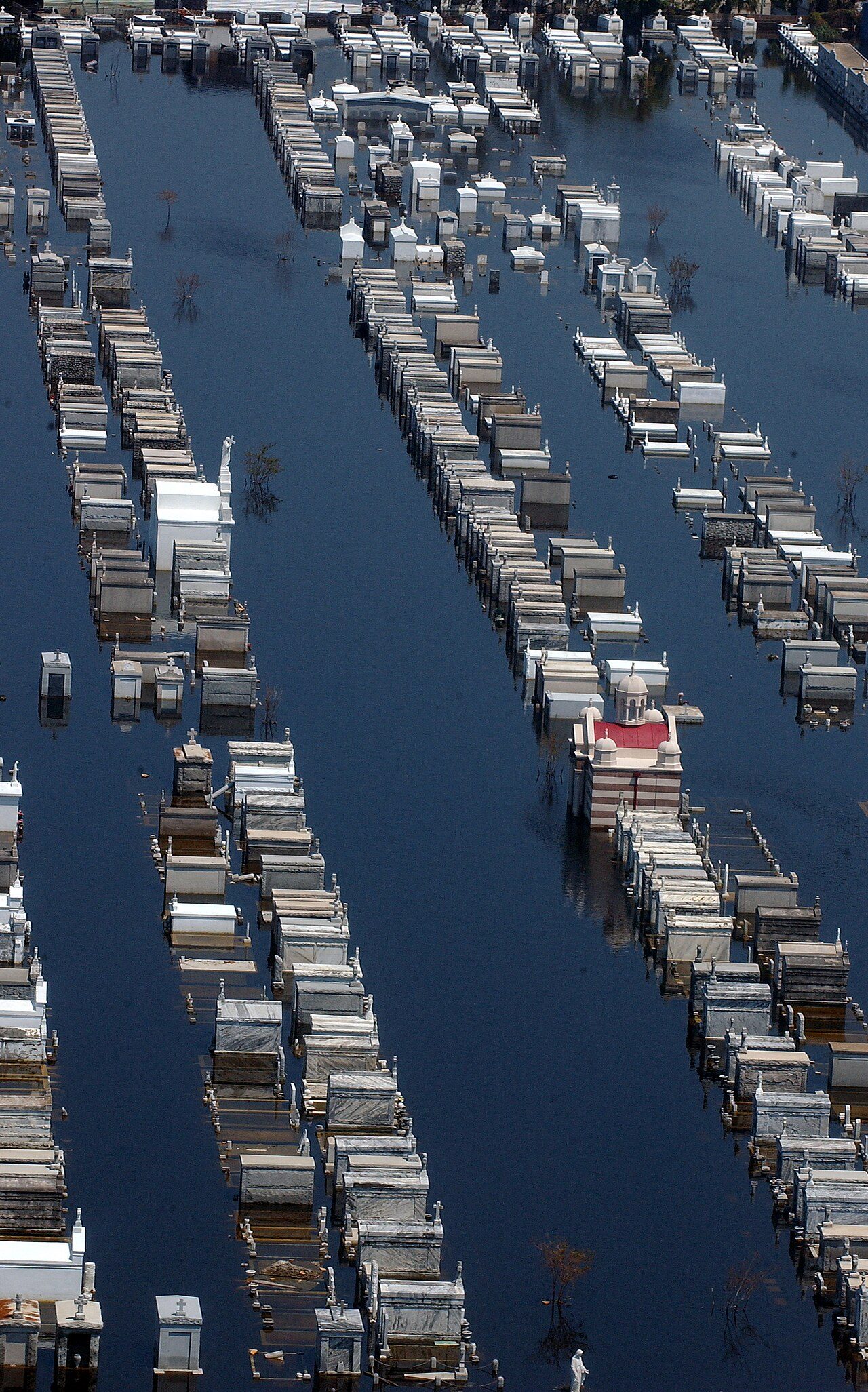
On 29 August 2005 Hurricane Katrina made landfall on the Gulf Coast as a Category 3 storm, and the failure of New Orleans's levees flooded 80 percent of the city, in one of the deadliest and costliest disasters in American history. August 29 is also the day of the Battle of Mohacs, Faraday's discovery of electromagnetic induction, and the Soviet Union's first atomic bomb test.
Choose another date: open the On This Day calendar to browse events, births and deaths for any day of the year.
At a Glance
- The landfall
- Near Buras-Triumph, Louisiana, early on 29 August 2005, as a Category 3 hurricane with winds above 200 km/h
- The surge
- A storm surge up to about 8 metres high devastated the Mississippi coast
- The flooding
- Levee and floodwall failures inundated about 80 percent of New Orleans
- The toll
- An estimated 1,392 deaths in modern counts; older official figures ran higher, to about 1,800
- The cost
- About 125 billion dollars in damage, among the costliest natural disasters in United States history
- The shelter
- Tens of thousands who had not evacuated took refuge in the Superdome and the convention centre, in conditions that shamed the nation
Events on this day
- 1526Ottoman forces crush Hungary at the Battle of Mohacs, killing King Louis II and opening central Europe to a century and a half of Ottoman rule.
- 1756Frederick the Great invades Saxony, opening the Seven Years' War.
- 1831Michael Faraday demonstrates electromagnetic induction, the principle behind the electric generator and transformer.
- 1885Gottlieb Daimler patents the first motorcycle, the petroleum-driven Reitwagen.
- 1949The Soviet Union detonates its first atomic bomb in Kazakhstan, ending the American nuclear monopoly.
- 1952John Cage's 4'33, four and a half minutes of performed silence, is premiered in Woodstock, New York.
- 1957Senator Strom Thurmond ends his record 24-hour filibuster against the Civil Rights Act of 1957.
- 1991The Soviet parliament suspends the Communist Party, days after the failed Moscow coup.
- 1997Netflix is founded in California as a mail-order DVD rental company.
- 2005Hurricane Katrina makes landfall and New Orleans's levees fail — the featured story above.
Born on this day
- 1632John Locke — English philosopher whose ideas of rights and government shaped modern democracies.
- 1915Ingrid Bergman — Swedish actress of Casablanca and three Academy Awards.
- 1920Charlie Parker — American saxophonist who co-invented bebop.
- 1936John McCain — American naval aviator, prisoner of war and senator.
- 1947Temple Grandin — American animal scientist and autism advocate.
- 1958Michael Jackson — American singer who became the King of Pop.
Died on this day
- 1533Atahualpa — last Sapa Inca emperor, executed by Pizarro's Spaniards at Cajamarca.
- 1877Brigham Young — Mormon leader who led his church to Utah and governed it for three decades.
- 1982Ingrid Bergman — Swedish actress, dead in London on her 67th birthday.
- 2016Gene Wilder — American comic actor of Willy Wonka and Young Frankenstein, dead at 83.
The featured story: Hurricane Katrina makes landfall, 29 August 2005
Katrina had already killed people in Florida as a modest hurricane before it crossed into the Gulf of Mexico, drank the warm water, and came back as a monster. By the time it turned toward Louisiana it had reached Category 5, and although it weakened before landfall, it pushed a wall of water ahead of it. At about 6:10 in the morning of 29 August 2005 the eye crossed the coast near Buras-Triumph, Louisiana, as a strong Category 3. On the Mississippi coast the surge rose as high as eight metres, erasing beach towns. In New Orleans the storm itself passed to the east, close enough.
What drowned New Orleans was not the wind but the waterworks. Through the morning, the city's levees and floodwalls, built and maintained by the Army Corps of Engineers, failed at multiple points: the 17th Street and London Avenue canals breached into Lake Pontchartrain's surge, and the Industrial Canal gave way on both sides. By the next day roughly 80 percent of the city stood under water up to six metres deep in places. Later investigations, including the federal government's own Katrina review, concluded that the flooding of New Orleans was a man-made engineering failure riding on a natural disaster.
The human failure compounded the engineering one. Some 100,000 residents, disproportionately poor, elderly and Black, had not or could not evacuate. Tens of thousands gathered at the Superdome, whose roof peeled in the wind, and at the convention centre, where no supplies had been planned at all. Helicopters lifted survivors from rooftops for days while bodies floated in the streets of a major American city on live television. The official modern death count is an estimated 1,392, with damage put at about 125 billion dollars, tying Katrina with Harvey as the costliest storm in American records.
Katrina permanently changed its city: New Orleans lost roughly half its population in a year, and whole neighbourhoods, above all the Lower Ninth Ward, rebuilt slowly or not at all. It also changed the country's politics of disaster, ending careers, prompting the resignation of the FEMA director, and forcing a decade of inquiries into why the richest nation on Earth had let a forecast catastrophe happen on camera. The storm had been predicted, in detail, for years. The failure was not imagination. It was follow-through.
Why this date matters
August 29 is a day when systems are tested to destruction. An empire broke Hungary at Mohacs; a bomb test broke a monopoly; a hurricane broke a city's defences and exposed every weakness behind them. But the date also holds the counter-principle: Faraday in a laboratory finding the induction law that would light the world, and Cage in a concert hall proving that even silence, framed honestly, can be an event. The day's lesson is that what fails is usually not nature or art but the structures people trusted without checking. The rebuilding argument that followed, about whether a city below sea level should be defended at such cost, was settled less by engineers than by the residents who came back first and rebuilt with their own hands while the official plans were still being drawn.
Sources
- Encyclopaedia Britannica — On This Day: August 29
- HISTORY — What Happened on August 29
- The White House (George W. Bush Archives) — Hurricane Katrina: Lessons Learned, Chapter Four
- Wikimedia Commons — FEMA photograph by Jocelyn Augustino, New Orleans, 4 September 2005

The facts on this page were checked against these sources on 19 November 2026. The History Trail's permanent pages are researched and written for this site; the live profiles elsewhere on The History Trail are assembled automatically from Wikipedia and Wikidata.
About the Author
Researched and written by the The History Trail Editorial Team — the accountable editorial function behind this site's permanent story pages. The team works from the published sources cited on each page; it does not invent historians, reviewers or credentials, and it corrects errors openly.
Fact Check
Every load-bearing fact on this page traces to one of the sources listed above, and significant claims link to their source in the text. Our checking method is described on the methodology page; errors can be reported via the corrections page.
Sources & Citations
Cite this page as: The History Trail Editorial Team, The History Trail — this article's title, publication and update dates are shown beneath its headline. The full source list appears under Sources above; the site's source standards are on the sources page.