
Years
1215 in History
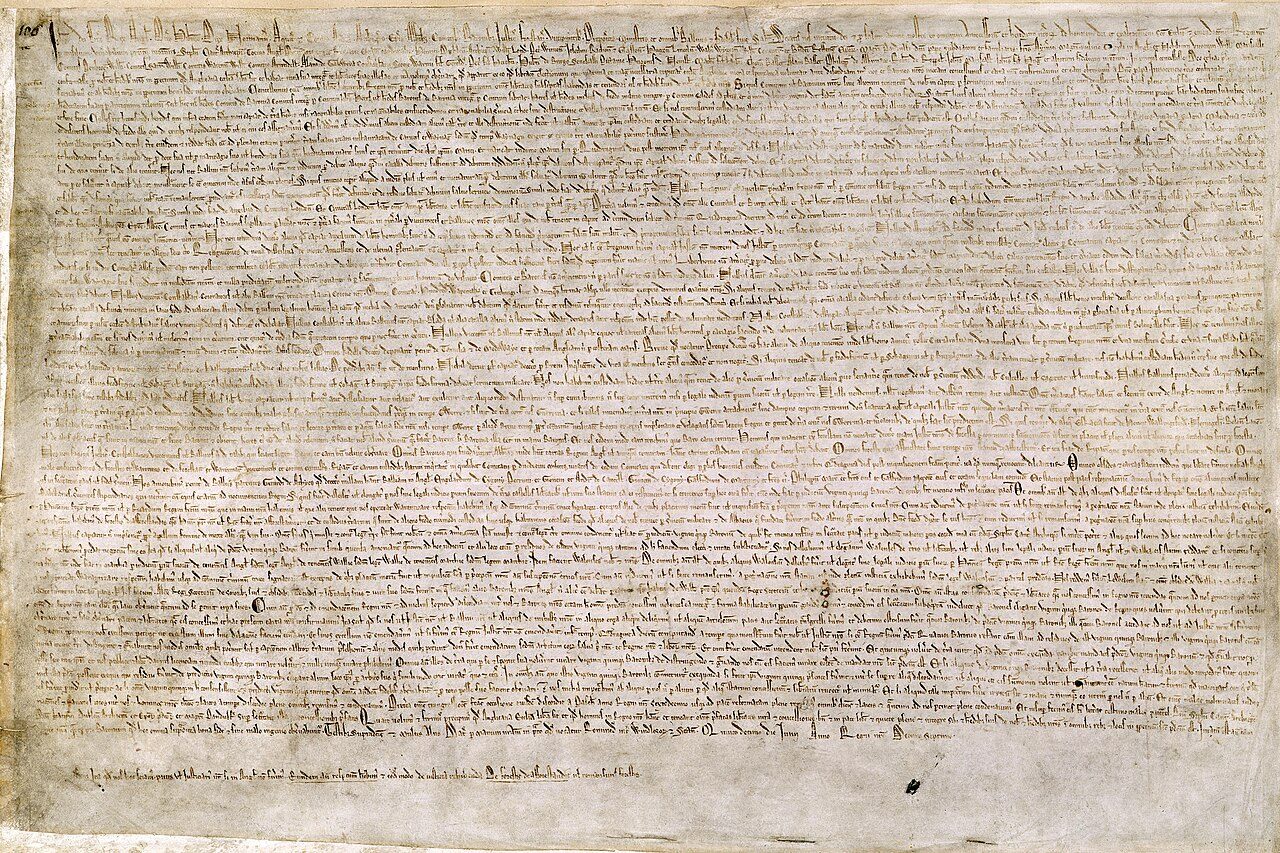
1215 is remembered for a single document. At Runnymede on 15 June, King John of England, faced by rebellious barons who had seized London, put his great seal to Magna Carta — the first written acceptance by an English king that his power had legal limits. The Pope annulled it within weeks and civil war followed, yet the charter was reissued for Henry III and became the enduring symbol of the rule of law.
At a Glance
- Defining event
- Magna Carta sealed at Runnymede, 15 June — King John accepts written limits on royal power
- The pressure
- Rebel barons occupy London in May and renounce their allegiance, forcing John to negotiate
- The text
- 63 clauses in abbreviated Latin, including clauses 39 and 40 on lawful judgement and unsold justice
- The reversal
- Pope Innocent III annuls the charter on 24 August; civil war resumes in the autumn
- Elsewhere in 1215
- Genghis Khan's Mongol forces capture Zhongdu, the Jin capital on the site of modern Beijing, on 1 June
- Remembered for
- The Great Charter — a failed peace treaty that became the symbol of the rule of law
The defining story: Magna Carta sealed at Runnymede
Magna Carta was born of failure. King John had lost Normandy and most of England's possessions in France, quarrelled with the Pope until England lay under interdict and he himself was excommunicated, and bought his way back by surrendering his kingdom to Rome as a papal fief. He financed it all with feudal dues raised to extortionate levels, ransoms, fines and seizures of hostages. When his final attempt to recover France collapsed at Bouvines in 1214, his barons' patience ended. In May 1215 the rebels occupied London and renounced their allegiance, and John, unable to be sure of winning a war, had to negotiate.
The meeting place was Runnymede, a water-meadow beside the Thames between Windsor and Staines, and the mediator was Archbishop Stephen Langton. On 15 June 1215 John put his great seal to the charter the barons had essentially dictated. He did not sign it — medieval kings authenticated documents with a seal — and the wax impression was pressed to a text of 63 clauses in abbreviated Latin. Most of it was practical and feudal: it limited the sums heirs owed for their inheritances, protected widows and the Church, and standardised weights and measures. Copies, called exemplifications, were made and distributed around the kingdom.
Two clauses reached far beyond the feudal bargain. Clause 39 promised that no free man would be seized, imprisoned, stripped of his rights or possessions, outlawed or exiled except by the lawful judgement of his equals or by the law of the land. Clause 40 added, in a single sentence, that to no one would the king sell, deny or delay right or justice. In 1215 'free men' were a minority of the population, but the wording was general enough for later generations to read much more into it — and they did.
As a peace treaty, the charter failed almost at once. John appealed to the Pope, his feudal overlord, and on 24 August 1215 Innocent III annulled it as shameful and demeaning, declaring it null and void. Both sides went back to war that autumn, and the rebel barons offered the English crown to Prince Louis of France. The year that had produced the most famous charter in English history ended with the kingdom sliding into civil war and a foreign prince preparing to invade — the document's survival would depend entirely on what happened after its maker was gone.
Timeline of 1215
- May
Rebel barons occupy London, forcing King John to negotiate rather than fight a war he cannot be sure of winning.
- 1 June
Genghis Khan's Mongol forces capture Zhongdu, the Jin dynasty capital on the site of modern Beijing, after a long siege.
- 15 June
King John seals Magna Carta at Runnymede, accepting the barons' terms in a charter of 63 clauses.
- June
Copies of the charter, called exemplifications, are made and distributed around the kingdom.
- 24 August
Pope Innocent III annuls the charter as shameful and demeaning, declaring it null and void.
- Autumn
Civil war resumes, and the rebel barons offer the English crown to Prince Louis of France.
Why 1215 still matters
Magna Carta matters because of what repetition did to it. John died in October 1216 with England half occupied, and the regents of his nine-year-old son, Henry III, reissued the charter that November to buy loyalty, again in 1217 alongside the separate Charter of the Forest — the reissue that gave it the name Magna Carta, the Great Charter — and again in 1225, in the definitive form that entered the statute book. A document issued to win a war became, by being reissued, part of the furniture of English law. Four exemplifications of the 1215 text survive, two at the British Library and one each at Lincoln Castle and Salisbury Cathedral, and they are inscribed on UNESCO's Memory of the World register.
Its afterlife grew larger than its text. In the seventeenth century, lawyers and parliamentarians fighting the Stuart kings revived clauses 39 and 40 as ancient authority for due process and against arbitrary imprisonment. From there the language travelled into later constitutional documents, including the United States Constitution and Bill of Rights, and in the twentieth century into modern declarations of human rights. The charter did not found democracy — it created no parliament and no votes, and its protections covered only free men — but it supplied words durable enough to be widened by every generation that needed an argument against arbitrary power. That is why 1215, a year of siege, annulment and civil war on two continents, is remembered for a meadow, a seal and a promise.
1215 on The History Trail
Magna Carta dominates 1215 on The History Trail, but the year also saw a Mongol siege end on the other side of the world.
- June 15 in History — Magna Carta is sealed at Runnymede.
- June 1 in History — Genghis Khan's forces capture Zhongdu, on the site of modern Beijing.
- Magna Carta — the full story of the charter, its clauses, its annulment and its reissues.
- 1066 in History — the Norman Conquest that reshaped the England whose barons later confronted King John.
- 1492 in History — the year Granada fell and Columbus crossed the Atlantic.
Sources
- The National Archives — Magna Carta, 1215
- Encyclopaedia Britannica — On This Day: June 15
- HISTORY — What Happened on June 15
- Encyclopaedia Britannica — On This Day: June 1
- HISTORY — What Happened on June 1
The facts on this page were checked against these sources on 19 November 2026. The History Trail's permanent pages are researched and written for this site; the live profiles elsewhere on The History Trail are assembled automatically from Wikipedia and Wikidata.
About the Author
Researched and written by the The History Trail Editorial Team — the accountable editorial function behind this site's permanent story pages. The team works from the published sources cited on each page; it does not invent historians, reviewers or credentials, and it corrects errors openly.
Fact Check
Every load-bearing fact on this page traces to one of the sources listed above, and significant claims link to their source in the text. Our checking method is described on the methodology page; errors can be reported via the corrections page.
Sources & Citations
Cite this page as: The History Trail Editorial Team, The History Trail — this article's title, publication and update dates are shown beneath its headline. The full source list appears under Sources above; the site's source standards are on the sources page.