
Years
1066 in History
1066 is the year England was conquered. It opened with the childless death of Edward the Confessor and the crowning of Harold Godwinson, and it closed with a Norman duke on the English throne: in between, Harold destroyed a Norwegian invasion at Stamford Bridge, then lost his kingdom and his life to William of Normandy at the Battle of Hastings on 14 October.
At a Glance
- Defining event
- The Battle of Hastings, 14 October — William of Normandy defeats and kills King Harold II
- Opened the year
- Death of Edward the Confessor, 5 January, leaving no heir and three rival claimants
- Crowned first
- Harold Godwinson, crowned at Westminster on 6 January, the day after Edward's death
- Turning point
- Stamford Bridge, 25 September — Harold destroys the Norwegian invasion of Harald Hardrada
- Closed the year
- William the Conqueror crowned king of England at Westminster Abbey, 25 December
- Remembered for
- The Norman Conquest — the last successful invasion of England, which remade its language, laws and ruling class
The defining story: the Battle of Hastings
England had three kings in 1066, and the year began with a vacancy. Edward the Confessor died childless on 5 January, and Harold Godwinson, the kingdom's most powerful earl, was crowned at Westminster the next day. His claim was contested from the start. Across the Channel, William, duke of Normandy, maintained that Edward had promised him the succession and that Harold had sworn to support him. In the north, Harald Hardrada of Norway pressed a rival claim of his own — and it was the Norwegian who moved first, invading England in the autumn.
Harold's response was one of the great forced marches of the age. He took his army the length of England and, on 25 September at Stamford Bridge, destroyed the Norwegian invasion, killing Hardrada and Harold's own brother Tostig. It was a complete victory — and it came at the worst possible moment. Three days later, on 28 September, William landed unopposed at Pevensey in Sussex, having finally sailed overnight on 27 September after weeks of waiting for a fair wind. Harold turned his exhausted army around and marched straight back south to meet a second invasion.
The armies met on 14 October on a ridge near Hastings, at the place now called simply Battle. Harold's English fought on foot in a dense shield wall along the ridge; William's Normans, Bretons and French attacked uphill with archers, infantry and cavalry. For a medieval battle it lasted extraordinarily long, from morning until dusk, a measure of how evenly matched the sides were. Norman attacks broke against the wall, and a rumour that William had been killed nearly broke his own army, until the duke raised his helmet and showed his face. Feigned retreats, whether planned or improvised, drew English pursuers downhill and thinned the wall at the top.
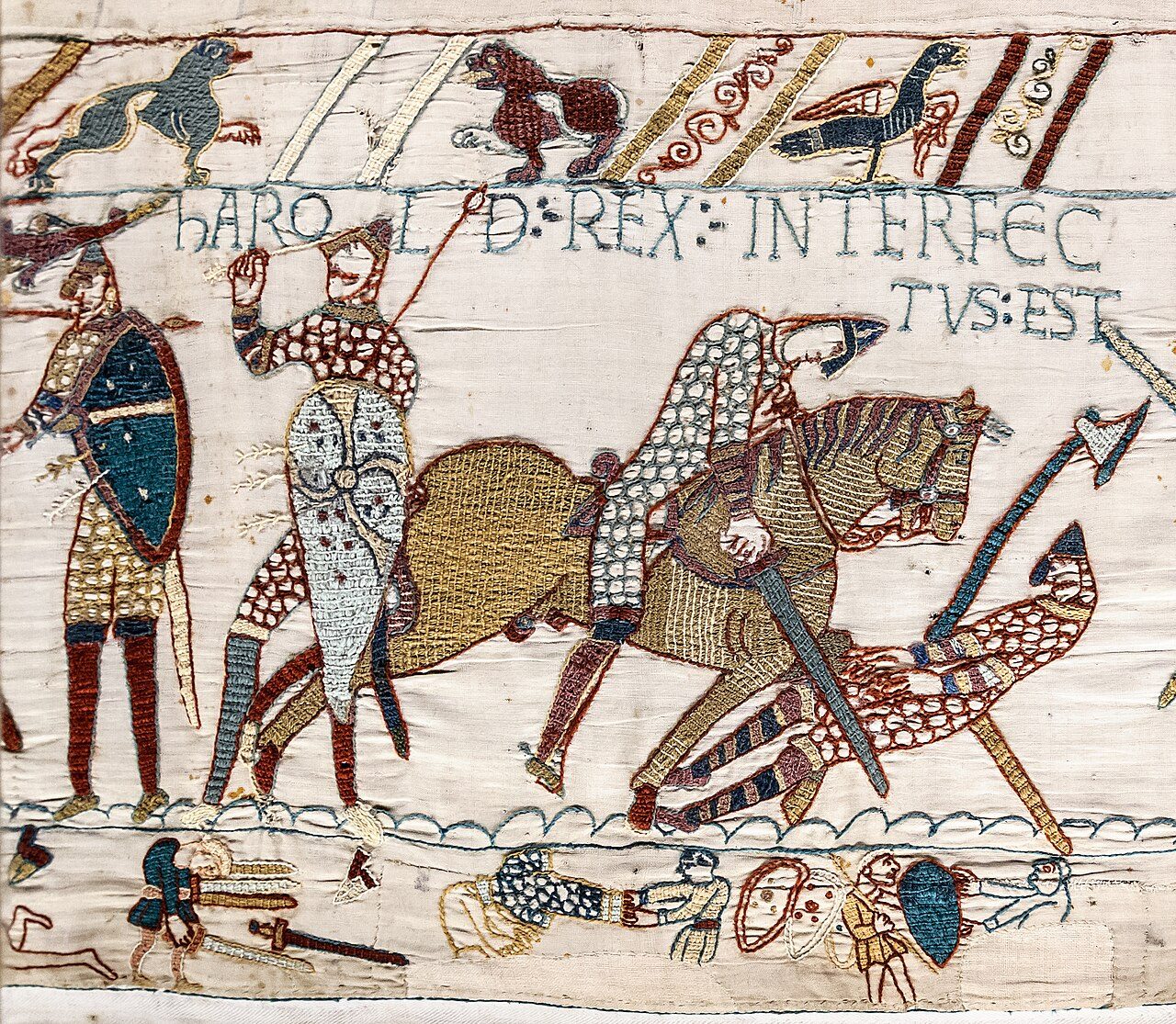
Late in the day Harold was killed, and his brothers Gyrth and Leofwine fell with him. Leaderless, the English line collapsed in the dusk and the road to London lay open. William pressed on to the capital, and on Christmas Day, 25 December, he was crowned king of England at Westminster Abbey — the same church where Harold had been crowned less than a year before. The conquest that had begun with a disputed succession was complete, and England would never be ruled the same way again.
Timeline of 1066
- 5 January
Edward the Confessor dies childless, triggering the succession crisis that leads to the Norman Conquest.
- 6 January
Harold Godwinson is crowned king of England at Westminster, the day after Edward's death.
- 25 September
At Stamford Bridge, Harold destroys the Norwegian invasion, killing King Harald Hardrada and his own brother Tostig.
- 27 September
William, duke of Normandy, finally embarks his invasion fleet and sails overnight for England after weeks of waiting for a fair wind.
- 28 September
William lands unopposed at Pevensey in Sussex, beginning the Norman Conquest of England.
- 14 October
At the Battle of Hastings, William defeats and kills King Harold II, deciding the succession by battle.
- 25 December
William the Conqueror is crowned king of England at Westminster Abbey, completing the Norman Conquest.
Why 1066 still matters
1066 matters because it is a hinge on which a whole country turned in a single year. The conquest replaced England's ruling class and, as the story of Hastings is still told, remade the kingdom's language, laws and aristocracy: the victors of one October day became the ancestors of a new England, and the defeated king became its most famous casualty. Few years in any nation's history divide so cleanly into a before and an after, with the dividing line drawn by a single battle fought between dawn and dusk.
The year also left behind the most vivid visual record of the medieval world. The Bayeux Tapestry, the great embroidered account of the conquest, preserves everything from the invasion fleet to the death of Harold — and even the sky's commentary: Halley's Comet, which appeared in 1066, was read in England as a portent of doom for Harold and in Normandy as a sign of favour for William, and the tapestry embroidered it above the worried English court, the first known illustration of the comet. The argument over what the tapestry shows, down to the manner of Harold's death, is still alive nearly a thousand years later — which is another way of saying that 1066 never quite finished happening.
1066 on The History Trail
1066 is one of the most fully told years on The History Trail, from its January succession crisis to its Christmas coronation.
- October 14 in History — the Battle of Hastings, the day England was conquered.
- September 25 in History — Harold's victory over the Norwegians at Stamford Bridge.
- September 28 in History — William lands unopposed at Pevensey in Sussex.
- January 6 in History — Harold Godwinson is crowned king at Westminster.
- December 25 in History — William the Conqueror is crowned at Westminster Abbey.
- Halley's Comet — the comet whose 1066 appearance was read as an omen and embroidered into the Bayeux Tapestry.
Sources
- Encyclopaedia Britannica — On This Day: January 5
- HISTORY — What Happened on January 5
- Wikipedia — Harold Godwinson
- Encyclopaedia Britannica — On This Day: October 14
- HISTORY — What Happened on October 14
- Encyclopaedia Britannica — Today in History: October 14, the Battle of Hastings
The facts on this page were checked against these sources on 19 November 2026. The History Trail's permanent pages are researched and written for this site; the live profiles elsewhere on The History Trail are assembled automatically from Wikipedia and Wikidata.
About the Author
Researched and written by the The History Trail Editorial Team — the accountable editorial function behind this site's permanent story pages. The team works from the published sources cited on each page; it does not invent historians, reviewers or credentials, and it corrects errors openly.
Fact Check
Every load-bearing fact on this page traces to one of the sources listed above, and significant claims link to their source in the text. Our checking method is described on the methodology page; errors can be reported via the corrections page.
Sources & Citations
Cite this page as: The History Trail Editorial Team, The History Trail — this article's title, publication and update dates are shown beneath its headline. The full source list appears under Sources above; the site's source standards are on the sources page.