
On This Day
September 28 in History
On 28 September 1781, American and French armies under George Washington and the comte de Rochambeau closed in around Lord Cornwallis's British army at Yorktown, Virginia, and began the siege that, three weeks later, forced the last major British surrender of the American Revolutionary War. September 28 is also the day William the Conqueror landed in England, Cabrillo reached California, and SpaceX first reached orbit.
Choose another date: open the On This Day calendar to browse events, births and deaths for any day of the year.
At a Glance
- The trap
- Cornwallis had fortified Yorktown expecting the Royal Navy to supply and, if needed, evacuate him
- The sea decided it
- A French fleet under Admiral de Grasse beat the British at the Battle of the Chesapeake on 5 September and sealed the bay
- The armies
- Some 9,000 Americans and 7,000 French troops began the siege on 28 September 1781
- The deception
- Washington had feinted toward New York for months, marching south only when the French fleet was committed
- The end
- Cornwallis surrendered on 19 October 1781; peace and American independence followed in 1783
- The scale
- Yorktown was the last major battle of the Revolutionary War
Events on this day
- 935Wenceslaus, duke of Bohemia — the 'Good King Wenceslas' of the carol — is murdered by his brother Boleslaus.
- 1066William, duke of Normandy, lands unopposed at Pevensey in Sussex, beginning the Norman Conquest of England.
- 1542Juan Rodríguez Cabrillo lands near present-day San Diego, the first European to set foot on the west coast of the future United States.
- 1781American and French forces begin the Siege of Yorktown — the featured story above.
- 1887The Yellow River floods in China begin; the death toll is estimated at between 900,000 and two million people, among the deadliest floods in history.
- 1924United States Army Air Service pilots land at Seattle, completing the first aerial circumnavigation of the world.
- 1928Alexander Fleming notices that a mould has killed bacteria around it in his London laboratory — the observation that leads to penicillin.
- 1939Germany and the Soviet Union sign their Boundary and Friendship Treaty, dividing conquered Poland between them.
- 1958French voters approve the constitution of the Fifth Republic, the system of government France retains today.
- 1995Israel and the PLO sign the Oslo II accord at the White House, extending Palestinian self-rule in the West Bank.
- 2008SpaceX's Falcon 1 reaches orbit, the first privately developed liquid-fuel rocket to do so.
Born on this day
- 551 BCConfucius — Chinese teacher and philosopher whose ideas shaped East Asian ethics and government; his birth is traditionally dated to this day.
- 1901William S. Paley — American broadcasting executive who built CBS into a network empire.
- 1925Seymour Cray — American engineer who designed the world's fastest supercomputers.
- 1934Brigitte Bardot — French actress who became an international film icon in the 1950s and 1960s.
- 1968Naomi Watts — British-Australian actress of Mulholland Drive and The Impossible.
Died on this day
- 1895Louis Pasteur — French chemist and microbiologist who proved the germ theory of disease and invented pasteurisation.
- 1964Harpo Marx — silent, harp-playing member of the Marx Brothers comedy team.
- 1970John Dos Passos — American novelist of the U.S.A. trilogy.
- 1978John Paul I — pope for only 33 days, whose sudden death fuelled decades of speculation.
- 2016Shimon Peres — Israeli prime minister and president who shared the Nobel Peace Prize for the Oslo Accords.
The featured story: the Siege of Yorktown begins, 28 September 1781
Yorktown was won before the first trench was dug, and it was won at sea. In the summer of 1781 Lord Cornwallis, having marched his British army through the Carolinas into Virginia, dug in at Yorktown on the York River, confident that the Royal Navy ruled the Chesapeake and could feed or rescue him at need. George Washington, camped outside New York, saw the one configuration that could ruin him: a French fleet in the bay and a combined Franco-American army at the siege lines, with Cornwallis's sea-road cut. When Admiral de Grasse agreed to bring his fleet from the West Indies, Washington gambled his whole campaign on it — leaving a skeleton force and a theatre of deception before New York, and marching his and Rochambeau's armies some 450 miles south.
The deception, complete with fake camps, forged plans and bread ovens built to suggest a long stay, worked perfectly. By the time the British understood the march's destination, it was too late; and on 5 September 1781 de Grasse's fleet fought the Royal Navy at the mouth of the Chesapeake and turned it away. Cornwallis was sealed in. On 28 September the allied armies — roughly 9,000 Americans and 7,000 French — completed their investment of Yorktown and broke ground for the siege parallels, in the formal European manner, under the direction of engineers who had done this before.
What followed was methodical strangulation. Allied batteries opened on 9 October — Washington himself fired the first American gun — and the parallels crept forward trench by trench. On the night of 14 October, French infantry stormed one British redoubt while American light infantry under Alexander Hamilton took the other at bayonet point, letting the allies plant guns within point-blank range. Cornwallis's one desperate breakout attempt, across the river on the night of 16 October, was scattered by a storm. On 17 October — four years to the day since Burgoyne's surrender at Saratoga — a British drummer beat a parley on the parapet.
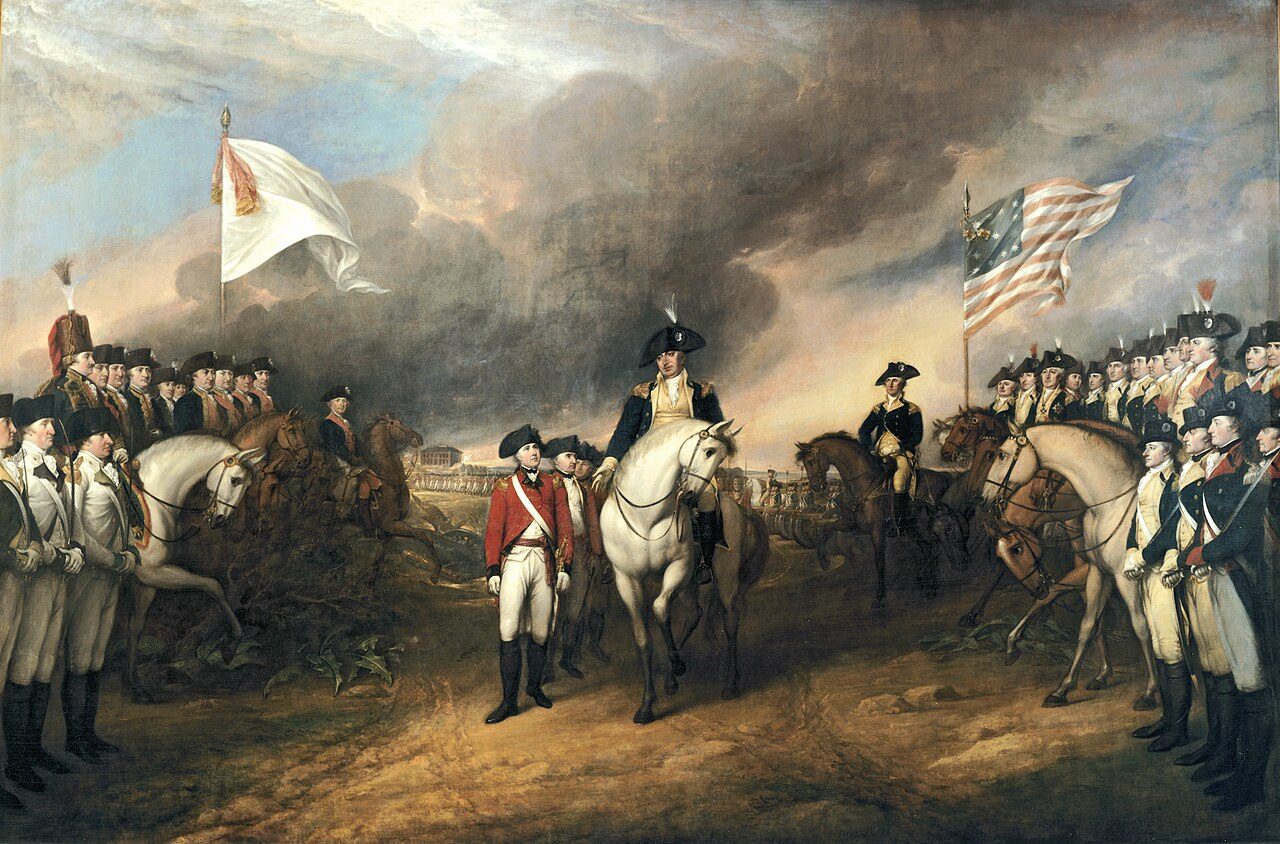
The surrender ceremony on 19 October, with the British marching out between French and American lines to lay down their arms, effectively ended the war's fighting. Peace took two more years of negotiation, but no British government could continue after Yorktown: Lord North, hearing the news in London, is said to have paced the room repeating 'Oh God, it is all over.' The siege that began on 28 September 1781 is the hinge on which American independence turned from a claim into a fact.
Why this date matters
September 28 is a day of landings that cannot be taken back. William steps ashore at Pevensey and England is never Anglo-Saxon again; Cabrillo steps ashore in California and a continent's west coast enters European maps; Washington's armies close their ring at Yorktown and an empire's American war is lost. Even its quieter entries share the finality — a mould noticed in a dish in 1928 that ends the age of helpless infection, a small private rocket in 2008 that opens orbit to companies. Things begin on this date that do not get undone.
Sources
- Encyclopaedia Britannica — On This Day: September 28
- HISTORY — This Day in History: September 28
- Wikimedia — On This Day feed: September 28
- Architect of the Capitol — Surrender of Lord Cornwallis
- Smithsonian National Museum of American History — Surrender of Lord Cornwallis at Yorktown
The facts on this page were checked against these sources on 19 November 2026. The History Trail's permanent pages are researched and written for this site; the live profiles elsewhere on The History Trail are assembled automatically from Wikipedia and Wikidata.
About the Author
Researched and written by the The History Trail Editorial Team — the accountable editorial function behind this site's permanent story pages. The team works from the published sources cited on each page; it does not invent historians, reviewers or credentials, and it corrects errors openly.
Fact Check
Every load-bearing fact on this page traces to one of the sources listed above, and significant claims link to their source in the text. Our checking method is described on the methodology page; errors can be reported via the corrections page.
Sources & Citations
Cite this page as: The History Trail Editorial Team, The History Trail — this article's title, publication and update dates are shown beneath its headline. The full source list appears under Sources above; the site's source standards are on the sources page.