
On This Day
January 6 in History
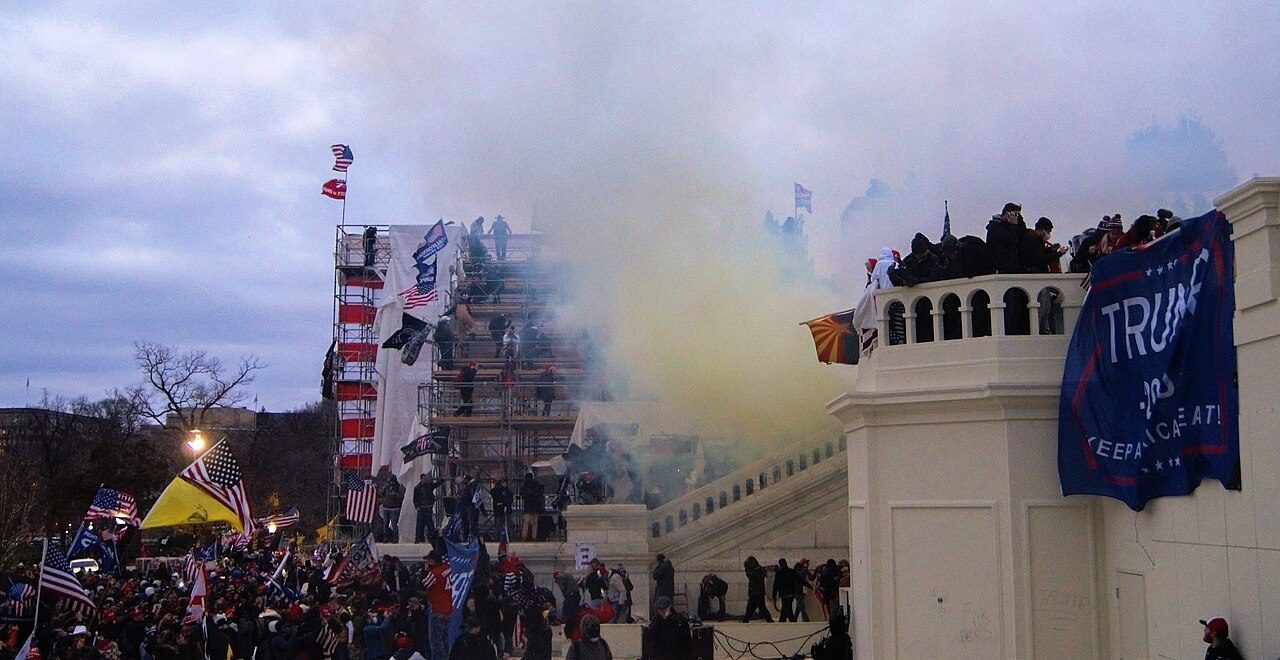
On 6 January 2021 a mob of supporters of President Donald Trump stormed the United States Capitol in Washington, forcing Congress to flee as it met to certify Joe Biden's victory in the 2020 presidential election. January 6 is also, by tradition, the birthday of Joan of Arc, and the day Samuel Morse first publicly demonstrated his telegraph.
Choose another date: open the On This Day calendar to browse events, births and deaths for any day of the year.
At a Glance
- The occasion
- A joint session of Congress meeting on 6 January 2021 to count the electoral votes and certify Joe Biden's victory in the 2020 presidential election
- The attack
- Thousands of Trump supporters, urged on at a rally near the White House, marched on the Capitol; hundreds broke into the building
- The cost
- About 140 Capitol and Metropolitan police officers were criminally assaulted, according to the Justice Department, and damage was put at about $1.5 million
- The outcome
- The building was cleared by about 6 p.m.; Congress resumed the same night and completed the certification of Biden's victory
- The sequel
- Trump was impeached by the House for 'incitement of insurrection' — the first president impeached twice — and acquitted by the Senate; the FBI treated the attack as domestic terrorism
Events on this day
- 1066Harold Godwinson is crowned king of England at Westminster, the day after Edward the Confessor's death — and within the year faces two invasions.
- 1412Joan of Arc is born in Domrémy, by tradition on this day, the feast of the Epiphany — the girl who will lift the siege of Orléans at seventeen.
- 1540Henry VIII marries Anne of Cleves at Greenwich; he dislikes her on meeting her, and the marriage is annulled within six months.
- 1759George Washington marries Martha Custis, one of the wealthiest widows in Virginia, at her home on the Pamunkey River.
- 1838Samuel Morse gives the first public demonstration of his electric telegraph, sending a message over wires at Morristown, New Jersey.
- 1912New Mexico is admitted to the Union as the 47th state.
- 1941President Franklin D. Roosevelt sets out the Four Freedoms — of speech, of worship, from want and from fear — in his State of the Union address.
- 1974Daylight saving time begins in January in the United States, moved forward as an energy-saving measure during the oil crisis.
- 1994Figure skater Nancy Kerrigan is clubbed in the leg at a Detroit rink by an attacker linked to the circle of her rival Tonya Harding.
- 2021A mob storms the United States Capitol as Congress certifies the 2020 election — the featured story above.
Born on this day
- 1367Richard II — king of England at ten, deposed by Henry Bolingbroke after a reign of pageantry and crisis.
- 1412Joan of Arc — French peasant visionary whose campaigns turned the Hundred Years' War; her birth date is traditional, fixed to the feast of Epiphany.
- 1811Charles Sumner — American senator and abolitionist, nearly killed by a caning in the Senate chamber in 1856.
- 1878Carl Sandburg — American poet and Lincoln biographer, the voice of Chicago's stockyards and prairies.
- 1931E. L. Doctorow — American novelist of Ragtime and Billy Bathgate.
- 1955Rowan Atkinson — English comedian, creator of Mr Bean and Blackadder.
Died on this day
- 1852Louis Braille — inventor of the braille reading system, dead at 43, two days after his birthday.
- 1884Gregor Mendel — Moravian friar whose experiments with peas founded the science of genetics, unrecognised in his lifetime.
- 1919Theodore Roosevelt — twenty-sixth president of the United States, dead at 60 at his home at Oyster Bay, New York.
- 1949Victor Fleming — American film director of Gone with the Wind and The Wizard of Oz, both released in 1939.
- 2022Sidney Poitier — Bahamian-American actor, the first Black winner of the Academy Award for Best Actor.
The featured story: the attack on the United States Capitol, 6 January 2021
The counting of electoral votes is normally the most ceremonial afternoon in American politics: a joint session of Congress, a mahogany box of certificates, a foregone conclusion. The session of 6 January 2021 was different because the losing president, Donald Trump, had spent two months refusing to accept the result of the 2020 election, which Joe Biden had won, and had summoned his supporters to Washington for the day of the count. That morning, at a rally near the White House, Trump urged the crowd to march on the Capitol and fight to overturn the result.
What followed was the first violent seizure of the Capitol in its history. Thousands marched on the building; hundreds forced their way inside, smashing windows, ransacking offices and driving the joint session into flight — senators and representatives evacuated or sheltering as rioters reached the Senate chamber minutes behind them. The Justice Department later reported that about 140 Capitol and Metropolitan police officers were criminally assaulted in the fighting, and damage to the building was put at about $1.5 million. The building was not secured until about 6 p.m., roughly four hours after the first breach.
Congress returned the same night and finished the count, certifying Biden's victory. The political consequences were immediate and lasting. The House of Representatives impeached Trump for 'incitement of insurrection', making him the first American president to be impeached twice; the Senate acquitted him after he had left office. The FBI treated the attack as an act of domestic terrorism, and hundreds of participants were prosecuted. For the first time in the republic's history, the transfer of power — the ritual the day was built around — had been interrupted by force.
January 6 had carried weight in American life long before 2021: it was already a date of democratic firsts and warnings, from Morse's telegraph demonstration in 1838 to Roosevelt's Four Freedoms address in 1941, and it is the feast of the Epiphany in the Christian calendar. The attack fixed a new meaning to it. The certification that the mob tried to stop took place anyway, in the same chamber, a few hours late — which is why the day is remembered both for the violence and for the fact that the procedure, in the end, held.
Why this date matters
January 6 is the feast of the Epiphany — a showing-forth — and the date keeps staging revelations. A king was crowned in a day and a kingdom's fate revealed within the year; a peasant girl was, by tradition, born who would reveal herself as France's improbable saviour; a telegraph clicked out its first public message and revealed the future of communication; a president named four freedoms and revealed the war aims of a still-neutral nation. In 2021 the revelation was darker: a mob showed how quickly a ceremonial count could become a siege. The date's lesson is that what is shown on it tends to be true, and tends to matter.
Sources
- Encyclopaedia Britannica — On This Day: January 6
- HISTORY — What Happened on January 6
- HISTORY — New Mexico joins the Union
- Historic Royal Palaces — Henry VIII's Six Wives
- Wikipedia — Harold Godwinson
The facts on this page were checked against these sources on 19 November 2026. The History Trail's permanent pages are researched and written for this site; the live profiles elsewhere on The History Trail are assembled automatically from Wikipedia and Wikidata.
About the Author
Researched and written by the The History Trail Editorial Team — the accountable editorial function behind this site's permanent story pages. The team works from the published sources cited on each page; it does not invent historians, reviewers or credentials, and it corrects errors openly.
Fact Check
Every load-bearing fact on this page traces to one of the sources listed above, and significant claims link to their source in the text. Our checking method is described on the methodology page; errors can be reported via the corrections page.
Sources & Citations
Cite this page as: The History Trail Editorial Team, The History Trail — this article's title, publication and update dates are shown beneath its headline. The full source list appears under Sources above; the site's source standards are on the sources page.