
Years
1958 in History
1958 is remembered as America's answer to Sputnik. On 31 January Explorer 1 became the first American satellite and discovered the Van Allen radiation belts on its first flight; on 29 July President Eisenhower signed the act creating NASA. The same year patented the Lego brick in the design still used today, launched the first mass-market instant noodles, and saw Brazil win its first World Cup with two goals from the 17-year-old Pele.
At a Glance
- Defining event
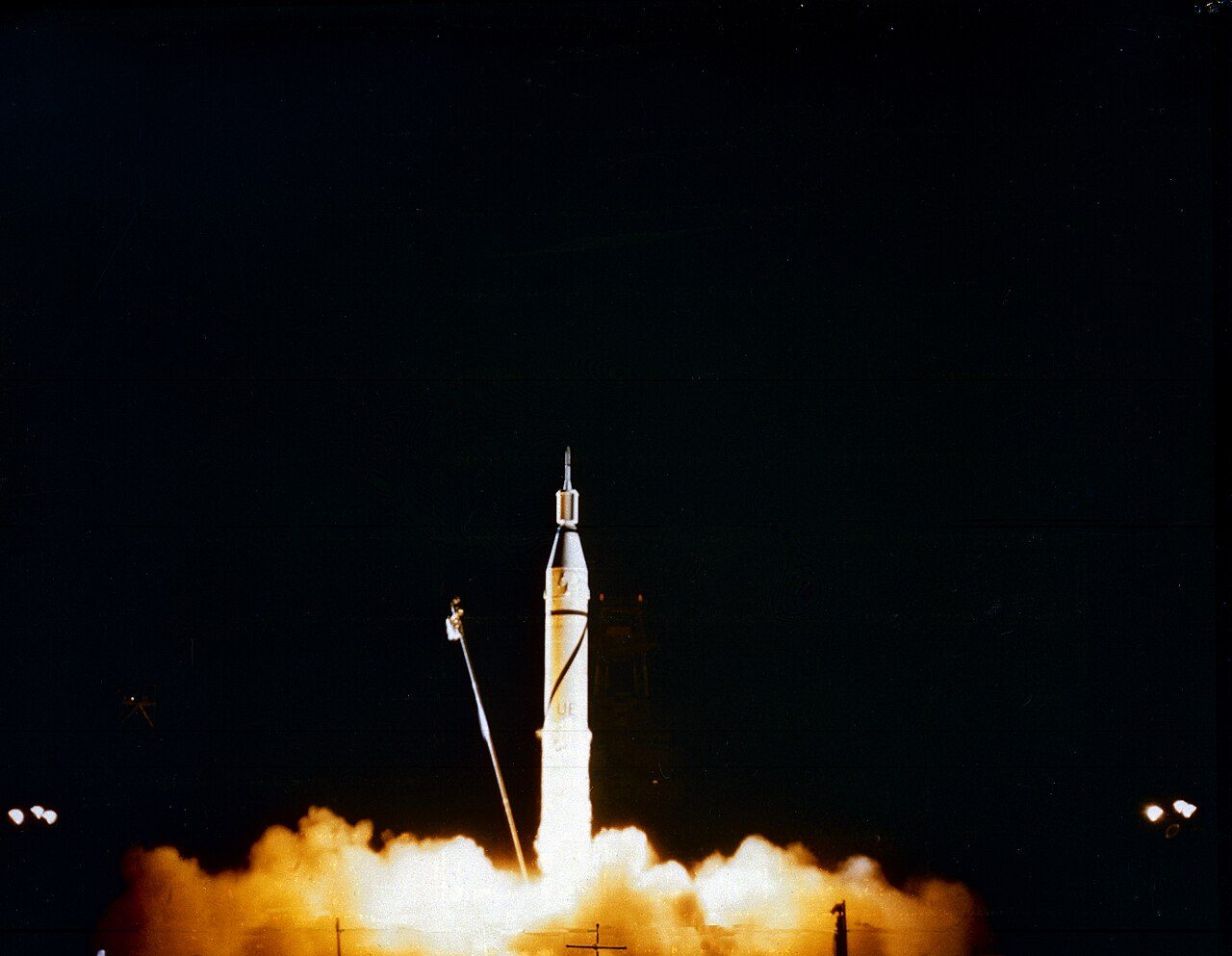
- Explorer 1 launched 31 January 1958 — the first American satellite
- Agency founded
- NASA created by the National Aeronautics and Space Act, signed 29 July
- Discovery
- Explorer 1 discovers the Van Allen radiation belts on its first flight
- Brick patented
- Lego patents its interlocking brick design on 28 January; bricks still fit today's
- World Cup
- Brazil beats Sweden 5–2 on 29 June to win its first World Cup; Pele, 17, scores twice
- By registered mail
- Harry Winston donates the Hope Diamond to the Smithsonian on 10 November, sending it by ordinary post
The defining story: America's first satellite
At 10:48 p.m. Eastern time on 31 January 1958, a four-stage Juno I rocket lifted off from Cape Canaveral, Florida, carrying a slender metal cylinder not quite seven feet long. Eighty-four days earlier the United States had had no satellite at all, and had watched, humiliated, as the Soviet Union orbited Sputnik 1 in October 1957 and then Sputnik 2, while America's own Vanguard rocket collapsed in flames on live television in December. The cylinder on the Juno I was the answer: Explorer 1, the first satellite of the United States, built in less than three months by the Jet Propulsion Laboratory and launched by the Army Ballistic Missile Agency under Wernher von Braun.
The partnership was improvised at every level. Von Braun's team adapted their Jupiter-C missile with clustered solid-fuel upper stages; JPL, under William Pickering, designed and built the satellite itself in a crash programme; and the scientific instrument, a cosmic-ray detector, came from James Van Allen of the University of Iowa. Explorer 1 was a modest machine, 14 kilograms of instruments, batteries and transmitter wrapped in a steel casing, spinning for stability. Just after 12:30 a.m. a tracking station in California picked up its signal: it was in orbit, circling the Earth every 114 minutes.
Then the modest machine produced a genuine discovery. Van Allen's detector recorded the expected cosmic rays at low altitude, and then, near the top of the orbit, nothing at all. The counters were not broken; they were saturated, overwhelmed by radiation so intense it drove them off the scale. Explorer 1 had flown into a vast belt of charged particles trapped by Earth's magnetic field. Confirmed by Explorer 3 two months later, these became the Van Allen radiation belts, the first major scientific discovery of the space age, made by the very first American satellite on its very first flight. Explorer 1 transmitted until 23 May 1958 and stayed in orbit for twelve years, circling the Earth more than 58,000 times.
The institutional answer followed in the summer. On 29 July 1958 Eisenhower signed the National Aeronautics and Space Act, creating NASA as a civilian agency built on the existing National Advisory Committee for Aeronautics rather than handing space to the armed services. NASA opened for business on 1 October 1958 with some 8,000 employees inherited from the NACA, and on 11 October it launched Pioneer 1, its first space probe, which failed to reach the Moon but returned valuable data on the radiation belts. From Sputnik's shock to a signed act had taken under ten months.
Timeline of 1958
- 4 January
Sputnik 1 burns up on re-entry after three months in orbit.
- 28 January
Lego patents the design of its interlocking brick.
- 31 January
Explorer 1, the first American satellite, is launched from Cape Canaveral.
- 6 February
A plane carrying the Manchester United team crashes at Munich; 23 people die, including eight of the Busby Babes.
- 14 March
Perry Como's Catch a Falling Star becomes the first single certified as a Gold Record.
- 4 April
The peace symbol designed by Gerald Holtom makes its first public appearance on the Aldermaston march.
- 15 May
The Soviet Union launches Sputnik 3.
- 29 June
Brazil beats Sweden 5–2 to win its first World Cup, with two goals from the 17-year-old Pele.
- 29 July
Eisenhower signs the National Aeronautics and Space Act, creating NASA.
- 3 August
The nuclear submarine USS Nautilus reaches the North Pole beneath the Arctic ice.
- 25 August
Momofuku Ando launches Chicken Ramen in Japan, the first mass-market instant noodles.
- 4 October
BOAC begins the first transatlantic commercial jet service, between London and New York.
- 23 October
Boris Pasternak is awarded the Nobel Prize in Literature for Doctor Zhivago; Soviet pressure soon forces him to refuse it.
- 1 December
Fire sweeps the Our Lady of the Angels school in Chicago, killing 95 people in all.
Why 1958 still matters
Explorer 1's deeper legacy was institutional: the shock it answered created NASA within the year, and the Army, JPL and Iowa team that built it became the template for American space science. Within eleven years of the signature on the Space Act, the agency it created had landed two men on the Moon. The space race is usually told through the giants that followed — Gagarin, Apollo, the Moon — but for the United States it effectively began with a spinning steel pencil on the last night of January 1958, and with data that at first looked like instrument failure.
The year's other foundings proved just as durable in daily life. Lego's 1958 patent fixed the stud-and-tube design so precisely that bricks made to it still fit the ones sold today. Momofuku Ando's Chicken Ramen, launched on 25 August, created the mass-market instant noodle. Gerald Holtom's peace symbol, first carried on the Aldermaston march on 4 April, became the most reproduced protest emblem of the century. BOAC's Comet 4 service on 4 October began transatlantic commercial jet travel, and the USS Nautilus reached the North Pole beneath the ice on 3 August.
Tragedy and politics framed the inventions. The Munich air disaster on 6 February killed 23 people, including eight of Manchester United's Busby Babes. The Chicago school fire on 1 December killed 87 children and three nuns, with five more children dying later of their injuries — 95 deaths in all — and became a turning point in American school fire-safety law. France approved the Fifth Republic's constitution on 28 September and elected Charles de Gaulle its first president on 21 December. Prince, Madonna, Michael Jackson and Tim Burton were all born in 1958.
1958 on The History Trail
Orbit, agency and invention fill 1958 on The History Trail.
- January 31 in History — Explorer 1 is launched, told in full.
- July 29 in History — NASA is created by the Space Act.
- January 28 in History — Lego patents its interlocking brick.
- August 25 in History — The first mass-market instant noodles launch in Japan.
- June 29 in History — Brazil wins its first World Cup, with Pele scoring twice.
- NASA — The agency created in 1958 that landed men on the Moon.
- Lego — The brick patented in 1958, still fitting today's bricks.
- Instant noodles — Ando's 1958 Chicken Ramen and the food it created.
Sources
- NASA — Explorer 1 Overview
- NASA — 65 Years Ago: The National Aeronautics and Space Act of 1958 Creates NASA
- Encyclopaedia Britannica — On This Day: January 31
- Encyclopaedia Britannica — On This Day: July 29
- Encyclopaedia Britannica — On This Day: January 28
- Encyclopaedia Britannica — On This Day: August 25
- Encyclopaedia Britannica — On This Day: June 29
- Encyclopaedia Britannica — On This Day: December 1
The facts on this page were checked against these sources on 19 November 2026. The History Trail's permanent pages are researched and written for this site; the live profiles elsewhere on The History Trail are assembled automatically from Wikipedia and Wikidata.
About the Author
Researched and written by the The History Trail Editorial Team — the accountable editorial function behind this site's permanent story pages. The team works from the published sources cited on each page; it does not invent historians, reviewers or credentials, and it corrects errors openly.
Fact Check
Every load-bearing fact on this page traces to one of the sources listed above, and significant claims link to their source in the text. Our checking method is described on the methodology page; errors can be reported via the corrections page.
Sources & Citations
Cite this page as: The History Trail Editorial Team, The History Trail — this article's title, publication and update dates are shown beneath its headline. The full source list appears under Sources above; the site's source standards are on the sources page.