
Things
Instant noodles
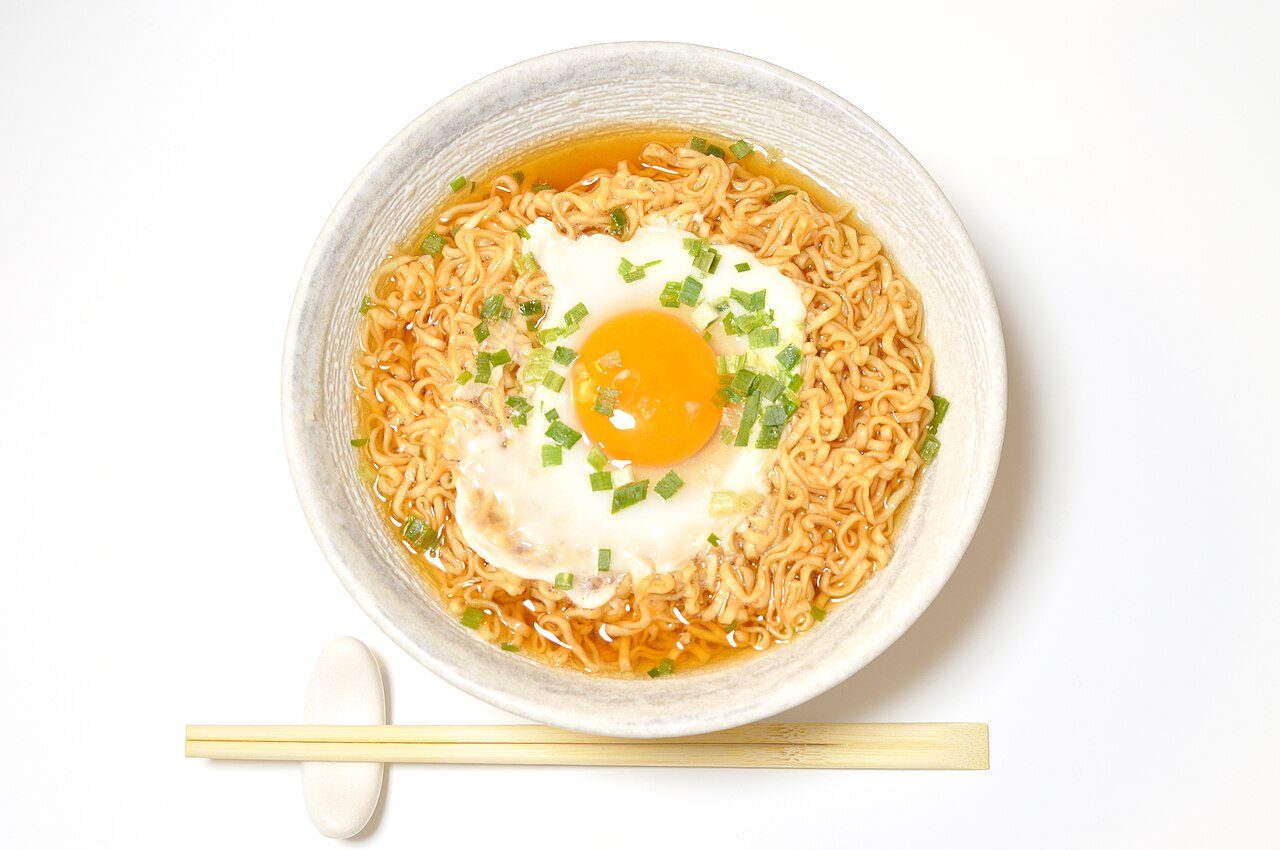
Instant noodles - a dried, precooked noodle block revived with hot water - were invented by Momofuku Ando of Nissin Foods in Japan and first sold as Chikin Ramen on 25 August 1958. Ando perfected flash-frying in a shed in Ikeda, Osaka; his Cup Noodles followed in 1971, and the world now eats more than 120 billion servings a year.
At a Glance
- What they are
- A precooked, dried block of noodles sold with flavouring, prepared in minutes by adding hot water
- Inventor
- Momofuku Ando (1910-2007), Taiwanese-born founder of Nissin Food Products in Japan
- First product
- Chikin Ramen, on sale 25 August 1958 in Japan at 35 yen a packet, made by flash-frying seasoned noodles in a shed in Ikeda, Osaka
- The method
- Flash-frying drives water out of steamed noodles, preserving them and leaving pores that let hot water rehydrate them in minutes - an idea Ando credited to his wife Masako's tempura
- The cup
- Cup Noodles, launched 18 September 1971, sold the noodles in the waterproof cup they are cooked and eaten in
- World consumption
- 120.2 billion servings in 2023, according to the World Instant Noodles Association
- The museums
- CUPNOODLES MUSEUM OSAKA IKEDA opened in 1999 with a recreation of Ando's shed; a second museum opened in Yokohama in 2011
Introduction
Instant noodles are a precooked, dried block of noodles, sold with flavouring, that returns to an edible meal in minutes with hot water. They feel like a food that must always have existed. In fact the modern product has a named inventor, a known workshop and a precise birthday: Momofuku Ando, working in a small shed behind his house in Ikeda, Osaka, perfected flash-frying noodles in 1958, and his company Nissin put the first packet, Chikin Ramen, on sale on 25 August that year.
The scale that followed is difficult to grasp. The World Instant Noodles Association, the industry body that compiles the global count, recorded 120.2 billion servings eaten worldwide in 2023. A food invented by one 48-year-old man who had just lost his fortune became, within two generations, one of the most eaten prepared foods on earth - and the subject of two museums in Japan.
Noodles Before Instant Noodles
Noodles themselves are ancient in China, and noodle soup travelled from China to Japan, where it developed into ramen - the dish Ando's product imitated. One much older Chinese preparation matters here: Yi noodles, egg noodles that are fried and dried so they keep, then revived in soup. A story attached to them, set in the Qing dynasty, tells of a chef who rescued already-cooked noodles by frying them in hot oil and serving them in broth. That tale is presented here as legend, not documented fact - but the technique it describes, frying cooked noodles dry so that water can later restore them, is recognisably the principle Ando industrialised.
Ando's own hometown adds a second thread. Nippon.com notes that Tainan, in Taiwan, where Ando was born and raised, is known for yi-mian, noodles deep-fried before boiling that keep for some time - which some people call a forerunner of instant ramen. Ando himself, by his own account, took the decisive idea not from yi-mian but from watching his wife Masako make tempura, driving moisture out of food by frying it. Both threads can be true as background; only the tempura one is Ando's stated inspiration.
Ando and the Shed in Ikeda
Momofuku Ando was born on 5 March 1910 in Taiwan, then under Japanese rule, and raised by grandparents who ran a kimono shop. He built and lost several businesses, and in 1957 the credit union he headed collapsed; Nippon.com records that, except for a rental property in Ikeda, he lost all his wealth overnight. He was 47. His often-told starting point was a memory from the hungry years after the Second World War: a long line of people waiting in the cold at a black-market stall near Osaka's main station for a bowl of hot ramen. Food, he concluded, came before clothing, housing, art or culture - and Japanese people loved noodles.
In a workshop of about ten square metres behind his Ikeda house, working alone with ordinary tools, Ando spent roughly a year trying to make a noodle that would keep for months and cook with nothing but hot water. He later said he slept four hours a night and took no day off. The breakthrough was flash-frying: steamed, seasoned noodles fried briefly in oil, which drives out the water, leaves tiny holes through which hot water later re-enters, and preserves the block. The seasoning was already in the noodles, so the buyer added only water.
Chikin Ramen, Cup Noodles and the World
Chikin Ramen went on sale on 25 August 1958 at 35 yen a packet - expensive beside a bowl of fresh udon at about six yen, and nicknamed 'magic ramen' by the press. Demonstrations in department stores overcame the price objection, and within five years annual sales had reached 4.3 billion yen. Ando's company took the name Nissin Food Products. Rival Japanese makers followed, and the product spread through Asia and to the United States in the 1960s, where a Nissin subsidiary was established.
The second invention completed the first. On 18 September 1971 Nissin launched Cup Noodles: noodles sold in the waterproof cup they are cooked and eaten in, needing no bowl at all. The cup made instant noodles a food for offices, trains, convenience stores and dormitories worldwide, and local versions multiplied everywhere - each country developing its own brands and flavours, from Indonesia's Indomie to India's Maggi noodles. Ando kept working into old age: in 2005 Nissin produced Space Ram, a vacuum-packed version eaten by astronaut Soichi Noguchi aboard the space shuttle Discovery. Ando died on 5 January 2007, aged 96.
Timeline
- Qing dynasty
By legend, a Chinese chef rescues cooked egg noodles by frying them and serving them in soup - the story attached to Yi noodles, a fried, dried noodle that keeps.
- 5 March 1910
Momofuku Ando is born in Taiwan, then under Japanese rule, and raised in Tainan, a city known for its fried yi-mian noodles.
- 1957
The credit union Ando heads collapses and he loses nearly all his wealth; he begins experimenting in a shed behind his Ikeda house.
- 25 August 1958
Chikin Ramen, the world's first instant noodles, goes on sale in Japan at 35 yen a packet.
- 1960s
Instant noodles spread through Asia and reach the United States, where Nissin establishes a subsidiary.
- 18 September 1971
Nissin launches Cup Noodles, the first instant noodles sold in their own cooking and eating cup.
- 1983
Ando establishes the Ando Foundation from his personal fortune; the foundation later operates the instant noodle museums in Ikeda and Yokohama.
- 21 November 1999
The Momofuku Ando Instant Ramen Museum opens in Ikeda, Osaka, with a recreation of Ando's work shed.
- 2005
Space Ram, a version of instant ramen adapted for zero gravity, is eaten aboard the space shuttle Discovery by astronaut Soichi Noguchi.
- 5 January 2007
Momofuku Ando dies, aged 96.
- 2011
A second museum, CUPNOODLES MUSEUM YOKOHAMA, opens in Yokohama.
- 2023
WINA counts 120.2 billion servings of instant noodles eaten worldwide, about 93.3 billion of them in packets and 26.9 billion in cups.
Significance
Instant noodles changed what a meal could be: shelf-stable for months, costing very little, needing no kitchen, no skill and almost no time. For students, night-shift workers, travellers and families with little money, they filled a gap no earlier food had filled at that price. The same properties - light, cheap, long-keeping and cookable anywhere hot water exists - have also made instant noodles a standard item in emergency food supplies after natural disasters. And the counting itself became part of the story: the World Instant Noodles Association now publishes the global total every year, which is how the 120.2 billion servings of 2023 entered the record.
Myths and disputes
Did Ando copy Yi noodles? The honest answer separates three claims. Fried, dried noodles that keep and revive in soup existed in China long before 1958, and early instant noodle packaging was even labelled 'Yi noodles', according to the Journal of Ethnic Foods. Tainan's yi-mian formed part of Ando's own food background. What Ando invented, and what no earlier maker had sold, was the industrial product: a standardised, seasoned, flash-fried noodle block, mass-produced and marketed as a complete instant meal. Histories that call him the inventor of instant noodles and histories that stress the Chinese background are describing different things - the product and the principle.
His own legend also needs one qualification. The tempura story - inspiration from watching his wife fry - is Ando's account of his invention, told by him for the rest of his life and preserved by the museums his foundation runs. It is the best-attested version of the moment of insight, but it is a founder's retrospective story, and this page presents it as such rather than as independently witnessed fact.
Legacy
Ando's legacy is unusually visible. The CUPNOODLES MUSEUM in Ikeda, opened in 1999 where he worked, preserves a faithful recreation of the shed - ordinary saucepans, sieves and flour - as its first exhibit, and a second museum followed in Yokohama in 2011. The product itself needs no museum: at more than 120 billion servings a year, instant noodles are eaten on every continent, in flavours Ando never imagined, by people most of whom have never heard his name.
Sources
- Nippon.com - Ando Momofuku: An Inventor Who Used His Noodle to Change Global Food Culture
- CUPNOODLES MUSEUM - The Birth of Chicken Ramen, Osaka Ikeda
- CUPNOODLES MUSEUM YOKOHAMA - Museum brochure (Ando Foundation)
- Highlighting Japan (Government of Japan) - Ando Momofuku, the Inventor of Instant Noodles
- Nippon.com - Cup Noodles Museum Osaka Ikeda: Design Your Very Own Instant Ramen
The facts on this page were checked against these sources on 19 November 2026. The History Trail's permanent pages are researched and written for this site; the live profiles elsewhere on The History Trail are assembled automatically from Wikipedia and Wikidata.
About the Author
Researched and written by the The History Trail Editorial Team — the accountable editorial function behind this site's permanent story pages. The team works from the published sources cited on each page; it does not invent historians, reviewers or credentials, and it corrects errors openly.
Fact Check
Every load-bearing fact on this page traces to one of the sources listed above, and significant claims link to their source in the text. Our checking method is described on the methodology page; errors can be reported via the corrections page.
Sources & Citations
Cite this page as: The History Trail Editorial Team, The History Trail — this article's title, publication and update dates are shown beneath its headline. The full source list appears under Sources above; the site's source standards are on the sources page.