
On This Day
January 31 in History
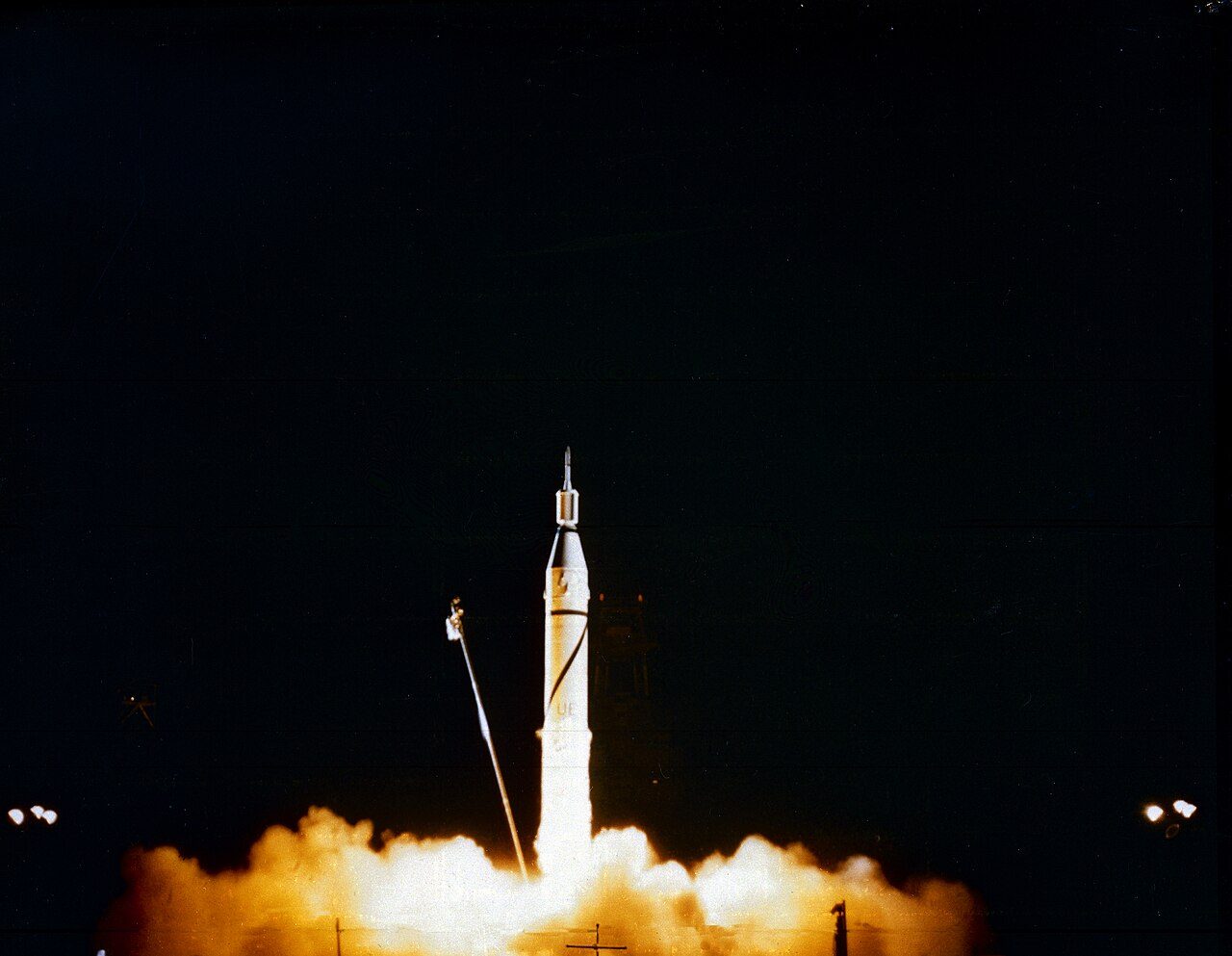
On the night of 31 January 1958, Explorer 1 rode a Juno I rocket from Cape Canaveral to become the first American satellite — built in 84 days to answer Sputnik — and on its first flight it discovered the Van Allen radiation belts. January 31 is also the day Guy Fawkes was executed, the Thirteenth Amendment passed the House, Apollo 14 left for the Moon, and Britain left the European Union.
Choose another date: open the On This Day calendar to browse events, births and deaths for any day of the year.
At a Glance
- The launch
- 31 January 1958, 10:48 p.m. EST, from Cape Canaveral, Florida, on a Juno I (modified Jupiter-C) rocket
- The makers
- Satellite designed and built by the Jet Propulsion Laboratory under William Pickering; rocket by the Army Ballistic Missile Agency under Wernher von Braun
- The satellite
- 203 cm long, about 14 kg, built in under three months after Sputnik; orbit roughly 360 by 2,550 km, one circuit every 114 minutes
- The discovery
- James Van Allen's cosmic-ray detector found the radiation belts around Earth that now carry his name — confirmed by Explorer 3
- The context
- Sputnik 1 had flown on 4 October 1957 and the Navy's Vanguard had failed on live television in December; Explorer 1 was America's answer
- The end
- Transmissions ceased 23 May 1958; the satellite re-entered and burned up on 31 March 1970 after more than 58,000 orbits
Events on this day
- 1606Guy Fawkes is executed in London for his part in the Gunpowder Plot to blow up Parliament and King James I.
- 1865The U.S. House of Representatives passes the Thirteenth Amendment abolishing slavery; Lincoln signs it the next day.
- 1943Field Marshal Friedrich Paulus surrenders the southern pocket of the German Sixth Army at Stalingrad, the turning point of the war in the East.
- 1945Private Eddie Slovik is executed by firing squad in France, the only American soldier put to death for desertion in the Second World War.
- 1950President Truman publicly orders the development of the hydrogen bomb, escalating the arms race with the Soviet Union.
- 1958Explorer 1, the first American satellite, is launched from Cape Canaveral — the featured story above.
- 1961Ham the chimpanzee flies a suborbital Mercury-Redstone mission, surviving splashdown and opening the way for American astronauts.
- 1971Apollo 14 lifts off for the Moon, with Alan Shepard — America's first man in space — in command.
- 1990The first McDonald's in the Soviet Union opens in Moscow's Pushkin Square, drawing a queue of some 30,000 people on its first day.
- 2020The United Kingdom formally leaves the European Union at 11 p.m., 47 years after joining and three and a half years after the Brexit referendum.
Born on this day
- 1797Franz Schubert — Austrian composer of more than 600 songs, dead at 31 with a symphonic legacy beyond counting.
- 1872Zane Grey — American novelist who defined the literary Western, author of Riders of the Purple Sage.
- 1915Thomas Merton — American Trappist monk and writer whose Seven Storey Mountain became a spiritual classic.
- 1919Jackie Robinson — American baseball player who broke the major leagues' colour barrier in 1947.
- 1923Norman Mailer — American novelist and provocateur, author of The Naked and the Dead.
- 1931Ernie Banks — 'Mr. Cub', the beloved Chicago shortstop who wanted to play two.
- 1947Nolan Ryan — American pitcher whose fastball and 5,714 strikeouts defined three decades of baseball.
Died on this day
- 1561Menno Simons — Dutch priest whose followers became the Mennonites, dead in Germany at about 65.
- 1606Guy Fawkes — Gunpowder Plot conspirator, executed in London at 35.
- 1788Charles Edward Stuart — 'Bonnie Prince Charlie', the Jacobite pretender, dead in Rome at 67.
- 1892Charles Haddon Spurgeon — English Baptist preacher, the 'Prince of Preachers', dead in France at 57.
- 1956A. A. Milne — English author who created Winnie-the-Pooh, dead at 74.
The featured story: Explorer 1, America's first satellite, 31 January 1958
At 10:48 p.m. Eastern time on 31 January 1958, a four-stage Juno I rocket lifted off from Cape Canaveral, Florida, carrying a slender metal cylinder not quite seven feet long. Eighty-four days earlier, the United States had had no satellite at all — and had watched, humiliated, as the Soviet Union orbited first Sputnik 1 in October 1957 and then Sputnik 2, while America's own Vanguard rocket collapsed in flames on live television in December. The cylinder on the Juno I was the answer: Explorer 1, the first satellite of the United States, built in less than three months by the Jet Propulsion Laboratory in California and launched by the Army Ballistic Missile Agency under Wernher von Braun.
The partnership was improvised at every level. Von Braun's team at Redstone Arsenal in Alabama adapted their Jupiter-C missile with clustered solid-fuel upper stages; JPL, under William Pickering, designed and built the satellite itself in a crash programme; and the scientific instrument — a cosmic-ray detector — came from James Van Allen of the University of Iowa. Explorer 1 was a modest machine, 14 kilograms of instruments, batteries and transmitter wrapped in a steel casing, spinning for stability. Just after 12:30 a.m., a tracking station in California picked up its signal: it was in orbit, in a higher ellipse than planned, circling the Earth every 114 minutes.
Then the modest machine produced a genuine discovery. Van Allen's detector recorded the expected cosmic rays at low altitude — and then, near the top of the orbit, nothing at all. The counters were not broken; they were saturated, overwhelmed by radiation so intense it drove them off the scale. Explorer 1 had flown into a vast belt of charged particles trapped by Earth's magnetic field. Confirmed by Explorer 3 two months later, these became the Van Allen radiation belts — the first major scientific discovery of the space age, made by the very first American satellite on its very first flight.
Explorer 1 transmitted until its batteries faded on 23 May 1958 and stayed in orbit for twelve years, circling the Earth more than 58,000 times before burning up over the Pacific on 31 March 1970. Its deeper legacy was institutional: the shock it answered created NASA within the year, and the Army-JPL-Iowa team that built it became the template for American space science. The space race is usually told through the giants that followed — Gagarin, Apollo, the Moon. It effectively began, for the United States, with this spinning steel pencil on the last night of January 1958.
Why this date matters
January 31 is the day the space age became American as well as Soviet — the night Explorer 1 answered Sputnik and, almost by accident, discovered the Van Allen belts on its first flight. But the date's gravity runs in every direction: Guy Fawkes to the scaffold, the Thirteenth Amendment through the House, Paulus surrendering at Stalingrad, the only American desertion execution of the Second World War, Moscow queuing for its first McDonald's, and Britain walking out of the European Union. Beginnings and endings share this date in unusual concentration — plots ending, worlds opening.
Sources
- Encyclopaedia Britannica — On This Day: January 31
- HISTORY — What Happened on January 31
- NASA — Explorer 1 Overview
The facts on this page were checked against these sources on 19 November 2026. The History Trail's permanent pages are researched and written for this site; the live profiles elsewhere on The History Trail are assembled automatically from Wikipedia and Wikidata.
About the Author
Researched and written by the The History Trail Editorial Team — the accountable editorial function behind this site's permanent story pages. The team works from the published sources cited on each page; it does not invent historians, reviewers or credentials, and it corrects errors openly.
Fact Check
Every load-bearing fact on this page traces to one of the sources listed above, and significant claims link to their source in the text. Our checking method is described on the methodology page; errors can be reported via the corrections page.
Sources & Citations
Cite this page as: The History Trail Editorial Team, The History Trail — this article's title, publication and update dates are shown beneath its headline. The full source list appears under Sources above; the site's source standards are on the sources page.