
Years
1949 in History
1949 is remembered as the year the postwar map hardened. The Soviet Union lifted its blockade of West Berlin on 12 May after the Allied airlift defeated it; the Federal Republic of Germany was founded on 23 May and East Germany answered in October; NATO was signed in April; the Soviet Union detonated its first atomic bomb on 29 August; and on 1 October Mao Zedong proclaimed the People's Republic of China.
At a Glance
- Defining event
- Berlin Blockade lifted, 12 May 1949 — the airlift defeats the siege without a shot
- Alliance
- NATO treaty signed 4 April; it takes effect 24 August
- Two Germanys
- Federal Republic founded 23 May; German Democratic Republic founded 7 October
- Nuclear balance
- Soviet Union detonates its first atomic bomb, 29 August, ending the American monopoly
- In China
- Mao proclaims the People's Republic of China on 1 October
- In print
- George Orwell's Nineteen Eighty-Four is published on 8 June
The defining story: the blockade lifted, the map divided
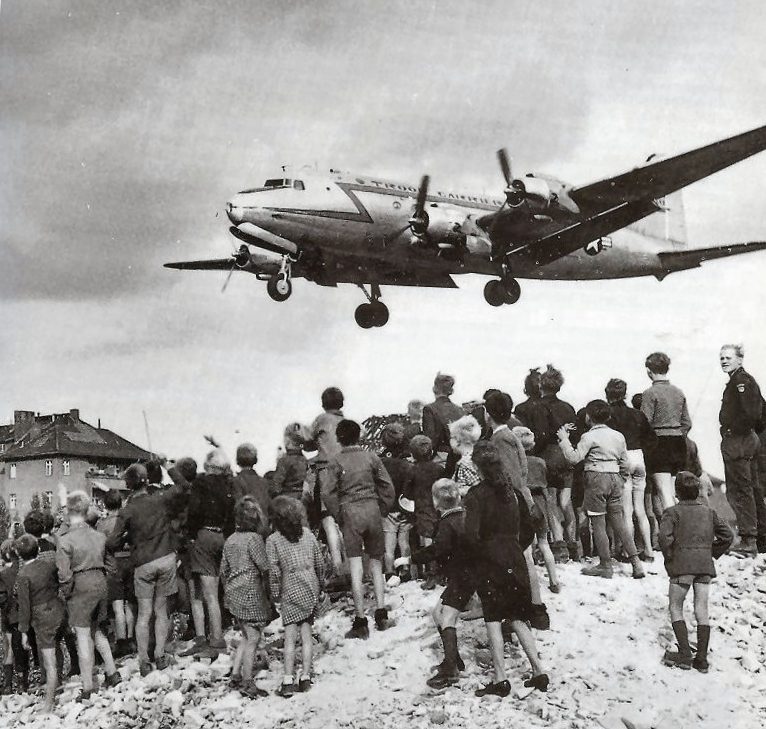
At one minute past midnight on 12 May 1949, the barriers came up on the roads and railways into West Berlin, and the first trucks and trains rolled in from the West in almost eleven months. The Soviet Union had lifted its blockade of the city — the first great confrontation of the Cold War — because the blockade had failed. For 321 days the Western Allies had supplied a city of more than two million people entirely by air, at its peak landing aircraft every few minutes around the clock, and on one record day in April 1949 delivering nearly 13,000 tons of food, coal and supplies. Moscow, not Washington, blinked first.
Life inside the city had been rationed, cold and dark, with electricity for a few hours a day, but the population held and the airlift held with it, at the cost of dozens of Allied airmen who died in crashes. American pilot Gail Halvorsen began dropping candy on handkerchief parachutes for Berlin's children, and the candy bombers became the blockade's enduring image. The airlift itself did not stop with the blockade; flights continued until 30 September to build stockpiles against a renewed siege. The larger consequences hardened quickly around the lifted siege.
Germany was formally divided within months. The Parliamentary Council in Bonn had adopted the Basic Law on 8 May; on 23 May 1949 Konrad Adenauer signed and proclaimed it, and the Federal Republic of Germany entered history — a document deliberately called a Basic Law rather than a constitution, meant to be temporary until reunification. Elections followed in August and Adenauer became the first Chancellor in September. On 7 October the Soviet zone answered by founding the German Democratic Republic. NATO, signed on 4 April by the United States, Canada and ten European nations, took effect on 24 August, giving the division its military architecture.
Asia divided in the same season. Communist forces crossed the Yangtze and occupied Nanjing, the Nationalist capital, on 24 April, effectively deciding the Chinese Civil War. On 1 October, before an estimated 300,000 people in Tiananmen Square, Mao Zedong proclaimed the People's Republic of China from the Gate of Heavenly Peace. The Republic of China's government did not dissolve; by December it had relocated to Taiwan, leaving two governments each claiming to be China. On 29 August the Soviet Union detonated its first atomic bomb in Kazakhstan, ending the American nuclear monopoly years earlier than Washington had expected.
Timeline of 1949
- 25 January
The first Emmy Awards are presented in Hollywood; only six awards are given.
- 4 April
The United States, Canada and ten European nations sign the treaty creating NATO.
- 24 April
Communist forces cross the Yangtze and occupy Nanjing; the Chinese Civil War is effectively decided.
- 12 May
The Soviet Union lifts its blockade of West Berlin.
- 23 May
The Federal Republic of Germany is established as the Basic Law is proclaimed in Bonn.
- 8 June
George Orwell's Nineteen Eighty-Four is published in London.
- 3 August
The National Basketball Association is formed by the merger of two leagues.
- 24 August
The North Atlantic Treaty takes effect, bringing NATO formally into existence.
- 29 August
The Soviet Union detonates its first atomic bomb in Kazakhstan.
- 30 September
The Berlin Airlift ends after fifteen months of supplying West Berlin.
- 1 October
Mao Zedong proclaims the People's Republic of China in Beijing.
- 7 October
The German Democratic Republic, East Germany, is formally founded.
- 26 November
India's Constituent Assembly adopts the constitution of the Republic of India.
- 27 December
The Netherlands transfers sovereignty over the Dutch East Indies to the Republic of Indonesia.
Why 1949 still matters
Few years divide so cleanly into before and after. The Basic Law, drafted as a provisional framework, anchored West Germany's transformation into a stable, prosperous democracy, and when Germany reunified in 1990 the eastern states simply joined the Federal Republic under its terms — the temporary document of 1949 remains Germany's constitution today. NATO, founded the same spring, became the West's enduring alliance. The Soviet bomb ended the brief American nuclear monopoly and set the terms of the arms race, while China's proclamation reshaped the lives of more people at once than almost any other twentieth-century date.
The cultural record of 1949 reads like a warning label for the new order: Orwell published Nineteen Eighty-Four in June, giving the Cold War its most durable vocabulary of surveillance and control, in the very months the two blocs acquired their states, alliances and bombs. The Geneva Conventions, the subject of a permanent story on this site, belong to the same impulse — an attempt to write rules for wars everyone now expected to be worse. The first Knesset opened in Jerusalem on 16 February, the first Emmy Awards were given on 25 January, and the NBA was formed on 3 August: new institutions for a new world, large and small.
Decolonisation completed the year's pattern. Indonesia received sovereignty from the Netherlands on 27 December after more than three centuries of Dutch rule, India's constitution was adopted on 26 November to take effect the following January, and Siam resumed the name Thailand on 11 May. The map of 1949 — two Germanys, two Chinas in claim, an armed Europe and a decolonising Asia — is recognisably the map the rest of the century inherited.
1949 on The History Trail
Blockade, Basic Law and Beijing fill 1949 on The History Trail.
- May 12 in History — The Berlin Blockade is lifted, told in full.
- May 23 in History — The Federal Republic of Germany is founded.
- October 1 in History — The People's Republic of China is proclaimed.
- April 4 in History — The NATO treaty is signed.
- August 29 in History — The Soviet Union tests its first atomic bomb.
- June 8 in History — Nineteen Eighty-Four is published.
- Geneva Conventions — The rules of war rewritten in the year the blocs hardened.
Sources
- Encyclopaedia Britannica — Berlin blockade and airlift
- Encyclopaedia Britannica — On This Day: May 23
- Encyclopaedia Britannica — On This Day: October 1
- Encyclopaedia Britannica — On This Day: April 4
- Encyclopaedia Britannica — On This Day: August 29
- Encyclopaedia Britannica — On This Day: June 8
- Encyclopaedia Britannica — On This Day: December 27
The facts on this page were checked against these sources on 19 November 2026. The History Trail's permanent pages are researched and written for this site; the live profiles elsewhere on The History Trail are assembled automatically from Wikipedia and Wikidata.
About the Author
Researched and written by the The History Trail Editorial Team — the accountable editorial function behind this site's permanent story pages. The team works from the published sources cited on each page; it does not invent historians, reviewers or credentials, and it corrects errors openly.
Fact Check
Every load-bearing fact on this page traces to one of the sources listed above, and significant claims link to their source in the text. Our checking method is described on the methodology page; errors can be reported via the corrections page.
Sources & Citations
Cite this page as: The History Trail Editorial Team, The History Trail — this article's title, publication and update dates are shown beneath its headline. The full source list appears under Sources above; the site's source standards are on the sources page.