
On This Day
May 12 in History
On 12 May 1949 the Soviet Union lifted its blockade of West Berlin, conceding defeat in the Cold War's first great confrontation: for 321 days the Western Allies had supplied a city of two million people entirely by air. May 12 is also Florence Nightingale's birthday, the day George VI was crowned, and the day of the Sichuan earthquake of 2008.
Choose another date: open the On This Day calendar to browse events, births and deaths for any day of the year.
At a Glance
- The blockade
- 24 June 1948 — the USSR cuts all road, rail and canal links to West Berlin, deep inside the Soviet zone
- The airlift
- Allied aircraft deliver food, coal and supplies around the clock; the peak day brings in nearly 13,000 tons
- The city
- More than two million West Berliners supplied entirely by air for 321 days
- The end
- 12 May 1949 — the Soviets reopen the land routes; airlift flights continue to September to build stockpiles
- The candy bombers
- Pilots drop an estimated 23 tons of sweets on handkerchief parachutes to Berlin's children
- The consequence
- West Germany and NATO are founded within the year; Berlin stays divided, and the Wall follows in 1961
Events on this day
- 1191Richard I of England marries Berengaria of Navarre in Cyprus; she is crowned queen consort the same day.
- 1743Maria Theresa is crowned Queen of Bohemia in Prague, holding her Habsburg inheritance against the powers that had tried to take it.
- 1846The Donner Party wagon train leaves Independence, Missouri, for California — the start of a journey that will end in catastrophe in the Sierra Nevada.
- 1926Roald Amundsen's airship Norge completes the first verified flight over the North Pole.
- 1937King George VI and Queen Elizabeth are crowned at Westminster Abbey, on the day once set for the coronation of the abdicated Edward VIII.
- 1949The Soviet Union lifts its blockade of West Berlin — the featured story above.
- 1967The Jimi Hendrix Experience releases its debut album, Are You Experienced, in Britain, announcing a new sound in rock music.
- 2008A magnitude 8.0 earthquake strikes Sichuan province, China, killing more than 69,000 people and leaving millions homeless.
- 2015A second major earthquake in three weeks strikes Nepal, killing more than 200 people in a country still digging out from the first.
Born on this day
- 1820Florence Nightingale — founder of modern nursing, born in the Italian city she was named for; her birthday is now International Nurses Day.
- 1907Katharine Hepburn — American actress who won a record four Academy Awards for Best Actress across a sixty-year career.
- 1925Yogi Berra — New York Yankees catcher whose malapropisms became American folklore and who won ten World Series.
- 1937George Carlin — American comedian whose 'seven words' routine reshaped the law of broadcast decency.
- 1980Rishi Sunak — British politician who became the United Kingdom's first prime minister of Indian heritage in 2022.
- 1981Rami Malek — American actor, Oscar winner for playing Freddie Mercury in Bohemian Rhapsody.
Died on this day
- 1994John Smith — leader of Britain's Labour Party, whose sudden death at 55 opened the way for Tony Blair.
- 2001Perry Como — American crooner of 'Magic Moments' and a pioneering television variety host.
- 2008Irena Sendler — Polish social worker who smuggled some 2,500 Jewish children out of the Warsaw Ghetto, dead at 98.
- 2017Mauno Koivisto — president of Finland who steered his country through the end of the Cold War.
The featured story: the Soviet Union lifts the Berlin Blockade, 12 May 1949
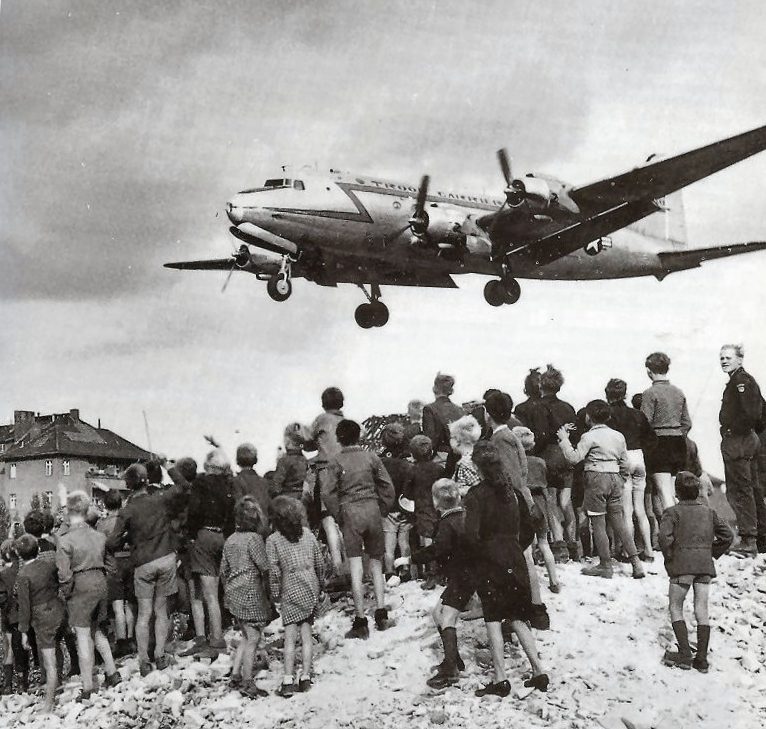
At one minute past midnight on 12 May 1949, the barriers came up on the roads and railways into West Berlin, and the first trucks and trains rolled in from the West in almost eleven months. The Soviet Union had lifted its blockade of the city — the first great confrontation of the Cold War — and it had lifted it because the blockade had failed. For 321 days, the Western Allies had supplied a city of more than two million people entirely by air, and Moscow, not Washington, blinked first.
The blockade had begun on 24 June 1948, after the Western powers introduced a new currency, the Deutschmark, into their zones of occupied Germany and into West Berlin. The Soviets, determined to force the West out of the city that sat 110 miles inside their zone, cut every road, rail line and canal. The Western answer was an airlift on a scale nobody had attempted: at its peak, aircraft were landing in Berlin every few minutes around the clock, and on one record day in April 1949 they delivered nearly 13,000 tons of food, coal and supplies. American pilot Gail Halvorsen began dropping candy on handkerchief parachutes for Berlin's children, and the 'candy bombers' became the blockade's enduring image.
Life inside the city was rationed, cold and dark — electricity ran for a few hours a day, and Berliners planted gardens in the ruins — but the population held, and the airlift held with it. The cost was real: dozens of Allied airmen died in crashes during the operation. By the spring of 1949 the blockade was hurting the Soviet position more than the Western one, disrupting East German trade and hardening Western opinion. Quiet negotiations at the United Nations produced the settlement: the blockade ended on 12 May, and a foreign ministers' conference followed, which settled nothing fundamental.
The airlift itself did not stop with the blockade; flights continued until September 1949 to build up stockpiles against a renewed siege. The larger consequences hardened quickly. Within weeks the Federal Republic of Germany — West Germany — was founded, NATO had been signed in April, and the Soviet zone answered with the German Democratic Republic in October. Berlin remained a divided island inside East Germany, and twelve years later the dispute that the blockade opened was sealed in concrete with the Berlin Wall. But May 12 proved the Cold War's first lesson: a city could be fed from the sky, and a siege could be beaten without a shot.
Why this date matters
May 12 is a day of sieges lifted and care organised. The blockade of Berlin ends on it because logistics, patience and civilian endurance outlasted coercion; Florence Nightingale, its birthday child, had made the same discovery in a different field a century earlier — that systems, statistics and stubborn organisation save more lives than heroics. Even the day's crownings fit the pattern: George VI took the throne on it in 1937 precisely because duty, quietly done, was what the moment required. May 12 rewards the people who keep the supplies — and the standards — moving.
Sources
- Encyclopaedia Britannica — On This Day: May 12
- HISTORY — What Happened on May 12
- Encyclopaedia Britannica — Berlin blockade and airlift
- Harry S. Truman Library — The Berlin Airlift
The facts on this page were checked against these sources on 19 November 2026. The History Trail's permanent pages are researched and written for this site; the live profiles elsewhere on The History Trail are assembled automatically from Wikipedia and Wikidata.
About the Author
Researched and written by the The History Trail Editorial Team — the accountable editorial function behind this site's permanent story pages. The team works from the published sources cited on each page; it does not invent historians, reviewers or credentials, and it corrects errors openly.
Fact Check
Every load-bearing fact on this page traces to one of the sources listed above, and significant claims link to their source in the text. Our checking method is described on the methodology page; errors can be reported via the corrections page.
Sources & Citations
Cite this page as: The History Trail Editorial Team, The History Trail — this article's title, publication and update dates are shown beneath its headline. The full source list appears under Sources above; the site's source standards are on the sources page.