
Years
1947 in History
1947 is the year British India ended. At midnight on 14-15 August, India became independent with Jawaharlal Nehru as its first prime minister, and Pakistan had been born the day before, amid a Partition that displaced millions. Around that ending, the Cold War's founding doctrines were proclaimed and the United Nations voted to partition Palestine.
At a Glance
- Defining event
- Indian independence at midnight, 14-15 August 1947, under the Indian Independence Act
- Partition
- Pakistan becomes a sovereign state, 14 August, with Muhammad Ali Jinnah as first governor-general; the border is published only on 17 August
- Cold War opens
- Truman Doctrine proclaimed, 12 March; Marshall proposes aid to rebuild Europe at Harvard, 5 June
- Palestine
- The UN General Assembly adopts the partition plan, Resolution 181, by 33 votes to 13, 29 November
- Sound barrier
- Chuck Yeager flies the Bell X-1 past Mach 1, 14 October, the first to do so in level flight
- Baseball's barrier
- Jackie Robinson breaks major league baseball's colour barrier, 15 April
The defining story: Indian independence and Partition
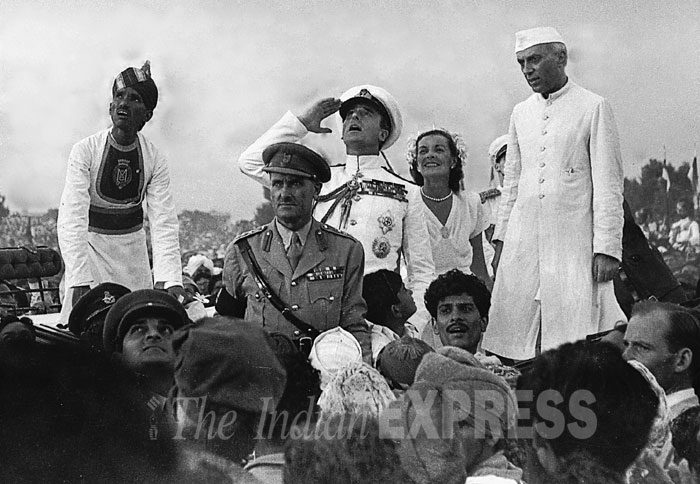
At the stroke of midnight on 14-15 August 1947, British rule in India ended. The legal instrument was the Indian Independence Act, which had received royal assent on 18 July: it created two new dominions, India and Pakistan, and set them free of the British Parliament from 15 August. Pakistan had become a sovereign state the day before, 14 August, with Muhammad Ali Jinnah as its first governor-general. In the Constituent Assembly in New Delhi, Jawaharlal Nehru marked the hour with one of the century's famous speeches, recalling the tryst with destiny India had made long years before and had now come to redeem. The last viceroy, Lord Mountbatten, stayed on briefly as independent India's first governor-general, and Nehru became its first prime minister; the photograph on this page shows Mountbatten and his wife with Nehru amid the crowds at the first Independence Day celebrations in New Delhi.
The date itself was Mountbatten's choice, and a personal one: 15 August was the second anniversary of Japan's surrender in 1945, the day he had received as Allied supreme commander in South-East Asia. The timetable he set was breakneck. The frontier between the two new states, the Radcliffe Line, named for the British lawyer Cyril Radcliffe, who had never been to India before and was given a matter of weeks to draw it, was not even published until 17 August, two days after the countries it divided had come into existence. Millions of people woke up independent without knowing for certain which country they were in.
That uncertainty turned to catastrophe. Partition cut through the provinces of Punjab and Bengal and set off one of the largest mass migrations in history: Muslims heading for Pakistan, Hindus and Sikhs heading for India, in columns that stretched for miles. The migration came with mass violence, massacres, abductions and trains arriving full of the dead. Estimates of how many died vary widely, from several hundred thousand to a million or more; millions more crossed the new borders and never went home. Within ten weeks the two new states were at war: on 26 October the Maharaja of Jammu and Kashmir signed the Instrument of Accession to India, opening the first Indo-Pakistani war. The joy of independence and the horror of Partition are inseparable in the memory of August 1947, and the border drawn in those weeks still shapes the politics of South Asia.
The rest of the year arranged the world the new states were born into. On 12 March President Truman proclaimed the Truman Doctrine, pledging American support to peoples resisting subjugation, the founding statement of Cold War containment; on 5 June Secretary of State George C. Marshall, speaking at Harvard, proposed the American aid to rebuild war-shattered Europe that became the Marshall Plan; and in July Truman signed the National Security Act, creating the Central Intelligence Agency, which formally came into existence in September. On 29 November the UN General Assembly passed Resolution 181 by 33 votes to 13, recommending the partition of Mandate Palestine into Arab and Jewish states with Jerusalem under international administration.
Timeline of 1947
- 12 February
Christian Dior presents his first collection in Paris; its cinched waists and full skirts are christened the New Look.
- 12 March
President Truman proclaims the Truman Doctrine, pledging American support to peoples resisting subjugation.
- 15 April
Jackie Robinson plays his first game for the Brooklyn Dodgers, breaking major league baseball's colour barrier.
- 3 May
Japan's post-war constitution comes into force, renouncing war and making the emperor a symbol.
- 5 June
Secretary of State George C. Marshall, speaking at Harvard, proposes American aid to rebuild war-shattered Europe.
- 25 June
The Diary of Anne Frank is published in Amsterdam under the title Het Achterhuis.
- 26 July
President Truman signs the National Security Act, reorganising the US armed forces and creating the CIA.
- 14 August
Pakistan becomes a sovereign state as British India is partitioned, with Muhammad Ali Jinnah as its first governor-general.
- 15 August
India becomes independent of British rule at midnight, with Jawaharlal Nehru as its first prime minister.
- 9 September
Operators of the Harvard Mark II computer find a moth trapped in a relay, the first literal computer 'bug', taped into the logbook.
- 14 October
Captain Chuck Yeager flies the rocket-powered Bell X-1 past Mach 1, the first person to break the sound barrier in level flight.
- 30 October
The General Agreement on Tariffs and Trade, GATT, is signed in Geneva.
- 20 November
Princess Elizabeth marries Philip Mountbatten at Westminster Abbey.
- 29 November
The United Nations votes to partition Palestine, adopting Resolution 181 by 33 votes to 13.
Why 1947 still matters
The independence of India and Pakistan was the largest single act of decolonisation in history, and its unfinished business, above all Kashmir, whose accession opened the first Indo-Pakistani war within weeks, still drives South Asian politics. The manner of the ending matters as much as the fact: a border drawn in weeks by a man who had never visited the country, published after the states it divided already existed, became the standing warning about partitions imposed in haste, a warning the United Nations' own Palestine plan, adopted that November, would test again within a year.
The year's other settlements built the Western half of the postwar world. The Truman Doctrine and the Marshall speech defined containment and reconstruction, the twin policies of the early Cold War; the National Security Act created the institutional machinery, including the CIA and an independent US Air Force, that still runs American security; and GATT laid a foundation of the modern world trading system. In daily life the future arrived just as fast: Jackie Robinson's April debut began the integration of American sport, The Diary of Anne Frank reached print in June, and in October Chuck Yeager's flight past Mach 1 opened the supersonic age. Few years have closed one era and opened another on so many fronts at once.
1947 on The History Trail
Indian independence and the Palestine partition vote carry featured stories on The History Trail, and the Cold War has a page of its own.
- August 14 in History — Pakistan becomes a sovereign state as British India is partitioned.
- August 15 in History — India becomes independent at midnight, with Nehru as its first prime minister.
- November 29 in History — The United Nations adopts the Palestine partition plan, Resolution 181.
- Cold War — The conflict whose founding doctrines were proclaimed in 1947, told as a permanent story.
- Pakistani rupee — A permanent page from the site's collection, among the stories this year touches.
- Lego — A permanent page from the site's collection, among the stories this year touches.
Sources
- Encyclopaedia Britannica — On This Day: February 12
- Encyclopaedia Britannica — On This Day: March 12
- Encyclopaedia Britannica — On This Day: April 15
- Encyclopaedia Britannica — On This Day: May 3
- Encyclopaedia Britannica — On This Day: June 5
The facts on this page were checked against these sources on 19 November 2026. The History Trail's permanent pages are researched and written for this site; the live profiles elsewhere on The History Trail are assembled automatically from Wikipedia and Wikidata.
About the Author
Researched and written by the The History Trail Editorial Team — the accountable editorial function behind this site's permanent story pages. The team works from the published sources cited on each page; it does not invent historians, reviewers or credentials, and it corrects errors openly.
Fact Check
Every load-bearing fact on this page traces to one of the sources listed above, and significant claims link to their source in the text. Our checking method is described on the methodology page; errors can be reported via the corrections page.
Sources & Citations
Cite this page as: The History Trail Editorial Team, The History Trail — this article's title, publication and update dates are shown beneath its headline. The full source list appears under Sources above; the site's source standards are on the sources page.