
On This Day
August 14 in History
On 14 August 1945 Japan accepted the terms of the Potsdam Declaration, and President Truman announced the surrender to the world — the announcement that ended the Second World War, almost six years after it began. August 14 is also the day Pakistan became a sovereign state, Social Security became law in the United States, and Usain Bolt completed his Olympic sprint treble.
Choose another date: open the On This Day calendar to browse events, births and deaths for any day of the year.
At a Glance
- The decision
- Japan's Imperial Rescript on the Termination of the War, issued on 14 August 1945, accepted the terms of the Potsdam Declaration
- The announcement
- President Truman announced the surrender at the White House at 7 p.m. Washington time on 14 August; it was already 15 August in Japan
- The broadcast
- The emperor's recorded message was broadcast to the Japanese people at noon on 15 August — the first time most had heard his voice
- The wording
- The rescript spoke of enduring the unendurable, but never used the word 'surrender'
- The near-coup
- On the night of 14–15 August, hardline officers tried to seize the recording and stop the broadcast; the attempt failed
- The formal end
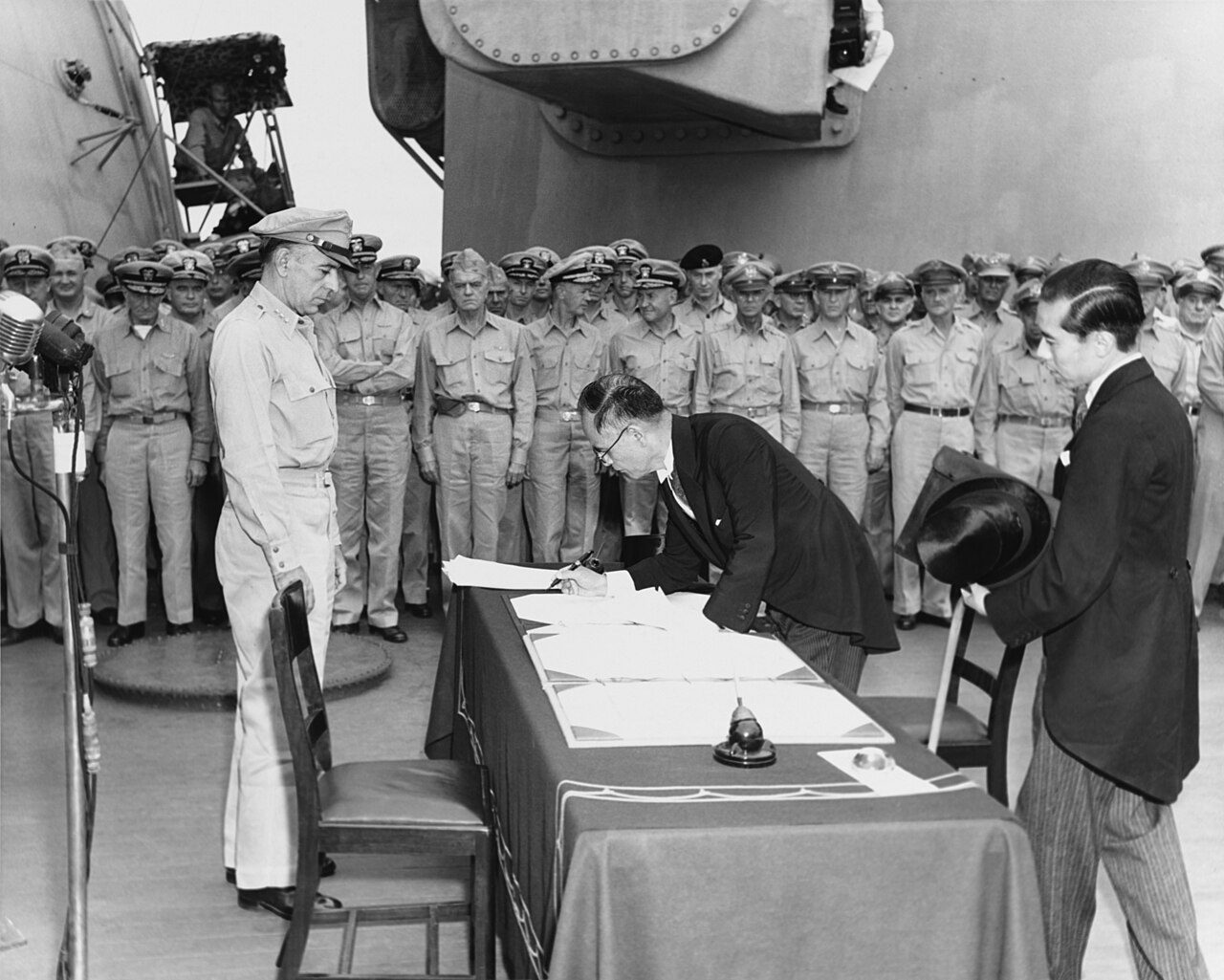
- The Instrument of Surrender was signed aboard USS Missouri in Tokyo Bay on 2 September 1945
Events on this day
- 1795George Washington signs the Jay Treaty with Britain, settling disputes left over from the Revolutionary War.
- 1900An international force relieves the siege of the foreign legations in Beijing, breaking the climax of the Boxer Rebellion in China.
- 1917China declares war on Germany and Austria-Hungary, joining the First World War on the Allied side.
- 1935Franklin D. Roosevelt signs the Social Security Act, creating America's system of old-age pensions and unemployment insurance.
- 1941Roosevelt and Churchill issue the Atlantic Charter, the joint statement of war aims agreed aboard ship at Placentia Bay.
- 1945Japan accepts the Potsdam Declaration, and President Truman announces the surrender that ends the Second World War — the featured story above.
- 1947Pakistan becomes a sovereign state as British India is partitioned, with Muhammad Ali Jinnah as its first governor-general.
- 1971Bob Gibson pitches the first no-hitter of his career, for the St. Louis Cardinals against Pittsburgh.
- 1985Michael Jackson buys the ATV music catalogue — and with it the publishing rights to most of the Beatles' songs — for $47 million.
- 1994The terrorist known as Carlos the Jackal is captured in Khartoum, Sudan, and flown to France to face trial.
- 2003A cascading power failure blacks out much of the north-eastern United States and Ontario, leaving tens of millions of people without electricity.
- 2016Usain Bolt wins the 100 metres at the Rio Olympics, becoming the first man to take the title at three consecutive Games.
Born on this day
- 1867John Galsworthy — English novelist of The Forsyte Saga and winner of the Nobel Prize in Literature.
- 1941David Crosby — American singer and guitarist, of the Byrds and of Crosby, Stills & Nash.
- 1945Steve Martin — American comedian and actor, star of The Jerk and Planes, Trains and Automobiles.
- 1945Wim Wenders — German film director, maker of Paris, Texas and Wings of Desire.
- 1959Earvin 'Magic' Johnson — American basketball star who led the Los Angeles Lakers to five NBA titles.
- 1966Halle Berry — American actress, the first Black woman to win the Academy Award for Best Actress.
- 1983Mila Kunis — Ukrainian-born American actress, star of That '70s Show and Black Swan.
Died on this day
- 1951William Randolph Hearst — American newspaper magnate whose chain shaped popular journalism; the model for Citizen Kane.
- 1956Bertolt Brecht — German playwright, author of Mother Courage and The Threepenny Opera.
- 1984J. B. Priestley — English novelist and playwright, author of An Inspector Calls.
- 1988Enzo Ferrari — Italian racing driver and founder of the Ferrari car company, dead at 90.
- 2004Czesław Miłosz — Polish poet and Nobel laureate in Literature, author of The Captive Mind.
The featured story: Japan's surrender is announced, 14 August 1945
By the summer of 1945 Japan was beaten but not finished. Its cities had been burned out by bombing, its navy destroyed and its people blockaded, yet its government was deadlocked: the military leaders on the Supreme War Council wanted to fight on, and the Potsdam Declaration of 26 July, in which the Allies demanded surrender and promised 'prompt and utter destruction' if it was refused, had been met with silence. The deadlock was broken from above. The emperor, Hirohito, intervened in his government's councils — a step almost without precedent — and came down on the side of accepting the Allied terms.
On 14 August 1945 the decision was made formal in an Imperial Rescript on the Termination of the War, in which the emperor accepted the Potsdam Declaration. That evening in Washington, at seven o'clock, President Truman stepped before reporters at the White House and announced that Japan had surrendered. Crowds poured into the streets of American and Allied cities. Because of the time difference it was already 15 August in Japan itself — which is why the same ending is commemorated on two different dates on opposite sides of the Pacific.
Inside Japan the announcement nearly failed to happen. The rescript did not speak plainly: in the emperor's formal language it said that 'the war situation has developed not necessarily to Japan's advantage' and that his people must 'endure the unendurable' — the word surrender never appeared. And on the night of 14–15 August a group of hardline army officers, determined to fight on, attempted a coup: they murdered the commander of the Imperial Guard, issued forged orders and hunted through the palace for the recording of the emperor's message before it could be broadcast. They failed to find it, and the coup collapsed.
At noon on 15 August the recording was played on Japanese radio — the first time almost all of the emperor's subjects had ever heard his voice — and the war was over in fact as well as on paper. The formal Instrument of Surrender was signed on 2 September 1945 aboard the battleship USS Missouri in Tokyo Bay, in a ceremony of a few minutes that closed the Second World War almost exactly six years after it had begun in Europe. The announcement of 14 August, rather than the signature of September, is the moment the world remembers: the evening the news arrived, all at once, everywhere.
Why this date matters
August 14 is a date on which long struggles are settled by signatures. Washington signs a treaty that keeps a young republic out of war in 1795; Roosevelt signs the Atlantic Charter in 1941 and Social Security into law in 1935; and in 1945 a single announcement closes the largest war in history. The next day the consequences keep unfolding — Pakistan in 1947, India at midnight — but the 14th is when the decisions are taken. It is a day of documents rather than battles, which is fitting: more history has been ended by men signing paper on this date than by armies on a field.
Sources
- Encyclopaedia Britannica — On This Day: August 14
- HISTORY — This Day in History: August 14
- National Diet Library — The Imperial Rescript on Surrender
- timeanddate — On This Day: August 14
The facts on this page were checked against these sources on 19 November 2026. The History Trail's permanent pages are researched and written for this site; the live profiles elsewhere on The History Trail are assembled automatically from Wikipedia and Wikidata.
About the Author
Researched and written by the The History Trail Editorial Team — the accountable editorial function behind this site's permanent story pages. The team works from the published sources cited on each page; it does not invent historians, reviewers or credentials, and it corrects errors openly.
Fact Check
Every load-bearing fact on this page traces to one of the sources listed above, and significant claims link to their source in the text. Our checking method is described on the methodology page; errors can be reported via the corrections page.
Sources & Citations
Cite this page as: The History Trail Editorial Team, The History Trail — this article's title, publication and update dates are shown beneath its headline. The full source list appears under Sources above; the site's source standards are on the sources page.