
Years
1903 in History
1903 is the year humanity took to the air. On a freezing December morning at Kill Devil Hills, North Carolina, two bicycle makers from Dayton, Ohio, flew the first powered, sustained and controlled aeroplane — twelve seconds that opened the age of flight. The same year Henry Ford founded the company that would put the world on wheels.
At a Glance
- Defining event
- Orville Wright makes the first powered, controlled aeroplane flight on 17 December — 120 feet in 12 seconds
- The day's best
- Wilbur's fourth flight that day covers 852 feet in 59 seconds
- Motoring landmark
- Henry Ford founds the Ford Motor Company on 16 June with $28,000 from a dozen investors; it ships its first car on 20 July
- Born this year
- George Orwell, born Eric Blair in India on 25 June — the future author of Animal Farm and Nineteen Eighty-Four
- Rights milestone
- Emmeline Pankhurst founds the Women's Social and Political Union in Manchester on 10 October
- Sport landmark
- The Boston Red Sox beat Pittsburgh to win the first modern World Series, 13 October
The defining story: twelve seconds at Kill Devil Hills
The aeroplane was invented not by a university or a government laboratory but in a bicycle shop in Dayton, Ohio. Wilbur and Orville Wright, who built and repaired bicycles for a living, approached flight as an engineering problem with three parts — lift, power and, above all, control. From 1900 they tested gliders each autumn at Kill Devil Hills, near Kitty Hawk on North Carolina's Outer Banks, chosen for its steady winds, soft sand and privacy. Over a thousand glides taught them to fly; their decisive invention was three-axis control, the system that let a pilot command the machine in the air rather than merely balance in it.
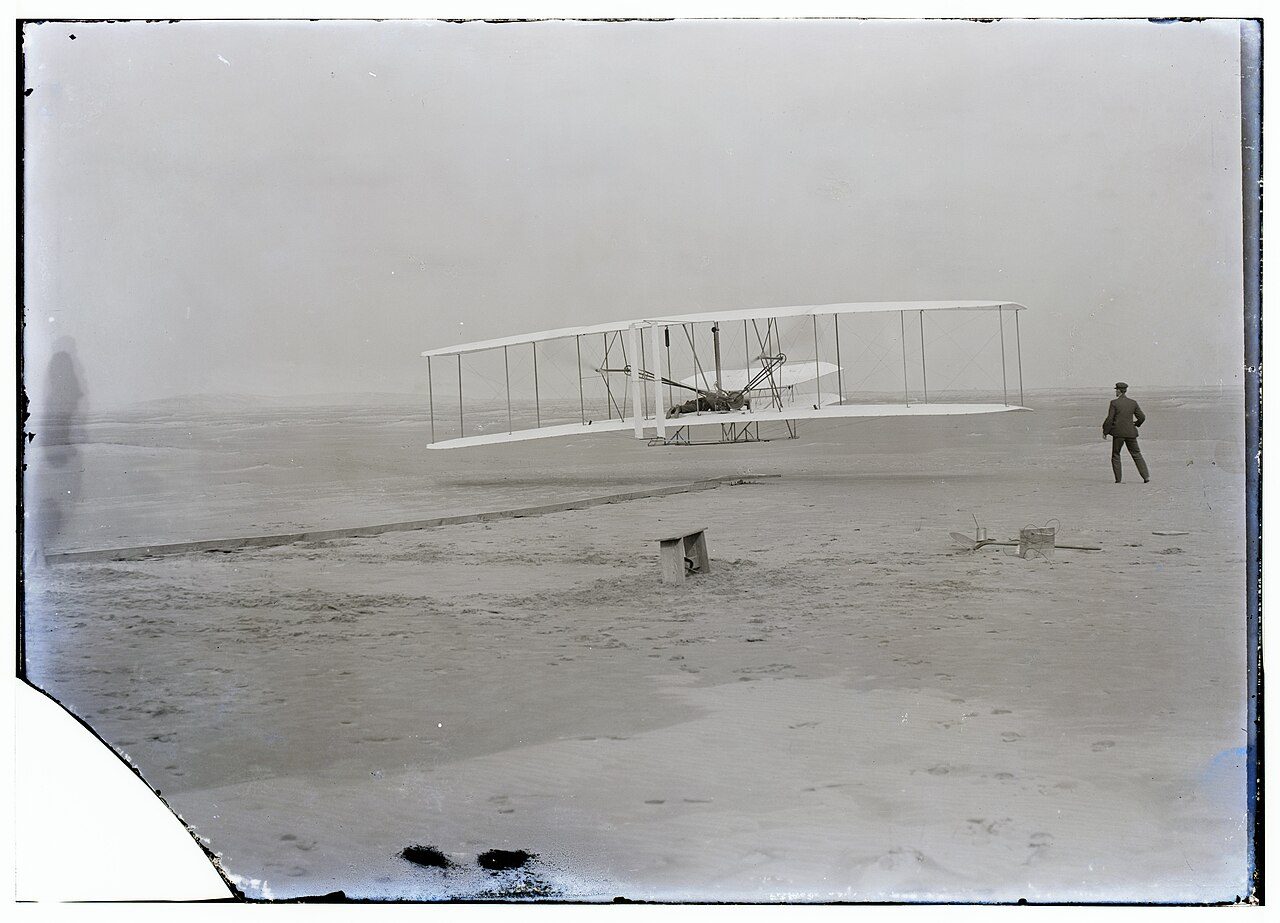
The first attempt, on 14 December, nearly ended the story. The brothers tossed a coin for the honour; Wilbur won, took off down the launching rail, oversteered, stalled and dived into the sand after 105 feet. Repairs took three days. On the morning of Thursday 17 December the weather was bitter — freezing temperatures, puddles iced over, a wind gusting to 27 miles per hour — but the brothers decided not to wait. It was Orville's turn. He had set up a camera on a tripod, aimed at the end of the rail, and asked John T. Daniels of the Kill Devil Hills lifesaving station to squeeze the shutter at the right moment.
The flight lasted twelve seconds and covered 120 feet over the ground — though into that headwind the machine had flown some 540 feet through the air. The brothers took turns for three more flights, each longer than the last, learning the machine's manners as they went. On the fourth, just before noon, Wilbur flew 852 feet in 59 seconds. Then, with the Flyer back on the sand, a gust caught it and rolled it over, wrecking it beyond repair; it never flew again. Daniels's photograph — Orville at the controls, Wilbur running alongside — became the most famous image of invention ever made, and the brothers' telegram home carried the news to Dayton.
Flight was not the year's only beginning. In May, Horatio Nelson Jackson and Sewall Crocker set out from San Francisco on the first transcontinental automobile trip, reaching New York in just over 63 days. On 16 June Henry Ford founded the Ford Motor Company in Detroit with $28,000 raised from a dozen investors, and on 20 July the new company shipped its first automobile, a Model A, to a Chicago dentist. In October, Emmeline Pankhurst founded the Women's Social and Political Union in Manchester — the militant suffragettes — and Boston beat Pittsburgh to win the first modern World Series of baseball. In November, Panama separated from Colombia with United States encouragement, clearing the way for the Panama Canal treaty. George Orwell, the century's great political novelist, was born in India in June.
Timeline of 1903
- 13 January
The first Korean immigrants to the United States, 102 people aboard the RMS Gaelic, arrive in Hawaii to work its plantations.
- 15 February
Toy maker Morris Michtom puts two stuffed bears in his shop window and calls them Teddy bears, after President Theodore Roosevelt.
- 23 May
Horatio Nelson Jackson and Sewall Crocker set out from San Francisco on the first transcontinental automobile trip.
- 16 June
Henry Ford founds the Ford Motor Company in Detroit with $28,000 raised from a dozen investors.
- 25 June
George Orwell is born in India — the future author of Animal Farm and Nineteen Eighty-Four.
- 20 July
The Ford Motor Company ships its first automobile, a Model A.
- 10 October
Emmeline Pankhurst founds the Women's Social and Political Union in Manchester, the militant suffragettes.
- 13 October
The Boston Red Sox beat the Pittsburgh Pirates to win the first modern World Series of baseball.
- 3 November
Panama separates from Colombia with United States encouragement, clearing the way for the Panama Canal treaty.
- 8 December
Herbert Spencer dies — the English philosopher who coined 'survival of the fittest'.
- 17 December
Orville Wright makes the first powered, sustained and controlled aeroplane flight at Kill Devil Hills.
- 28 December
John von Neumann is born — the mathematician whose work would underlie computing and the atomic age.
Why 1903 still matters
1903 still matters because it started the century's two great transport revolutions within six months of each other. The Ford Motor Company, founded with $28,000, grew into the firm whose production methods put the automobile within ordinary reach; the Wright Flyer, built by two bicycle mechanics, began an arc that ran from 120 feet of sand to the Moon in just 66 years. Neither triumph looked inevitable at the time — the Flyer was wrecked by a gust on its first day and never flew again — but both rested on the same insight the brothers stated plainly: control, not power, was the problem to solve.
The year's other foundings had long fuses. Pankhurst's Women's Social and Political Union turned the campaign for women's votes into a militant movement whose effects ran through the next two decades; Panama's separation set up the canal that would open in 1914 and redraw world shipping; and the births of Orwell and von Neumann gave the coming century two of the minds that would define its politics and its machines. Few years pack so many beginnings into twelve months.
The year's small beginnings had outsized futures. The Teddy bear, named for President Theodore Roosevelt and put in a shop window in February, became the universal childhood toy. The first modern World Series, played that October, fixed the championship structure baseball still uses. The first transcontinental automobile trip — San Francisco to New York in just over 63 days — proved the motor car could cross a continent years before the roads existed to make it easy. And the births of the year, Orwell and von Neumann among them, supplied two of the minds that would define the century the Wrights' machine opened.
1903 on The History Trail
The History Trail tells 1903 through the December morning the aeroplane age began.
- December 17 in History — the Wright brothers make the first powered flight at Kill Devil Hills.
- Wright Flyer vs Spitfire — how far flight came in the decades after 1903.
- Christmas Lights — a festive technology of the same electric age.
Sources
- Encyclopaedia Britannica — On This Day: June 16
- HISTORY — What Happened on June 16
- Encyclopaedia Britannica — On This Day: July 23
- Encyclopaedia Britannica — On This Day: October 10
- Encyclopaedia Britannica — On This Day: November 3
The facts on this page were checked against these sources on 19 November 2026. The History Trail's permanent pages are researched and written for this site; the live profiles elsewhere on The History Trail are assembled automatically from Wikipedia and Wikidata.
About the Author
Researched and written by the The History Trail Editorial Team — the accountable editorial function behind this site's permanent story pages. The team works from the published sources cited on each page; it does not invent historians, reviewers or credentials, and it corrects errors openly.
Fact Check
Every load-bearing fact on this page traces to one of the sources listed above, and significant claims link to their source in the text. Our checking method is described on the methodology page; errors can be reported via the corrections page.
Sources & Citations
Cite this page as: The History Trail Editorial Team, The History Trail — this article's title, publication and update dates are shown beneath its headline. The full source list appears under Sources above; the site's source standards are on the sources page.