
On This Day
March 14 in History
On 14 March 1879, in the German city of Ulm, Albert Einstein was born — the child who grew up to recast humanity's understanding of space, time and gravity, and to become the most famous scientist of the modern age. March 14 is also the day Eli Whitney patented the cotton gin in 1794, penicillin first cured a patient in 1942, and Stephen Hawking died in 2018.
Choose another date: open the On This Day calendar to browse events, births and deaths for any day of the year.
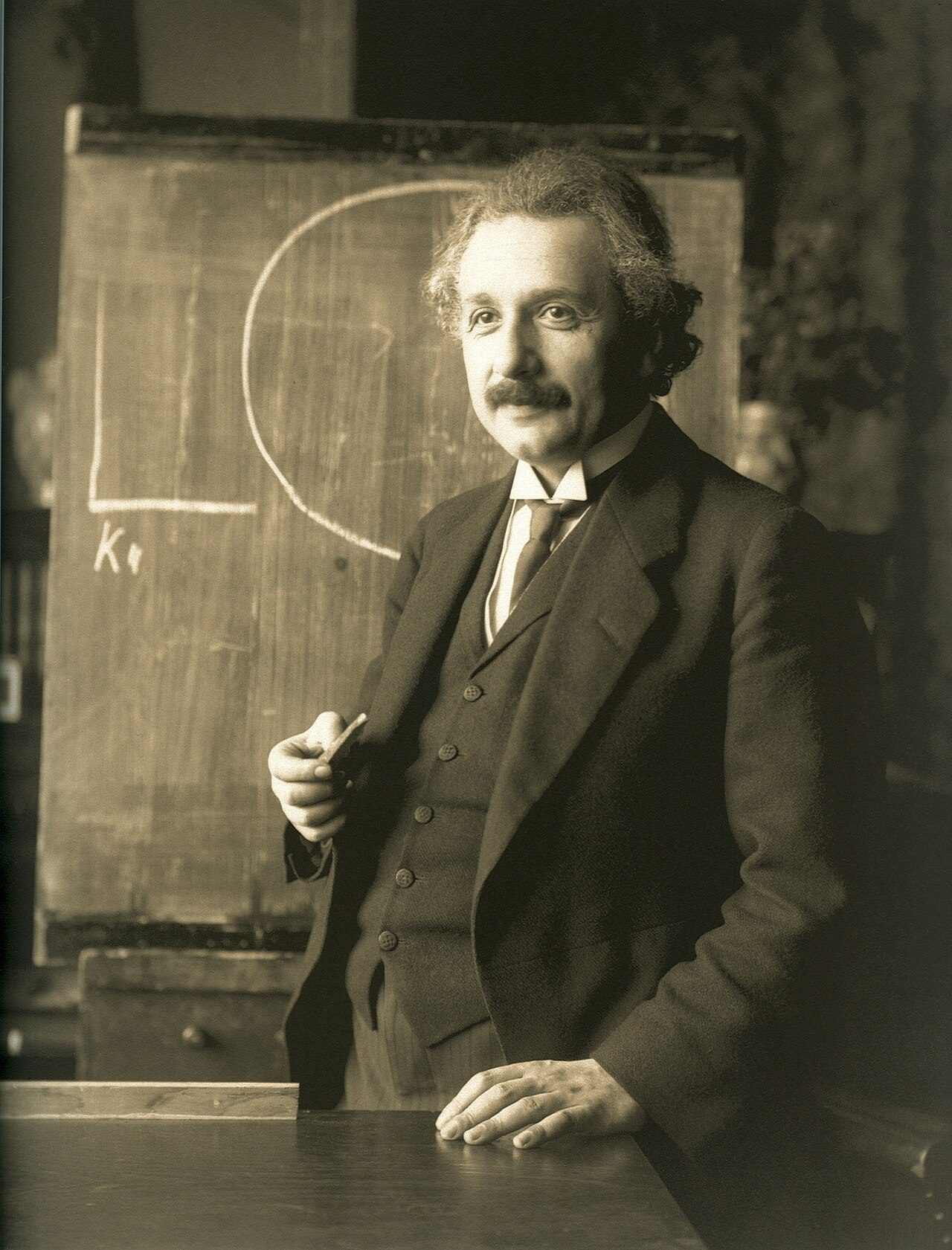
At a Glance
- Born
- 14 March 1879, Ulm, Kingdom of Württemberg, German Empire (Nobel Prize biographical)
- Training
- Mathematics and physics at Zurich; worked as a patent clerk in Bern while producing his breakthrough papers
- Miracle year
- 1905 — papers on the photoelectric effect, Brownian motion and special relativity, and the equation E = mc²
- Masterwork
- The general theory of relativity (1915), recasting gravity as the bending of space-time
- Nobel Prize
- Physics, 1921 — awarded for the photoelectric effect, not for relativity
- Died
- 18 April 1955, Princeton, New Jersey, aged 76
Events on this day
- 1794Eli Whitney receives a patent for the cotton gin, the machine that transforms cotton production — and entrenches slavery — in the American South.
- 1879Albert Einstein is born in Ulm, Germany — the featured story above.
- 1900The Gold Standard Act becomes law in the United States, formally placing the dollar on the gold standard.
- 1942The first American patient is successfully treated with penicillin, the antibiotic whose mass production will transform medicine.
- 1950The FBI issues its first 'Ten Most Wanted Fugitives' list, a publicity device that becomes a permanent institution.
- 1953Days after Stalin's death, Nikita Khrushchev is named a secretary of the Soviet Communist Party's Central Committee, beginning his rise to power.
- 1958Perry Como's 'Catch a Falling Star' becomes the first single certified as a Gold Record by the American recording industry.
- 1964Jack Ruby is convicted in Dallas of murdering Lee Harvey Oswald, President Kennedy's assassin; the conviction is later overturned, and Ruby dies before a retrial.
- 1967President John F. Kennedy's body is moved to its permanent gravesite at Arlington National Cemetery, where an eternal flame burns.
- 1991The Birmingham Six are freed after 16 years in prison, their convictions for the 1974 Birmingham pub bombings quashed as unsafe.
Born on this day
- 1804Johann Strauss I — Austrian composer of waltzes and the Radetzky March, father of Johann Strauss II.
- 1820Victor Emmanuel II — first king of a united Italy, crowned in 1861.
- 1854Paul Ehrlich — German physician and immunologist, Nobel laureate who sought a 'magic bullet' cure for disease.
- 1864Casey Jones — American locomotive engineer whose fatal crash in 1900 became a folk ballad.
- 1933Michael Caine — English actor whose career runs from Zulu to The Dark Knight.
- 1948Billy Crystal — American comedian and actor, star of When Harry Met Sally.
Died on this day
- 1757John Byng — British admiral, executed by firing squad aboard his own flagship after failing to relieve besieged Minorca.
- 1883Karl Marx — German philosopher, co-author of The Communist Manifesto and author of Das Kapital, dead in exile in London.
- 2014Tony Benn — British Labour politician and diarist, for half a century a leading figure of his party's left.
- 2018Stephen Hawking — English theoretical physicist who transformed the study of black holes, dead at 76 after living with motor neurone disease for more than 50 years.
The featured story: Albert Einstein is born, 14 March 1879
Albert Einstein was born on 14 March 1879 in Ulm, a city in the Kingdom of Württemberg in the German Empire, the first child of Hermann and Pauline Einstein. The family moved to Munich while he was still an infant, and it was there — in a childhood that was, by most accounts, quiet, solitary and unremarkable at school — that the boy who would remake physics first encountered the wonders that drove him: a compass needle's invisible obedience, and the geometry he taught himself from a book he called his 'holy little geometry book'.
Restless under the discipline of German schooling, he left for Switzerland in 1895, renounced his German citizenship the following year, and eventually trained as a teacher of mathematics and physics in Zurich. Unable at first to find an academic post, he took a job examining patent applications in Bern — and there, in 1905, his 'miracle year', the 26-year-old clerk published the papers that founded modern physics: on the photoelectric effect, on Brownian motion, on the special theory of relativity, and the short note that gave the world its most famous equation, E = mc².
A decade later, in 1915, he completed the general theory of relativity, recasting gravity itself as the bending of space and time by mass and energy — the work Britannica summarises as the achievement that made him, for the public, the very image of genius. Yet when the Nobel Prize in Physics came to him for 1921, it was awarded not for relativity, which the committee still treated as unsettled, but 'for his discovery of the law of the photoelectric effect', the most concrete of the 1905 papers.
Einstein spent his final decades at Princeton, New Jersey — the world's most famous scientist, and its most famous refugee from the Europe that had produced him. He died there on 18 April 1955, aged 76, still working on the unified theory that eluded him to the end. No scientist since Newton has so completely changed what educated people believe the universe is like; and it began, improbably, in a provincial German city, on an ordinary March day in 1879.
Why this date matters
March 14 is a date of outsized beginnings and endings in the life of the mind. It gave the world Einstein and, 139 years later, took Hawking — the two physicists the modern public knows by a single name and a silhouette. Around those poles it gathers the machinery of the modern age: the cotton gin that reshaped an economy and a crime, the antibiotic that first proved itself on a single patient in 1942, the gold standard, the gold record, the most-wanted list. Few dates so compactly show how much of the future can be latent in a single day's small print.
Sources
- HISTORY — What Happened on March 14
- Encyclopaedia Britannica — On This Day: March 14
- Nobel Prize — Albert Einstein: Biographical
- Encyclopaedia Britannica — Albert Einstein
The facts on this page were checked against these sources on 19 November 2026. The History Trail's permanent pages are researched and written for this site; the live profiles elsewhere on The History Trail are assembled automatically from Wikipedia and Wikidata.
About the Author
Researched and written by the The History Trail Editorial Team — the accountable editorial function behind this site's permanent story pages. The team works from the published sources cited on each page; it does not invent historians, reviewers or credentials, and it corrects errors openly.
Fact Check
Every load-bearing fact on this page traces to one of the sources listed above, and significant claims link to their source in the text. Our checking method is described on the methodology page; errors can be reported via the corrections page.
Sources & Citations
Cite this page as: The History Trail Editorial Team, The History Trail — this article's title, publication and update dates are shown beneath its headline. The full source list appears under Sources above; the site's source standards are on the sources page.