
On This Day
November 19 in History
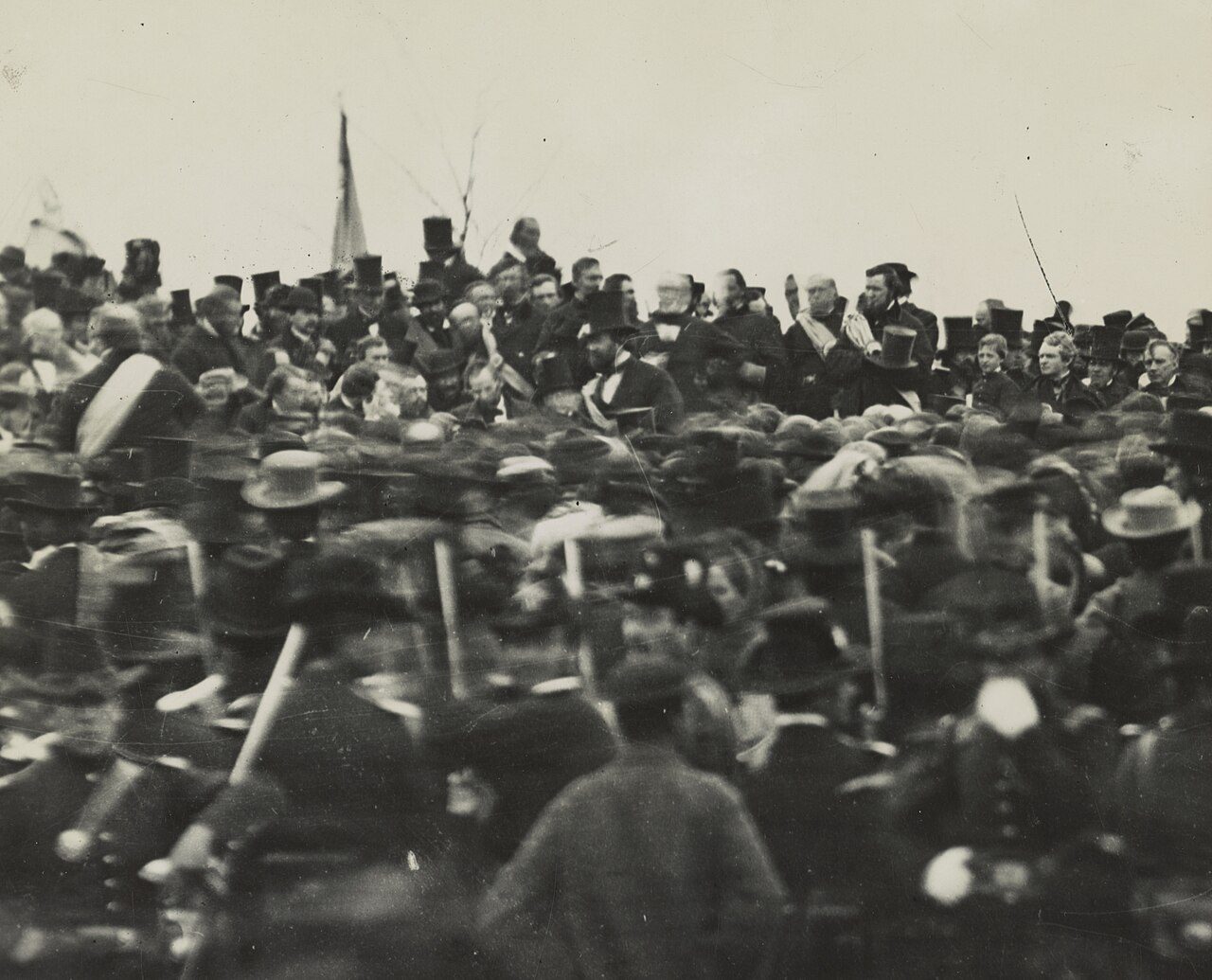
On 19 November 1863, at the dedication of a cemetery for the Union dead of Gettysburg, Abraham Lincoln rose after a two-hour oration by the day's main speaker and spoke for about two minutes. The Gettysburg Address — some 270 words — rededicated the United States to the proposition that all men are created equal, and became the most famous speech in American history. November 19 is also the day the Stalingrad counteroffensive began and Sadat landed in Israel.
Choose another date: open the On This Day calendar to browse events, births and deaths for any day of the year.
At a Glance
- Occasion
- Dedication of the Soldiers' National Cemetery at Gettysburg, Pennsylvania, 19 November 1863
- The battle
- Four and a half months earlier: the Battle of Gettysburg, 1–3 July 1863, the Civil War's bloodiest battle
- Length
- About 270 words, delivered in roughly two minutes — after Edward Everett's two-hour keynote oration
- Lincoln's role
- He had been invited to give only 'a few appropriate remarks' after the main speech
- Opening
- 'Four score and seven years ago' — counting back 87 years to 1776 and the Declaration of Independence
- Copies
- Five manuscript copies in Lincoln's hand survive; the Bliss copy, the last he wrote, is the standard text
Events on this day
- 1794The United States and Britain sign the Jay Treaty, settling leftover disputes from the Revolutionary War.
- 1863Abraham Lincoln delivers the Gettysburg Address at the dedication of the Soldiers' National Cemetery — the featured story above.
- 1941The Australian cruiser HMAS Sydney and the German raider Kormoran sink each other off Western Australia; Sydney is lost with all 645 hands.
- 1942The Red Army launches Operation Uranus, the counteroffensive that encircles the German Sixth Army at Stalingrad.
- 1969Pelé scores his 1,000th career goal, a penalty for Santos against Vasco da Gama at the Maracanã.
- 1975One Flew Over the Cuckoo's Nest opens in cinemas; it goes on to sweep the five major Academy Awards.
- 1977Egypt's President Anwar Sadat arrives in Israel, the first Arab leader to visit the Jewish state.
- 1985Ronald Reagan and Mikhail Gorbachev open their first summit in Geneva, the start of the Cold War's thaw.
- 1990Milli Vanilli are stripped of their Grammy Award after admitting they did not sing on their album.
- 2005U.S. Marines kill 24 Iraqi civilians at Haditha after a roadside bombing, an atrocity exposed the following year.
- 2010An explosion at the Pike River Mine in New Zealand kills 29 men in the country's worst mining disaster in a century.
Born on this day
- 1831James A. Garfield — 20th president of the United States, assassinated in 1881.
- 1917Indira Gandhi — prime minister of India for four terms, assassinated in office in 1984.
- 1938Ted Turner — American media mogul who founded CNN, the first 24-hour news channel.
- 1942Calvin Klein — American fashion designer.
- 1961Meg Ryan — American actress of When Harry Met Sally and Sleepless in Seattle.
- 1962Jodie Foster — American actress and director, twice an Academy Award winner.
Died on this day
- 1665Nicolas Poussin — the leading painter of French classicism, dead in Rome.
- 1692Thomas Shadwell — English playwright and poet laureate.
- 1828Franz Schubert — Austrian composer, dead at 31 with most of his work unpublished.
- 1988Christina Onassis — Greek shipping heiress, daughter of Aristotle Onassis.
- 2014Mike Nichols — American director of The Graduate and Who's Afraid of Virginia Woolf?
The featured story: the Gettysburg Address, 19 November 1863
The battle had ended four and a half months before, but Gettysburg was not done burying its dead. The three days of fighting in July 1863 left some 7,000 corpses on Pennsylvania farmland, hastily interred in shallow graves that the rain was already washing open. Pennsylvania's governor bought seventeen acres on Cemetery Hill for a proper soldiers' cemetery, and the reburials were still under way — the National Park Service notes they were far from complete — when the dedication ceremony was set for 19 November. The organisers chose Edward Everett of Massachusetts, the most celebrated orator in America, to give the address, and invited the president, almost as an afterthought of protocol, to add 'a few appropriate remarks'.
Everett spoke for two hours, a learned, flowing reconstruction of the battle that the crowd received warmly. Then Lincoln stood. What he said — the Park Service's summary is blunt: he spoke for two minutes — began by reaching past the Constitution to the Declaration of Independence: 'Four score and seven years ago our fathers brought forth on this continent a new nation, conceived in Liberty, and dedicated to the proposition that all men are created equal.' In ten sentences he declined to describe the battle, argued that the living could not consecrate ground the dead had already consecrated, and transferred the war's meaning from preserving a union of states to completing a nation's unfinished founding: 'that this nation, under God, shall have a new birth of freedom — and that government of the people, by the people, for the people, shall not perish from the earth.' Contemporary reaction split on party lines, and Lincoln himself is said to have feared the speech had failed.
The fear was misplaced, and Everett knew it before anyone: he wrote to Lincoln the next day that he wished he had come as near the central idea of the occasion in two hours as Lincoln had in two minutes. Lincoln wrote back, graciously, that he was glad the speech had not been 'a total failure'. Five copies in his hand survive; the version he wrote last, the Bliss copy, is the one carved on the Lincoln Memorial. The address did its political work at once — it told a war-weary North what the slaughter was for, in terms that made emancipation and union the same cause — and its longer work across the following century, as the text to which American arguments about equality keep returning.
There is a coda the ceremony's organisers could not have foreseen. Lincoln had arrived in Gettysburg already unwell, and grew sicker on the train home; his valet fell ill too, and modern historians have argued the president was in the early stages of smallpox as he spoke — Britannica's account notes he was in no shape to be giving a speech. He recovered. The cemetery he dedicated now holds more than 6,000 graves, and every 19 November the town marks Dedication Day, with the address read aloud where it was first given: two minutes, still doing their work.
Why this date matters
November 19 is the calendar's day of consecration and consequence. A president dedicates a cemetery and, almost accidentally, a nation's creed; a Soviet counteroffensive begins that will trap an army and turn a world war; an Egyptian president lands in an enemy capital to start a peace. Even its smaller entries are hinge moments — a treaty that kept a young republic out of war, a summit that began the Cold War's end. It is a date on which short acts — a speech, a landing, a signature — carried very long shadows.
Sources
- Encyclopaedia Britannica — On This Day: November 19
- HISTORY — What Happened on November 19
- National Park Service — History of the Soldiers' National Cemetery
- Wikimedia — On This Day feed: November 19
The facts on this page were checked against these sources on 19 November 2026. The History Trail's permanent pages are researched and written for this site; the live profiles elsewhere on The History Trail are assembled automatically from Wikipedia and Wikidata.
About the Author
Researched and written by the The History Trail Editorial Team — the accountable editorial function behind this site's permanent story pages. The team works from the published sources cited on each page; it does not invent historians, reviewers or credentials, and it corrects errors openly.
Fact Check
Every load-bearing fact on this page traces to one of the sources listed above, and significant claims link to their source in the text. Our checking method is described on the methodology page; errors can be reported via the corrections page.
Sources & Citations
Cite this page as: The History Trail Editorial Team, The History Trail — this article's title, publication and update dates are shown beneath its headline. The full source list appears under Sources above; the site's source standards are on the sources page.