
Years
1783 in History
1783 is the year the American Revolution was formally ended and its victor voluntarily disarmed. On 3 September the Treaty of Paris recognised the independence of the United States. In Paris itself, the Montgolfier balloon carried human beings into the air for the first time. And in December George Washington bade farewell to his officers and resigned his commission to Congress — the precedent on which the republic's civilian rule rests.
At a Glance
- Defining event
- Treaty of Paris signed, 3 September 1783 — Britain recognises the independence of the United States
- The precedent
- Washington resigns his commission at Annapolis, 23 December, and retires to Mount Vernon
- First flight
- Pilâtre de Rozier and the Marquis d'Arlandes make the first untethered human flight over Paris, 21 November
- The disaster
- The Laki eruption begins in Iceland on 8 June; more than 9,000 Icelanders die by common estimate
- The danger averted
- Washington talks his officers out of a threatened revolt at Newburgh, 15 March
- A liberator born
- Simón Bolívar is born on 24 July
The defining story: peace, and a general goes home
The republic nearly broke before the peace arrived. In March 1783, unpaid Continental Army officers at Newburgh, New York, were moving toward a threatened revolt against Congress, and on 15 March Washington addressed them and talked them out of it — saving the young republic's civilian rule at the moment of its victory. It was the year's first great act of restraint, and it rehearsed its last.
Across the Atlantic, the year was remaking the skies and the earth. On 4 June the Montgolfier brothers gave the first public demonstration of their hot-air balloon at Annonay, France, the unmanned balloon rising about a kilometre. Four days later, on 8 June, the Laki fissure eruption began in Iceland; its ash, famine and disease killed, by common estimate, more than 9,000 Icelanders and disrupted weather worldwide. In Paris on 22 May a London court case arising from the Zong — an insurance dispute over at least 130 captive Africans thrown overboard from a slave ship — kept the slave trade's logic before the public. And on 24 July Simón Bolívar was born in Caracas, the future liberator of much of South America from Spanish rule.
On 3 September the Treaty of Paris was signed. In its first article Britain acknowledged the thirteen states, named one by one, to be free, sovereign and independent, and relinquished every claim to their government and territory; the treaty's boundaries ran to British North America in the north, the Mississippi in the west and the 31st parallel in the south. The American Revolutionary War was formally over. In the autumn the conquest of the air followed the conquest of independence: on 15 October Jean-François Pilâtre de Rozier made the first human ascent in a Montgolfier balloon, rising tethered above Paris, and on 21 November he and the Marquis d'Arlandes made the first untethered human flight, travelling about five and a half miles over Paris.
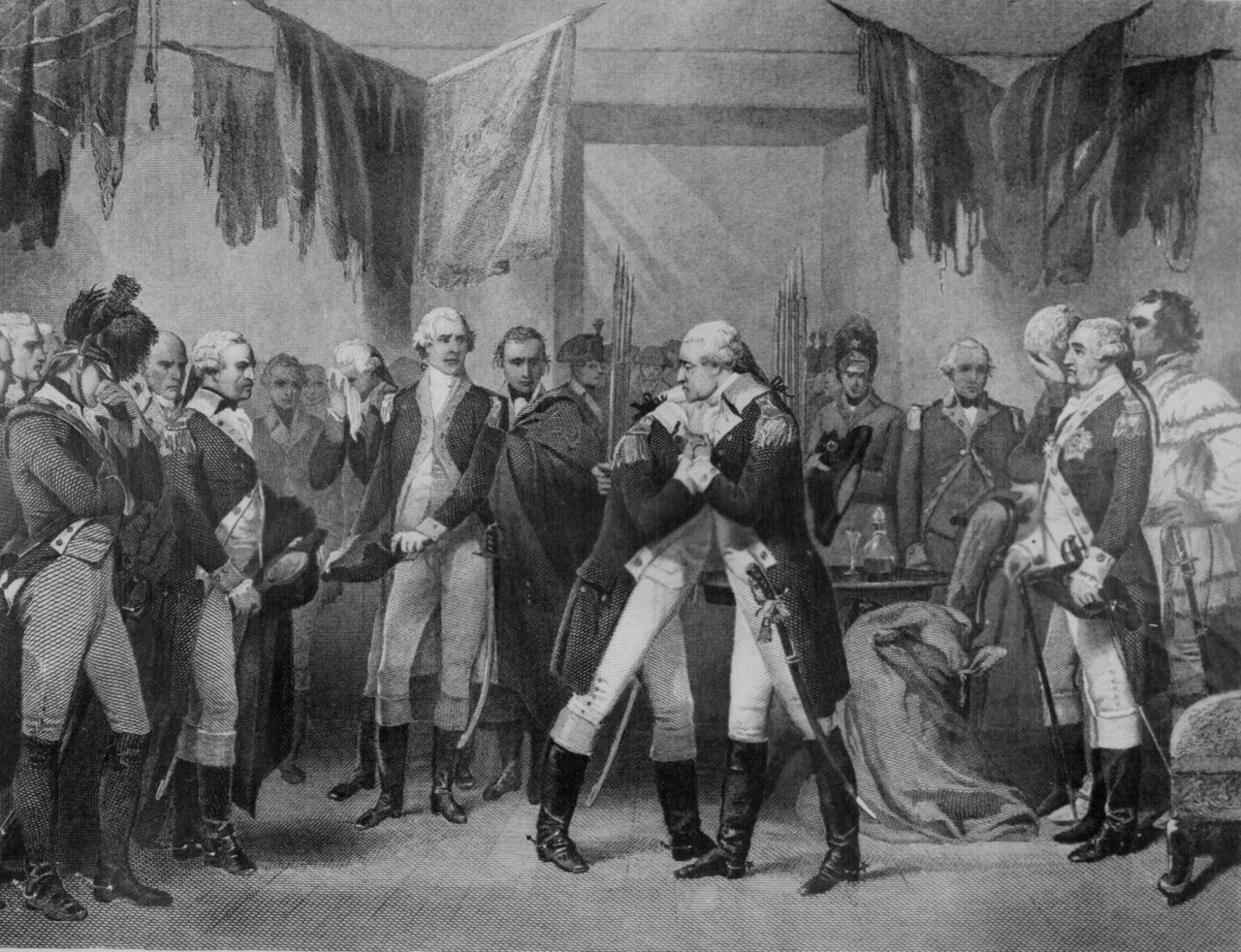
The ending belonged to Washington. On 25 November the last British troops evacuated New York City and Washington entered in triumph. On 4 December, in the Long Room of Fraunces Tavern, he took an emotional leave of his officers, filling his glass and embracing them one by one. Then, at noon on 23 December at Annapolis, he handed his commission — granted in June 1775 — back to Congress and retired, reaching Mount Vernon on Christmas Eve, his first Christmas at home in eight years. A victorious general had given power back to a civil legislature, and contemporaries reached for Cincinnatus, returning to his plough, to name what they had seen.
Timeline of 1783
- 15 March
George Washington addresses his officers at Newburgh and talks them out of a threatened revolt against Congress.
- 22 May
A London court hears the Zong case, an insurance dispute over at least 130 captive Africans thrown overboard from a slave ship.
- 4 June
The Montgolfier brothers give the first public demonstration of their hot-air balloon at Annonay, France.
- 8 June
The Laki fissure eruption begins in Iceland; its ash, famine and disease kill more than 9,000 Icelanders by common estimate.
- 24 July
Simón Bolívar, the future liberator of much of South America from Spanish rule, is born.
- 3 September
The Treaty of Paris is signed; Britain recognises the independence of the United States and the Revolutionary War formally ends.
- 15 October
Jean-François Pilâtre de Rozier makes the first human ascent in a Montgolfier hot-air balloon, rising tethered above Paris.
- 21 November
Pilâtre de Rozier and the Marquis d'Arlandes make the first untethered human flight, over Paris.
- 25 November
The last British troops evacuate New York City, and Washington enters the city in triumph — Evacuation Day.
- 4 December
Washington bids farewell to his officers at Fraunces Tavern in New York.
- 23 December
George Washington resigns his commission before Congress at Annapolis and retires to Mount Vernon.
Why 1783 still matters
1783 still matters chiefly for a refusal. Victorious generals in the eighteenth century were expected to keep power; Washington surrendered his twice over — first persuading his own officers not to coerce Congress at Newburgh, then handing his commission back at Annapolis. That double restraint fixed civil supremacy as the American republic's founding precedent, the standard against which every later transfer of power is measured.
The Treaty of Paris mattered just as durably on paper: it did not merely end a war but defined a country, naming the thirteen states as sovereign and drawing boundaries to the Mississippi that doubled the republic's claimed map. The arguments it left unfinished — debts, loyalists, fisheries, borders — became the agenda of the young nation's first diplomacy.
And the balloons were more than spectacle. Within a single season, flight went from a provincial demonstration at Annonay to a tethered ascent and then a free flight over the capital of Europe. Human beings had left the ground by design, in the same year that an empire formally let go of its colonies and a volcano in Iceland dimmed harvests across the northern hemisphere — a year in which the old world's certainties rose, fell and drifted at once.
1783 on The History Trail
Peace signed, balloons rising and a sword returned — 1783 day by day.
- September 3 in History — The Treaty of Paris is signed, recognising American independence.
- December 4 in History — Washington bids farewell to his officers at Fraunces Tavern.
- December 23 in History — George Washington resigns his commission at Annapolis.
- Treaty of Paris (1783) — The peace that recognised the United States as free, sovereign and independent.
- November 25 in History — The last British troops evacuate New York City.
- November 21 in History — The first untethered human flight crosses Paris by balloon.
Sources
- Encyclopaedia Britannica — On This Day: September 3
- HISTORY — This Day in History: September 3
- HISTORY — George Washington bids farewell to his officers
- George Washington's Mount Vernon — Resignation of Military Commission
- Encyclopaedia Britannica — On This Day: November 21
- Encyclopaedia Britannica — On This Day: June 8
The facts on this page were checked against these sources on 19 November 2026. The History Trail's permanent pages are researched and written for this site; the live profiles elsewhere on The History Trail are assembled automatically from Wikipedia and Wikidata.
About the Author
Researched and written by the The History Trail Editorial Team — the accountable editorial function behind this site's permanent story pages. The team works from the published sources cited on each page; it does not invent historians, reviewers or credentials, and it corrects errors openly.
Fact Check
Every load-bearing fact on this page traces to one of the sources listed above, and significant claims link to their source in the text. Our checking method is described on the methodology page; errors can be reported via the corrections page.
Sources & Citations
Cite this page as: The History Trail Editorial Team, The History Trail — this article's title, publication and update dates are shown beneath its headline. The full source list appears under Sources above; the site's source standards are on the sources page.