
Things
Treaty of Paris (1783)
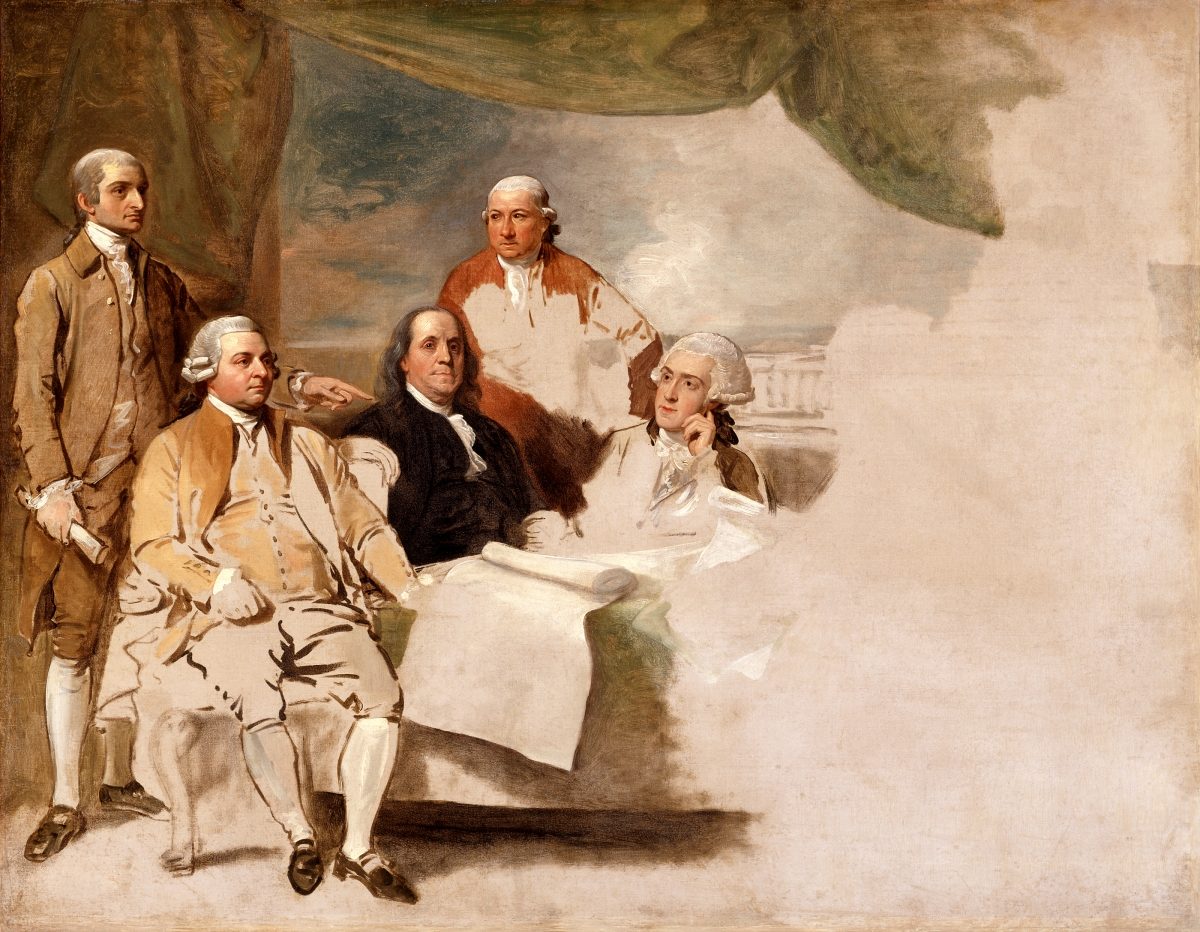
The Treaty of Paris, signed on 3 September 1783, was the peace treaty in which Great Britain formally recognised the United States as free, sovereign and independent, ending the American Revolutionary War. Negotiated by John Adams, Benjamin Franklin and John Jay against Britain's David Hartley, it also fixed the new nation's boundaries as far west as the Mississippi River and settled fishing rights, pre-war debts and the claims of American Loyalists.
At a Glance
- Signed
- 3 September 1783, at Paris; David Hartley signed for Great Britain and John Adams, Benjamin Franklin and John Jay for the United States
- What it ended
- The American Revolutionary War (1775-1783), a conflict that also drew in France, Spain and the Netherlands against Britain
- Article 1
- Britain acknowledged the thirteen named states to be free, sovereign and independent, and relinquished all claims to their government and territory
- Boundaries
- British North America to the north, the Mississippi River to the west and the northern border of Florida, at the 31st parallel, to the south
- Other terms
- American fishing rights on the Grand Banks and in the Gulf of St Lawrence; pre-war debts to be honoured; Congress to recommend restitution for Loyalists
- Ratified
- By the Congress of the Confederation at Annapolis on 14 January 1784; ratifications were exchanged at Paris on 12 May 1784
- Still in force
- Only Article 1, the recognition of the United States as free, sovereign and independent, remains in force; later treaties superseded the rest
Introduction
The United States declared independence in 1776, but a declaration is not a recognition. For seven years the thirteen states fought to make the claim real, and for most of that time the war was not theirs alone: France allied with them in 1778, Spain entered the war in 1779, and the Dutch Republic was also drawn in, making the American War of Independence, in the National Archives' words, a world conflict fought against the largest and most established powers on earth.
The Treaty of Paris closed that conflict. It is the document in which the British Crown itself, in the treaty's first article, acknowledged the thirteen states - named one by one, from New Hampshire to Georgia - to be free, sovereign and independent, and relinquished every claim to their government, propriety and territorial rights. Everything else in the treaty, from boundaries to fish, follows from that single admission.
From War to Negotiation
By 1782 Britain was ready to talk. The Office of the Historian records that Benjamin Franklin rejected informal British overtures offering the states some measure of autonomy within the empire: he insisted on recognition of independence, and refused to consider a peace separate from France, America's ally. Formal negotiations opened in Paris on 27 September 1782, with Franklin joined by John Adams and John Jay as peace commissioners.
Franklin demanded, among other things, the cession of Canada; the British government of Lord Shelburne would not accept it, and Canada stayed British. But after two months of hard bargaining the preliminary articles signed on 30 November 1782 gave the Americans most of what they needed: independence and boundaries accepted, fishing rights on the Newfoundland banks settled, pre-war debts addressed, restitution promised for Loyalist property, and British forces to evacuate. Those articles took effect only once Britain and France also agreed terms, which they did in preliminary form on 20 January 1783. The definitive treaty, signed the following September, carried the preliminary terms into final form.
The Terms: Independence, Boundaries and Fish
The treaty has ten articles. Article 2 drew the map: from the St Croix River and the highlands dividing the St Lawrence watershed from the Atlantic, along the 45th parallel and through the Great Lakes to the Lake of the Woods, then to and down the Mississippi, which became the western boundary, and south to the 31st parallel. The United States emerged roughly doubled, holding everything east of the Mississippi, north of Florida and south of Canada. Article 3 preserved American rights to take fish on the Grand Banks, on the other banks of Newfoundland and in the Gulf of St Lawrence, and to dry and cure fish on unsettled coasts of Nova Scotia, the Magdalen Islands and Labrador.
The remaining articles dealt with the war's wreckage. Creditors on both sides were to meet no lawful impediment in recovering bona fide debts. Congress would earnestly recommend - the treaty could promise no more - that the states restore confiscated Loyalist property, and no further confiscations were to be made. Prisoners were to be released, British forces withdrawn without carrying away American property, and navigation of the Mississippi was to remain forever free and open to both British subjects and American citizens.
Timeline
- 4 July 1776
The Continental Congress approves the Declaration of Independence; Britain does not recognise it, and the war continues.
- 6 February 1778
France signs treaties of alliance and of amity and commerce with the United States, formally recognising American independence.
- 19 October 1781
Lord Cornwallis surrenders to George Washington at Yorktown, the defeat that pushes Britain toward peace negotiations.
- 27 September 1782
Formal peace negotiations open in Paris, with Franklin, Adams and Jay as the American commissioners.
- 30 November 1782
Britain and the United States sign preliminary articles of peace accepting American independence and boundaries.
- 20 January 1783
France signs preliminary articles of peace with Great Britain, allowing the Anglo-American articles to take effect.
- 3 September 1783
The definitive Treaty of Paris is signed by David Hartley for Britain and by Adams, Franklin and Jay for the United States; Britain signs separate treaties with France and Spain the same day.
- 14 January 1784
The Congress of the Confederation ratifies the treaty at Annapolis, Maryland, inside the six-month deadline.
- 12 May 1784
British and American ratifications are exchanged at Paris; the treaty takes full effect.
- 1794
The Jay Treaty addresses the treaty's unfinished business, including British-held frontier forts and debts, after a decade of friction.
Significance
The treaty's significance begins with its first article: the former imperial power recognised its former colonies as a sovereign state, and that recognition, unlike the boundaries and fishery clauses, has never been superseded - it is the one article that remains in force today. The treaty also placed the United States on the map of international diplomacy for the first time as a negotiating equal, and, as the National Archives notes, its three negotiators achieved many of the objectives the new nation sought.
Its boundaries mattered just as much. By carrying American territory to the Mississippi, the treaty set the stage for a continental republic - and for conflicts the peacemakers did not settle, above all with the Native American nations who actually lived in much of the ceded land and were not parties to the treaty at all.
Myths and disputes
Was this the only Treaty of Paris? Far from it: Paris has given its name to dozens of treaties, including the 1763 treaty that ended the Seven Years' War, and the 1783 settlement itself was a bundle. Strictly, the Anglo-American document is one part of the Peace of Paris, alongside Britain's separate 1783 treaties with France, Spain and, provisionally, the Netherlands. Spain recovered East and West Florida under its own treaty - without a clearly fixed northern boundary, which produced a territorial dispute with the United States that lasted until the Treaty of Madrid in 1795.
Was the treaty honoured? Only in part, and this page flags the gap plainly. The Loyalist clause obliged Congress merely to recommend restitution, and individual states largely ignored the recommendation and the ban on further confiscations. Britain, citing those failures and unpaid debts, kept its troops in frontier forts on American soil for more than a decade, and Spain used its control of Florida to obstruct the American navigation of the Mississippi that Article 8 guaranteed. The Jay Treaty of 1794 was needed to clear much of the backlog. Even the text is sometimes misread: the National Archives notes that some online transcriptions omit Delaware from the list of states, but the original lists it.
Legacy
The treaty's most durable legacy is the country it recognised. The original documents survive in the National Archives, which holds two of at least three signed originals - on one the signatures and wax seals run horizontally, on the other vertically - with David Hartley's signature facing those of Adams, Franklin and Jay, signed in alphabetical order.
Benjamin West's unfinished group portrait became the settlement's visual emblem: the American commissioners painted, the British half of the canvas left blank because their negotiators would not sit. It is a fitting image for a treaty that settled the great question of independence completely, and left almost everything else - debts, forts, Loyalists, Florida, the Mississippi - to be argued over for another generation.
Sources
- National Archives - Treaty of Paris (1783)
- Office of the Historian, US Department of State - Treaty of Paris, 1783
- Yale Law School, Avalon Project - The Paris Peace Treaty of September 3, 1783
- Encyclopaedia Britannica - Peace of Paris
- World History Encyclopedia - Treaty of Paris of 1783
The facts on this page were checked against these sources on 19 November 2026. The History Trail's permanent pages are researched and written for this site; the live profiles elsewhere on The History Trail are assembled automatically from Wikipedia and Wikidata.
About the Author
Researched and written by the The History Trail Editorial Team — the accountable editorial function behind this site's permanent story pages. The team works from the published sources cited on each page; it does not invent historians, reviewers or credentials, and it corrects errors openly.
Fact Check
Every load-bearing fact on this page traces to one of the sources listed above, and significant claims link to their source in the text. Our checking method is described on the methodology page; errors can be reported via the corrections page.
Sources & Citations
Cite this page as: The History Trail Editorial Team, The History Trail — this article's title, publication and update dates are shown beneath its headline. The full source list appears under Sources above; the site's source standards are on the sources page.