
On This Day
December 23 in History
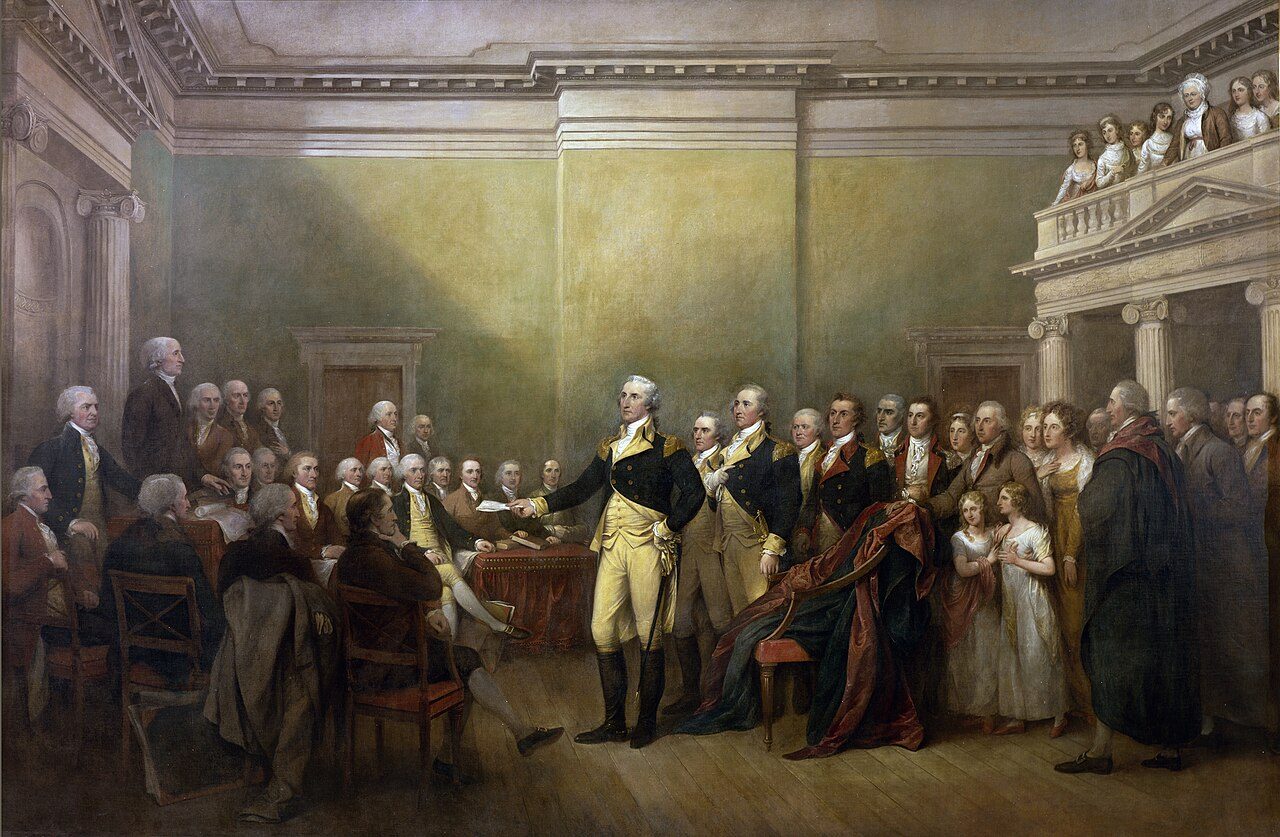
On 23 December 1783, in the Maryland State House at Annapolis, George Washington resigned his commission as commander-in-chief of the Continental Army and rode home to Mount Vernon a private citizen — the voluntary surrender of power that taught the young United States what a republic was. December 23 is also the day the Federal Reserve was created, Vincent van Gogh's ear incident shook Arles, and the crew of USS Pueblo came home from North Korea.
Choose another date: open the On This Day calendar to browse events, births and deaths for any day of the year.
At a Glance
- The setting
- The Senate chamber of the Maryland State House, Annapolis, where the Confederation Congress was sitting, at noon on 23 December 1783
- The act
- Washington handed his commission — granted in June 1775 — and a copy of his address to Thomas Mifflin, president of Congress
- His words
- 'I here offer my Commission, and take my leave of all the employments of public life'
- The journey home
- Washington rode out the same day and reached Mount Vernon on Christmas Eve, his first Christmas at home in eight years
- The precedent
- A victorious general giving power back to a civil legislature — the act contemporaries compared to Cincinnatus returning to his plough
Events on this day
- 1620One week after the Mayflower anchors at Plymouth, construction begins on the first permanent European settlement in New England.
- 1783George Washington resigns as commander-in-chief of the Continental Army before Congress at Annapolis and retires to Mount Vernon — the featured story above.
- 1823'A Visit from St. Nicholas', the poem that fixed the modern image of Santa Claus, is published anonymously in the Troy Sentinel newspaper in New York.
- 1888In Arles, France, Vincent van Gogh, after a furious argument with Paul Gauguin, cuts off part of his own left ear — the crisis that ends their partnership in the Yellow House.
- 1913President Woodrow Wilson signs the Federal Reserve Act, creating the Federal Reserve System as the central bank of the United States.
- 1941Wake Island falls to Japanese forces after a celebrated two-week defence by U.S. Marines, sailors and civilian contractors.
- 1944General Dwight Eisenhower confirms the death sentence of Private Eddie Slovik for desertion — the only American soldier executed for desertion in the Second World War.
- 1968North Korea releases the 82 surviving crewmen of the intelligence ship USS Pueblo, held captive for eleven months after the ship's seizure.
- 1972Franco Harris's 'Immaculate Reception' gives the Pittsburgh Steelers a last-seconds playoff win over the Oakland Raiders, one of the most famous plays in American football.
- 1986Dick Rutan and Jeana Yeager land the experimental aircraft Voyager in California, completing the first nonstop, unrefuelled flight around the world.
Born on this day
- 1805Joseph Smith — American religious leader, founder of the Latter Day Saint movement.
- 1867Madam C. J. Walker — American entrepreneur and philanthropist, born Sarah Breedlove, who built a hair-care empire and became a self-made millionaire.
- 1918Helmut Schmidt — West German chancellor from 1974 to 1982, and afterwards elder statesman of the republic.
- 1929Chet Baker — American jazz trumpeter and singer, the defining voice of West Coast cool jazz.
- 1933Akihito — emperor of Japan from 1989 to 2019, the first Japanese emperor to abdicate in more than two centuries.
Died on this day
- 1948Hideki Tojo — Japanese general and wartime prime minister, hanged in Tokyo after conviction by the International Military Tribunal for the Far East.
- 1953Lavrentiy Beria — Stalin's secret-police chief, executed in Moscow months after his arrest following Stalin's death.
- 2007Oscar Peterson — Canadian jazz pianist whose speed and swing made him one of the most recorded musicians in jazz.
- 2024Shyam Benegal — Indian director, a founder of the parallel cinema movement, dead in Mumbai at 90.
The featured story: Washington resigns his commission, 23 December 1783
By December 1783 the war was won and formally over: the Treaty of Paris had been signed in September, and the last British troops had evacuated New York on 25 November. Washington had said farewell to his officers at Fraunces Tavern and now travelled south to Annapolis, where Congress sat. Congress staged the occasion to emphasise that the general stood below the civil power: when Washington rose to speak, and when he retired, he was to bow, and Congress would answer only by uncovering their heads — the legislature would not rise for a soldier.
At noon on 23 December, Washington was led into the Senate chamber by the secretary of Congress, Charles Thomson, accompanied by two aides. The galleries held spectators, many of them women — unusual for the chamber. His address was short and, by all accounts, delivered with visible emotion. 'Having now finished the work assigned me,' he concluded, 'I retire from the great theatre of action; and bidding an affectionate farewell to this august body under whose orders I have so long acted, I here offer my Commission, and take my leave of all the employments of public life.' He handed the commission itself, the document of June 1775, to President Thomas Mifflin.
The significance was not lost on anyone present. Victorious generals in the eighteenth century were expected to convert armies into thrones — Cromwell was the standing warning, and some of Washington's own officers had earlier floated making him king, an idea he had rebuked with disgust. Instead the most powerful man in America publicly unmade himself, in a borrowed ceremony of bows, and rode home. King George III, told that Washington intended to resign, is said to have remarked that if he did, he would be the greatest man in the world.
Washington reached Mount Vernon on Christmas Eve, in time for his first Christmas at home in eight years. The retirement was not permanent — the Constitutional Convention and two presidential terms lay ahead — but that was the point: when he returned to public life, it would be by election and under a constitution, not by right of the sword. John Trumbull, who had served as his aide, later painted the Annapolis scene for the Capitol rotunda, judging it one of the highest moral lessons ever given to the world.
Why this date matters
December 23 is the year's great day of laying things down. Washington hands back an army; a crew of prisoners is handed back across a bridge at Panmunjom; a poem hands Christmas over to a jolly elf; and even its darker entries are surrenders — an artist's breakdown in Arles, a deserter's sentence confirmed, a war criminal on the gallows in Tokyo. Two days before the festival of peace, it is the date on which power, weapons and grudges are most often set aside — sometimes by choice, as at Annapolis, which is why that choice still shines.
Sources
- Encyclopaedia Britannica — On This Day: December 23
- HISTORY — What Happened on December 23
- George Washington's Mount Vernon — Resignation of Military Commission
- U.S. House of Representatives: History, Art & Archives — General George Washington Resigned his Commission in Annapolis, Maryland
The facts on this page were checked against these sources on 19 November 2026. The History Trail's permanent pages are researched and written for this site; the live profiles elsewhere on The History Trail are assembled automatically from Wikipedia and Wikidata.
About the Author
Researched and written by the The History Trail Editorial Team — the accountable editorial function behind this site's permanent story pages. The team works from the published sources cited on each page; it does not invent historians, reviewers or credentials, and it corrects errors openly.
Fact Check
Every load-bearing fact on this page traces to one of the sources listed above, and significant claims link to their source in the text. Our checking method is described on the methodology page; errors can be reported via the corrections page.
Sources & Citations
Cite this page as: The History Trail Editorial Team, The History Trail — this article's title, publication and update dates are shown beneath its headline. The full source list appears under Sources above; the site's source standards are on the sources page.