
On This Day
December 4 in History
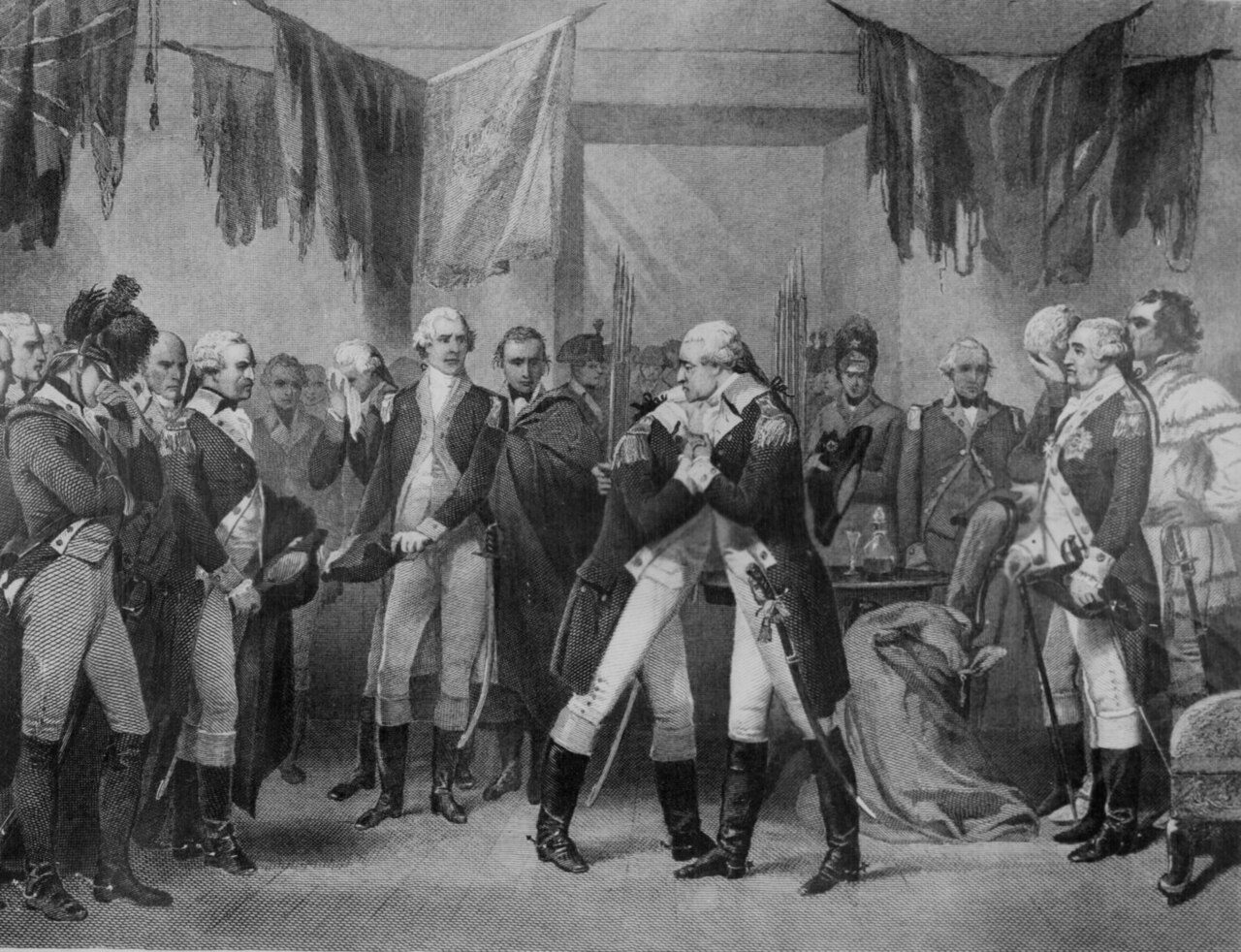
On 4 December 1783, in the Long Room of Fraunces Tavern in New York, General George Washington took leave of the officers who had won the American Revolution with him — embracing each of them in tears before riding away to surrender his commission and go home. It remains the defining image of a victorious commander voluntarily giving up power. December 4 is also the day a three-year-old Ivan the Terrible inherited Moscow, Black Panther Fred Hampton was killed in Chicago, and Led Zeppelin broke up.
Choose another date: open the On This Day calendar to browse events, births and deaths for any day of the year.
At a Glance
- The setting
- The Long Room of Fraunces Tavern, Pearl Street, New York, at noon on 4 December 1783
- The moment
- Washington fills his glass: 'With a heart full of love and gratitude, I now take leave of you' — then embraces every officer in the room
- The witness
- Colonel Benjamin Tallmadge's memoir describes the commander 'suffused in tears', grasping Henry Knox's hand first, 'incapable of utterance'
- What came next
- Washington rides to Annapolis and formally resigns his commission to Congress on 23 December 1783, reaching Mount Vernon on Christmas Eve
- Why it mattered
- A victorious general handing power back to civilians was nearly unheard of; George III is reported to have called it the act of 'the greatest character of the age'
- The place today
- Fraunces Tavern still stands at 54 Pearl Street, preserved as a museum
Events on this day
- 1533On the death of his father Vasily III, the three-year-old Ivan — the future Ivan the Terrible — is proclaimed grand prince of Moscow, with his mother Elena Glinskaya ruling as regent.
- 1783George Washington bids farewell to his officers at Fraunces Tavern in New York — the featured story above.
- 1867Oliver Hudson Kelley founds the Order of the Patrons of Husbandry — the Grange — which grows into the first powerful political movement of American farmers.
- 1909The first Grey Cup game is played in Toronto, deciding Canadian football's championship; the trophy becomes one of the oldest in North American sport.
- 1917Psychiatrist W. H. Rivers presents his paper The Repression of War Experience, drawn from treating shell-shocked officers at Craiglockhart hospital — among them the poets Siegfried Sassoon and Wilfred Owen.
- 1942In occupied Warsaw, Zofia Kossak and Wanda Filipowicz found Żegota, the Council to Aid Jews — the only organisation in German-occupied Europe created by a government-in-exile specifically to rescue Jews.
- 1969Chicago police raid a West Side apartment before dawn and kill Black Panther leaders Fred Hampton, 21, and Mark Clark, 22; ballistics later show police fired nearly a hundred shots to the Panthers' one.
- 1980Led Zeppelin announce they are disbanding, six weeks after the death of drummer John Bonham, ending the defining rock band of the 1970s.
- 1991Journalist Terry Anderson, the longest-held Western hostage in Lebanon, is freed after 2,454 days — nearly seven years — in captivity.
- 1992President George H. W. Bush orders 28,000 U.S. troops to Somalia to protect famine relief, in the mission named Operation Restore Hope.
- 1996NASA launches Mars Pathfinder, carrying the little Sojourner rover that will land on Mars the following July and return the first rover's-eye views of another planet.
- 2016A gunman who believes the false 'Pizzagate' conspiracy theory fires shots inside a Washington, D.C. pizzeria; no one is injured, and the episode becomes a landmark case study in online disinformation.
Born on this day
- 1866Wassily Kandinsky — Russian painter in Munich, among the first artists to make purely abstract paintings, and cofounder of Der Blaue Reiter.
- 1892Francisco Franco — Spanish general who won the Spanish Civil War and ruled Spain as dictator from 1939 until his death in 1975.
- 1949Jeff Bridges — American actor of The Big Lebowski and an Oscar winner for Crazy Heart.
- 1969Jay-Z — American rapper and entrepreneur, born Shawn Carter in Brooklyn, who built a business empire from a recording career.
Died on this day
- 1642Cardinal Richelieu — chief minister of France under Louis XIII, the architect of French royal absolutism and of France's rise in the Thirty Years' War.
- 1679Thomas Hobbes — English philosopher whose Leviathan founded modern political theory on the idea of a social contract, dead at 91.
- 1975Hannah Arendt — German-American political thinker, author of The Origins of Totalitarianism and Eichmann in Jerusalem.
- 1993Frank Zappa — American composer and guitarist whose work with the Mothers of Invention and solo albums redrew the borders of rock, jazz and orchestral music.
The featured story: Washington bids farewell to his officers, 4 December 1783
The war was won, and the hardest part was leaving. The Treaty of Paris had ended the American Revolution in September 1783; the last British troops had evacuated New York on 25 November; and George Washington, who had commanded the Continental Army for eight and a half years, intended to do the thing victorious generals almost never do — resign, and go home to farm. Before he could leave New York he had one duty left. At noon on 4 December 1783, the officers still in the city gathered in the Long Room of Fraunces Tavern at Pearl and Broad Streets, and Washington walked in to say goodbye.
Colonel Benjamin Tallmadge, who was there and left the fullest account, describes a room gone silent with feeling. Washington filled his glass with wine and spoke the toast that has come down with the scene: 'With a heart full of love and gratitude, I now take leave of you. I most devoutly wish that your latter days may be as prosperous and happy as your former ones have been glorious and honorable.' The officers drank. Then, Tallmadge writes, Washington said, 'I cannot come to each of you but shall feel obliged if each of you will come and take me by the hand.' Henry Knox, his chief of artillery, came first. Washington, 'suffused in tears', was incapable of speaking; he grasped Knox's hand and embraced him, and then did the same, one by one, for every officer in the room.
The emotion was earned. These were men who had survived Valley Forge, the retreats across New Jersey, Yorktown and eight years of an army that Congress could rarely pay, feed or clothe. Some in that room had earlier that year been part of the angry murmurs at Newburgh, when unpaid officers hinted the army might refuse to disband — a crisis Washington himself had faced down. Now the army was dissolving peacefully around a tavern table, and its commander was modelling the republic's central lesson in his own person: the sword answers to the civil power, and then it goes home.
Washington rode out of New York that afternoon, crossed New Jersey and reached Annapolis, where Congress sat, on 23 December he formally tendered his commission in a shaking voice — witnesses noted his hand trembled as he handed over the document he had received in 1775. He was at Mount Vernon by Christmas Eve, a private citizen for the first time in nearly nine years. He expected to stay one. Within six years the new republic would call him back — first to preside over the Constitutional Convention, then as its first president — but the authority he held in those offices rested squarely on this December day: everyone knew he had once held an army, and given it away.
Why this date matters
December 4 keeps staging the transfer — and the seizure — of power. A toddler inherits Moscow and grows into Ivan the Terrible; Franco, born this day, will take Spain by force; Hampton is killed by the state's police in his bed. Against all of them stands the tavern scene of 1783: the most powerful man in America weeping as he hands power back. The date is a small seminar on the oldest political question — what the strong do with strength when the fighting stops.
Sources
- Encyclopaedia Britannica — On This Day: December 4
- HISTORY — What Happened on December 4
- HISTORY — George Washington bids farewell to his officers
The facts on this page were checked against these sources on 19 November 2026. The History Trail's permanent pages are researched and written for this site; the live profiles elsewhere on The History Trail are assembled automatically from Wikipedia and Wikidata.
About the Author
Researched and written by the The History Trail Editorial Team — the accountable editorial function behind this site's permanent story pages. The team works from the published sources cited on each page; it does not invent historians, reviewers or credentials, and it corrects errors openly.
Fact Check
Every load-bearing fact on this page traces to one of the sources listed above, and significant claims link to their source in the text. Our checking method is described on the methodology page; errors can be reported via the corrections page.
Sources & Citations
Cite this page as: The History Trail Editorial Team, The History Trail — this article's title, publication and update dates are shown beneath its headline. The full source list appears under Sources above; the site's source standards are on the sources page.