
On This Day
January 2 in History
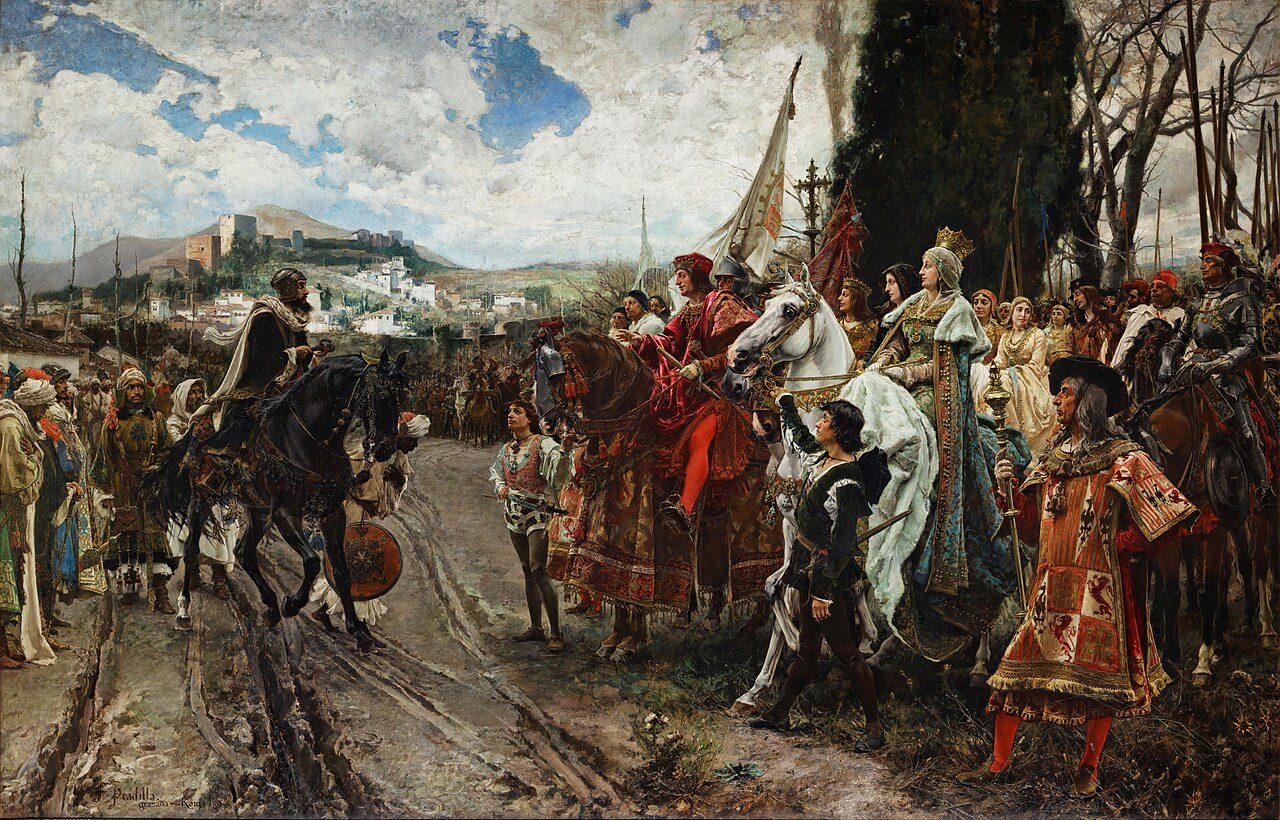
On 2 January 1492 Boabdil, the last Muslim ruler of Granada, surrendered his city and the Alhambra palace to Ferdinand of Aragon and Isabella of Castile, ending nearly eight centuries of Muslim rule in Iberia and completing the long Christian Reconquest of Spain. January 2 is also the day Georgia ratified the United States Constitution and India created its highest civilian honours.
Choose another date: open the On This Day calendar to browse events, births and deaths for any day of the year.
At a Glance
- The surrender
- On 2 January 1492 Boabdil handed Granada and the Alhambra to Ferdinand II of Aragon and Isabella I of Castile; the city was never stormed
- The war behind it
- The Granada War, February 1482 to January 1492, in which the Catholic Monarchs conquered the Nasrid emirate town by town
- The emirate
- The Nasrid Emirate of Granada, founded in 1238 by Muhammad I, was the last Muslim state in Iberia and had long survived by paying tribute to Castile
- The treaty
- The Treaty of Granada, signed on 25 November 1491, guaranteed the city's Muslims their worship, property, mosques and their own law
- The broken promise
- In 1502 the crown ordered the Muslims of Castile to convert to Christianity or leave, tearing up the treaty's guarantees
- The year it opened
- Within months came the Alhambra Decree expelling Spain's Jews (31 March 1492) and Columbus's agreement at Santa Fe, which sent him across the Atlantic
Events on this day
- 1492Boabdil, the last Nasrid emir, surrenders Granada and the Alhambra to Ferdinand and Isabella, ending Muslim rule in Iberia — the featured story above.
- 1788Georgia becomes the fourth state to ratify the United States Constitution.
- 1863The Battle of Stones River ends in Tennessee with a Union victory after three days of fighting.
- 1921A church service from Pittsburgh's Calvary Episcopal Church is broadcast by station KDKA — the first religious service carried on radio.
- 1942Japanese forces capture Manila, the capital of the Philippines, early in the Pacific War.
- 1949Luis Muñoz Marín is inaugurated as Puerto Rico's first democratically elected governor.
- 1954India establishes the Bharat Ratna and the Padma Vibhushan, among its highest civilian honours.
- 1963At Ap Bac in South Vietnam, Viet Cong forces defeat a much larger South Vietnamese force — their first major victory of the war.
- 1967Ronald Reagan is sworn in as governor of California, beginning his rise in national politics.
- 1974President Richard Nixon signs a national 55 mph speed limit into law, to save fuel during the oil embargo.
Born on this day
- 1752Philip Freneau — American poet and journalist, the 'poet of the American Revolution'.
- 1822Rudolf Clausius — German physicist who formulated the second law of thermodynamics and gave entropy its name.
- 1830Henry Flagler — American industrialist, co-founder of Standard Oil and builder of Florida's east-coast railway.
- 1884Oscar Micheaux — pioneering African American filmmaker and author.
- 1915John Hope Franklin — American historian whose From Slavery to Freedom reshaped the study of African American history.
- 1920Isaac Asimov — Russian-born American writer of the Foundation and Robot series; he celebrated 2 January as his birthday, though the exact date of his birth was never recorded.
Died on this day
- 1861Friedrich Wilhelm IV — king of Prussia whose refusal of a crown from the Frankfurt Parliament ended Germany's 1848 revolution.
- 1950Emil Jannings — German actor, winner of the first Academy Award for Best Actor.
- 1963Dick Powell — American singer and actor who reinvented himself as a hard-boiled film-noir lead.
- 1974Tex Ritter — American singing cowboy and country music star.
- 2000Patrick O'Brian — English novelist of the Aubrey–Maturin sea stories, beginning with Master and Commander.
The featured story: the fall of Granada, 2 January 1492
By the winter of 1491 the Emirate of Granada was a state waiting to end. Founded in 1238 by Muhammad I of the Nasrid dynasty, it was the last fragment of Muslim Iberia, a mountainous kingdom in the south that had survived for two and a half centuries by diplomacy, tribute payments to Castile and the shelter of its Sierra Nevada strongholds. Its capital held the Alhambra, the most beautiful palace complex in the Islamic west. But the marriage of Isabella of Castile and Ferdinand of Aragon had united Granada's two great Christian neighbours, and from February 1482 the Catholic Monarchs waged a deliberate war of conquest against it, taking its towns one by one with artillery, sieges and patience.
Granada's rulers helped destroy themselves. The emir Abu'l-Hasan Ali was challenged by his own son, Boabdil — Muhammad XII in most accounts — who rebelled, was captured by the Castilians at Lucena in 1483, and was released to fight his father and then his uncle as a Christian client. Civil war consumed the emirate's last decade. By the spring of 1491 Ferdinand and Isabella's army sat before the capital itself, building the siege town of Santa Fe in the plain below, and Granada, starving and isolated, had no ally left to call on. Boabdil opened secret negotiations, and on 25 November 1491 he signed the Treaty of Granada, surrendering the city on terms.
The terms were generous by the standards of the age. Granada's Muslims were promised their property, their mosques, their own judges and law, and freedom to practise their faith; Boabdil himself received a small lordship in the Alpujarras mountains. On the morning of 2 January 1492 Castilian troops quietly took possession of the Alhambra, and Boabdil rode out to meet Ferdinand, handing over the keys of the city — to the king, who passed them to Isabella, who passed them to the Count of Tendilla, the fortress's first Christian governor. There was no assault and no sack: eight centuries of Muslim Iberia ended in a ceremony.
The consequences ran far beyond one city. The fall of Granada completed what Spanish tradition calls the Reconquista, the Christian reconquest begun nearly eight centuries earlier, and it freed the Catholic Monarchs to reshape Spain as a single-faith state. Within three months the Alhambra Decree ordered Spain's Jews to convert or go into exile; within the year Columbus, waiting at Santa Fe during the siege, received his commission and sailed for the Atlantic. And the treaty's promises did not hold: pressure on Granada's Muslims mounted through the 1490s, revolt followed, and in 1502 the crown ordered the Muslims of Castile to choose baptism or exile — the capitulation of 1492 formally torn up.
Why this date matters
January 2 is a day of endings negotiated rather than fought to the death. Granada did not fall to a storming party; it was signed away, keys and all, and a civilisation that had lasted eight centuries closed with a ceremony. The same date brought quieter settlements: Georgia's ratification helped settle the argument over the American Constitution, India settled its gratitude into two new honours, and even the war news of the day — Stones River, Manila, Ap Bac — marked balances tipping rather than battles beginning. It is a day when history turns on signatures, surrenders and handovers: the paperwork by which one order gives way to the next.
Sources
- Encyclopaedia Britannica — On This Day: January 2
- HISTORY — What Happened on January 2
- HISTORY — Reconquest of Spain
- HISTORY — Georgia enters the Union
- Wikipedia — Granada War
The facts on this page were checked against these sources on 19 November 2026. The History Trail's permanent pages are researched and written for this site; the live profiles elsewhere on The History Trail are assembled automatically from Wikipedia and Wikidata.
About the Author
Researched and written by the The History Trail Editorial Team — the accountable editorial function behind this site's permanent story pages. The team works from the published sources cited on each page; it does not invent historians, reviewers or credentials, and it corrects errors openly.
Fact Check
Every load-bearing fact on this page traces to one of the sources listed above, and significant claims link to their source in the text. Our checking method is described on the methodology page; errors can be reported via the corrections page.
Sources & Citations
Cite this page as: The History Trail Editorial Team, The History Trail — this article's title, publication and update dates are shown beneath its headline. The full source list appears under Sources above; the site's source standards are on the sources page.