
Things
The Telephone: How the Human Voice Learned to Travel
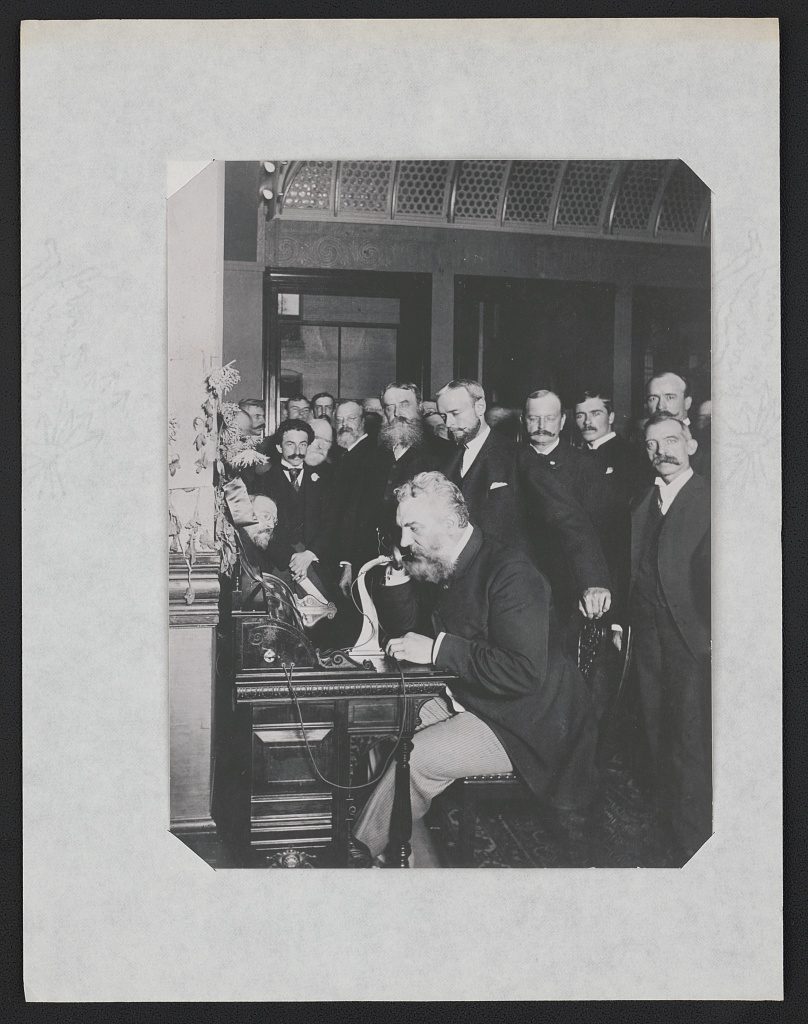
In March 1876 a Scottish-born teacher of the deaf patented a way of sending speech along a wire. Within two years the telephone had a company, an exchange and a directory — and conversation was no longer tied to a single room.
At a Glance
- Patent
- US Patent 174,465, granted 7 March 1876
- Patentee
- Alexander Graham Bell
- Assistant
- Thomas Watson
- First intelligible call
- 10 March 1876, Boston, Massachusetts
- First company
- Bell Telephone Company, formed 1877
- First exchange
- New Haven, Connecticut, 28 January 1878 — 21 subscribers
- Rival claimant
- Elisha Gray, who filed a caveat on the same day as Bell's application
'Mr Watson — Come Here': The First Call
Few inventions announce themselves in a single sentence, but the telephone nearly does. On 10 March 1876, in a Boston workshop, Alexander Graham Bell spoke into a crude transmitter and his assistant Thomas Watson, listening in another room, heard a clear instruction to come to him. It was a mundane request, yet it proved something no device had reliably done before: intelligible human speech could be converted into a varying electrical current, carried along a wire, and turned back into speech at the other end.
The telephone did not stay a workshop curiosity for long. It was demonstrated in public within months, defended in court for years, and sold as a service within two years of the patent. What began as one instrument talking to another became, step by step, a system: companies, exchanges, switchboards, directories and eventually a network that reached across a continent. This page follows that short, crowded path from experiment to infrastructure.
Bell, Sound and the Race for the Patent
Bell came to sound through teaching. His background was in hearing and speech rather than electrical engineering: he taught deaf pupils in Boston, and his father had devised a system of symbols to help deaf people learn to speak. In the early 1870s Bell was also chasing a commercial prize: a harmonic telegraph that could send several messages down one wire at once, using reeds tuned to different pitches. Experiments with those reeds, and with a device modelled on the human ear, convinced him that a membrane could follow the complex vibrations of a voice, not just single tones.
He was not working in an empty field. Antonio Meucci had built electrical voice devices in his home in the 1850s without patenting them, and in 1861 Johann Philipp Reis in Germany built instruments that could transmit tones but not the complex waveforms of speech. In the United States, Elisha Gray was pursuing speech transmission independently and had reached a similar membrane receiver. The question of 1876 was therefore not who first imagined speaking by wire, but who would file first, build a working instrument, and hold the patent when the courts had finished arguing.
Timeline
- 1861
Johann Philipp Reis builds instruments in Germany that transmit musical tones electrically, but they cannot reproduce the complex waveforms that make up speech.
- 3 June 1875
Bell and Watson test two membrane instruments built in Boston. No words get through, but speech-like sounds are heard at the receiving end.
- 14 February 1876
Bell's patent application is filed in Washington; hours later, Elisha Gray files a caveat for a similar device.
- 7 March 1876
Bell is granted US Patent 174,465 for a method of transmitting vocal sounds telegraphically — the founding patent of the telephone.
- 10 March 1876
Using a liquid transmitter, Bell speaks the first intelligible sentence by telephone to Watson in the next room.
- June 1876
The telephone is demonstrated publicly at the Centennial Exposition in Philadelphia, drawing the attention of scientists and the press.
- 9 October 1876
Bell holds a two-way outdoor test of the telephone between Boston and Cambridgeport, Massachusetts, a distance of about two miles.
- 1877
Gardiner Greene Hubbard forms the Bell Telephone Company to exploit the invention; its descendant is the telecommunications giant AT&T.
- 14 January 1878
Bell demonstrates the telephone before Queen Victoria at Osborne House on the Isle of Wight, with calls to Cowes, Southampton and London.
- 28 January 1878
The world's first commercial telephone exchange opens in New Haven, Connecticut, built by George W. Coy, with 21 subscribers paying $1.50 a month.
- 21 February 1878
The New Haven company publishes the first telephone directory: a single sheet listing its 50 subscribers.
- 7 January 1927
The first commercial transatlantic telephone service opens between New York and London, carried by long-wave radio: one circuit for the whole ocean, at $75 for the first three minutes.
Conversation Without an Operator
The telephone changed the unit of communication. The telegraph had already made messages fast, but it required operators, codes and written forms; a conversation was impossible. The telephone put an unmediated voice on the wire, so tone, hesitation and urgency travelled with the words. Businesses could negotiate in minutes rather than days, families separated by migration could hear each other, and the idea of being reachable — of a number standing for a person or a place — entered ordinary life.
Just as important was the system that grew around the instrument. An exchange turned a pair of telephones into a network in which any subscriber could, in principle, reach any other, and each new subscriber made the service more valuable to everyone already on it. That network logic, proven with Coy's hand-built switchboard in 1878, is the same logic later reused by radio, television and the internet: the device matters, but the web of connections matters more.
The Leap Across the Atlantic
One frontier took fifty years to cross. Telegraph cables had carried coded messages under the Atlantic since the 1860s, but a voice was too complex and too fragile for the cables of the day, so engineers turned to radio. In October 1915 speech was sent one-way from Arlington, Virginia, to the Eiffel Tower in Paris; in 1926 the first two-way conversation crossed the ocean. Then, on 7 January 1927, the experiment became a service: AT&T president Walter S. Gifford in New York opened the first commercial transatlantic telephone service with a call to Sir Evelyn Murray of the British General Post Office in London.
The service was a triumph with severe limits. A single radio circuit carried every call between two continents, so callers booked ahead and paid $75 for three minutes, and atmospheric static could batter a conversation mid-sentence. The limits lasted until 25 September 1956, when TAT-1, the first transatlantic telephone cable, opened between Oban in Scotland and Clarenville in Newfoundland with 36 circuits - and the telephone, eighty years after Bell's patent, finally crossed the ocean by wire.
From Bell's Patent to the Instant Voice
Bell's patent survived hundreds of legal challenges, and the company founded to exploit it grew into one of the largest corporations on earth. The deeper legacy, though, is behavioural. The telephone normalised the expectation that a voice can be summoned instantly across any distance, an expectation the mobile phone and the internet call inherited rather than invented. Every video call and voice note still runs on the principle demonstrated in 1876: vary a signal as the air varies, and speech can travel.
The priority argument has never fully closed: historians still debate Gray's caveat and Meucci's earlier devices. What is not disputed is what followed Bell's patent — a working instrument, a company, an exchange and a network, built faster than any rival managed.
Sources
- Smithsonian Institution — Alexander Graham Bell's Large Box Telephone
- Science Museum — Ahoy! Alexander Graham Bell and the first telephone call
- Encyclopaedia Britannica — Telephone: development of the telephone instrument
- National Park Service — Site of the First Telephone Exchange
- University of Connecticut Archives — The switchboard that launched the first public telephone company
- Science Museum Group Collection — Early Bell telephone used at Osborne Cottage, 1878
- Science Museum Blog (BT Archives) - Global Telephone Calls For All
The facts on this page were checked against these sources on 18 November 2026. The History Trail's permanent pages are researched and written for this site; the live profiles elsewhere on The History Trail are assembled automatically from Wikipedia and Wikidata.
About the Author
Researched and written by the The History Trail Editorial Team — the accountable editorial function behind this site's permanent story pages. The team works from the published sources cited on each page; it does not invent historians, reviewers or credentials, and it corrects errors openly.
Fact Check
Every load-bearing fact on this page traces to one of the sources listed above, and significant claims link to their source in the text. Our checking method is described on the methodology page; errors can be reported via the corrections page.
Sources & Citations
Cite this page as: The History Trail Editorial Team, The History Trail — this article's title, publication and update dates are shown beneath its headline. The full source list appears under Sources above; the site's source standards are on the sources page.