
Events
First Transatlantic Telephone Call
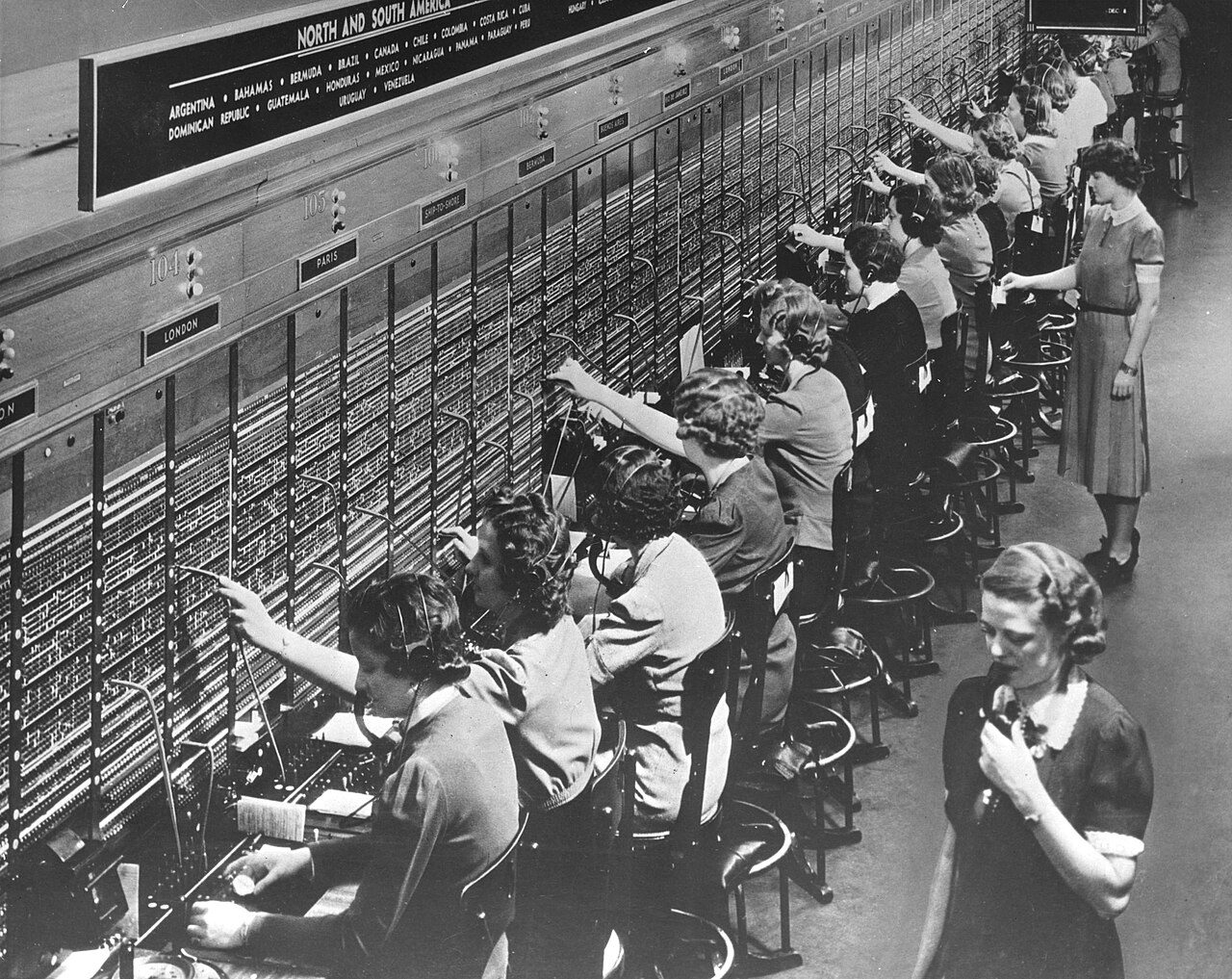
The first commercial transatlantic telephone service opened on 7 January 1927, when AT&T president Walter S. Gifford in New York spoke to Sir Evelyn Murray of the British General Post Office in London. The call crossed the ocean by radio, not cable; the whole Atlantic had a single circuit, one conversation at a time; and three minutes cost $75. Its centenary falls on 7 January 2027.
At a Glance
- Date
- 7 January 1927 (test call the day before, 6 January)
- The opening call
- Walter S. Gifford, president of AT&T, in New York, to Sir Evelyn P. Murray, secretary of the British General Post Office, in London
- How it crossed
- By long-wave radio: by wire from New York to a transmitter at Rocky Point, Long Island, then by radio to England, and by wire to London
- Capacity
- One circuit - a single conversation across the Atlantic at a time
- Price at opening
- $75 for the first three minutes, then $25 a minute, between New York and London
- First-year use
- Just over 2,300 connections in the first year, about seven a day
- The recording
- The opening conversations were recorded; the recording was named to the US National Recording Registry in 2005
Introduction
For fifty years after Alexander Graham Bell's patent of 1876, the telephone conquered continents but stopped at the ocean. Telegraph cables had crossed the Atlantic since the 1860s, carrying dots and dashes, but a human voice was a far heavier thing to send: it faded, distorted and drowned in static. The opening of a public telephone service between New York and London on 7 January 1927 was therefore a genuine threshold - the first time anyone with the money could book a call, pick up an ordinary telephone, and hold a conversation across an ocean.
It was also, by modern standards, an austere service. There was exactly one circuit. Calls were booked in advance, limited to a few minutes, and priced like luxuries, because they were: $75 bought the first three minutes, at a time when that was weeks of wages for many workers. Weather over the Atlantic could wreck a conversation mid-sentence. Yet demand was real from the first day, and the service ran for twenty-nine years until a cable finally did the job better.
Twelve Years of Almost: 1915 to 1926
The 1927 opening was the end of a long experimental road, and earlier 'firsts' need to be kept distinct from it. In October 1915, engineers using the US Navy's station at Arlington, Virginia, sent speech by radio across the Atlantic to a receiver at the Eiffel Tower in Paris. A voice had crossed the ocean - but one-way only: Paris could hear, and could reply only by telegraph. In 1916 a two-way conversation was held with a ship at sea. In 1923 a one-way transmission from AT&T president Harry Thayer in New York was heard in England.
The decisive step came in 1926, when the first two-way conversation across the Atlantic was achieved, followed by a public test of the New York-London radio-telephone service. Even that was an experiment, not a service: no member of the public could buy a call. What changed on 7 January 1927 was not the physics but the offer - a tariff, a booking system and an open door. That is why 1927, not 1915 or 1926, is the date of the first transatlantic telephone service, and why its centenary falls on 7 January 2027.
7 January 1927: The Service Opens
Engineers ran a full test conversation on 6 January 1927, beginning at 9:35 in the morning, New York time. The voices travelled by wire from New York to the radio transmitter at Rocky Point, Long Island, then by long-wave radio across some 3,000 miles of ocean to the receiving station at Rugby in England, and by wire the rest of the way to London; the return path ran from London by wire to Cupar in Scotland, by radio to Houlton, Maine, and by wire back to New York. The test recording - engineers remarking, among other things, that distance no longer meant anything - was preserved and, in 2005, named to the National Recording Registry of the Library of Congress.
The next day the service opened formally. Walter S. Gifford, president of AT&T, spoke from New York with Sir Evelyn P. Murray, secretary of the British General Post Office, which ran Britain's telephones. Gifford declared a telephonic path of speech open between the two cities, and after the ceremony the line was opened to subscribers. Contemporary newspapers reported heavy demand despite the price, and despite static on the opening day itself - a reminder that every call was at the mercy of the atmosphere.
Timeline
- October 1915
Speech is transmitted one-way by radio from Arlington, Virginia, to the Eiffel Tower in Paris - the first voice to cross the Atlantic, with replies sent by telegraph.
- 1916
The first two-way radio-telephone conversation is held with a ship at sea in the Atlantic.
- 1923
A one-way transmission by AT&T president Harry Thayer from New York is heard in England.
- 1926
The first two-way conversation across the Atlantic is achieved, and a public test of the New York-London radio-telephone service is made.
- 6 January 1927
A recorded test conversation is held over the full New York-London route, the day before the service opens.
- 7 January 1927
The first commercial transatlantic telephone service opens between New York and London, inaugurated by AT&T president Walter S. Gifford and Sir Evelyn P. Murray of the British General Post Office. Three minutes cost $75.
- 1928
Rates are cut and the service is extended beyond the two capital cities; in its first year the route carried just over 2,300 calls.
- 1935
AT&T completes the first round-the-world telephone call, routing a conversation around the globe.
- 25 September 1956
TAT-1, the first transatlantic telephone cable, opens between Oban in Scotland and Clarenville in Newfoundland, carrying 36 circuits and ending the radio era's one-call-at-a-time limit.
- 7 January 2027
Centenary of the first commercial transatlantic telephone service.
One Circuit, One Conversation
The technical heart of the service was also its bottleneck. A single long-wave radio channel carried everything, so the entire traffic between two continents took turns on one conversation. The Bell System's own technical journal recorded just over 2,300 connections in the first year - about seven calls a day. Callers booked ahead, were limited in how long they could talk, and paid a report charge if the person they wanted could not be reached. On the British side, Rugby station's history records a first-year charge of 15 pounds for three minutes.
Quality was a lottery played with the weather. Long-wave radio is battered by atmospheric conditions, and contemporary reports of the opening day complain of the worst static in weeks. None of this stopped the service growing: rates fell, more circuits were added by short-wave radio, and by the 1950s the radio system was carrying around a hundred thousand calls a year. But radio could never offer the privacy, reliability or capacity the traffic demanded. Only a cable could do that.
Significance
The significance of 7 January 1927 is that intercontinental speech became a product. Diplomacy, journalism and finance between America and Europe had run on cables written in code; from 1927 they could also run on voices, with tone and emphasis intact. The service proved a paying market existed for something engineers had treated as a stunt, and that proof justified the investment that followed - culminating on 25 September 1956, when TAT-1 opened with 36 circuits, carried 588 London-US calls in its first twenty-four hours, and doubled the traffic in its first year.
Questions readers ask
Was the 1927 call the first transatlantic telephone call? It was the first commercial one - the first any subscriber could book and pay for. Voices had crossed the Atlantic earlier, in 1915 one-way and in 1926 in a two-way experimental conversation, but those were demonstrations by engineers, not a service. Pages that call 1927 simply 'the first transatlantic call' compress that distinction away.
Why radio, and not a cable like the telegraph? A telegraph cable carries a simple on-off signal that survives a long, lossy journey under the sea. A voice signal is far more complex and far weaker, and no amplifier existed that could be sealed into a cable on the ocean floor and trusted for years. Radio avoided the ocean entirely. The flexible repeaters that finally made a telephone cable practical arrived only in the 1950s, which is why TAT-1 came twenty-nine years after the radio service.
What did $75 buy in 1927? Three minutes - and the meter ran at $25 for each additional minute. It was a business tool and a rich person's luxury, not a household service, which is why the opening mattered commercially: even at that price, the bookings came.
Legacy
Every international call made today descends from the bargain struck in 1927: that a voice crossing an ocean should be ordinary, bookable and priced by the minute. The radio circuit's limits defined the problem the cable age then solved, and TAT-1's success in 1956 began the build-out of undersea cables that now carry nearly all intercontinental traffic as light. On 7 January 2027 the service turns one hundred, in a world where a transatlantic call costs effectively nothing.
Sources
- Library of Congress - First Official Transatlantic Telephone Call (National Recording Registry essay)
- Science Museum Blog (BT Archives) - Global Telephone Calls For All
- Bell System Technical Journal - Transatlantic Telephony: Service and Operating Features (1928)
- IEEE Communications Society - First Transatlantic Phone Call
- EDN - 1st transatlantic telephone service is established, January 7, 1927
- Indianapolis Times, 7 January 1927 - contemporary report of the opening (Indiana University Library)
The facts on this page were checked against these sources on 19 November 2026. The History Trail's permanent pages are researched and written for this site; the live profiles elsewhere on The History Trail are assembled automatically from Wikipedia and Wikidata.
About the Author
Researched and written by the The History Trail Editorial Team — the accountable editorial function behind this site's permanent story pages. The team works from the published sources cited on each page; it does not invent historians, reviewers or credentials, and it corrects errors openly.
Fact Check
Every load-bearing fact on this page traces to one of the sources listed above, and significant claims link to their source in the text. Our checking method is described on the methodology page; errors can be reported via the corrections page.
Sources & Citations
Cite this page as: The History Trail Editorial Team, The History Trail — this article's title, publication and update dates are shown beneath its headline. The full source list appears under Sources above; the site's source standards are on the sources page.