
Trails
Connecting the World
A voice down a wire, a web of pages, music in your pocket, a game shared by cable, and finally everything in one slab of glass: how people learned to reach each other.
The trail at a glance
Every stop, in chronological order:
When Messages Outran Horses
For most of human history, a message moved at the speed of a horse, and a voice carried as far as a shout. This trail follows the machines that broke those limits one after another: the telephone, which put a voice inside a wire; the internet and the web, which put the world's documents within a click; and then a run of pocket devices — the Walkman, the Game Boy and the iPhone — that turned connection and entertainment into something you carried rather than somewhere you went.
The pattern repeats at every stop. Each technology begins as a specialist's instrument, expensive and faintly magical, and ends as an everyday habit so ordinary that children treat it as part of the furniture. The distance between people did not shrink in one leap. It shrank in five, and each of them is below.
Five Stops, in Chronological Order
- 1876
Telephone
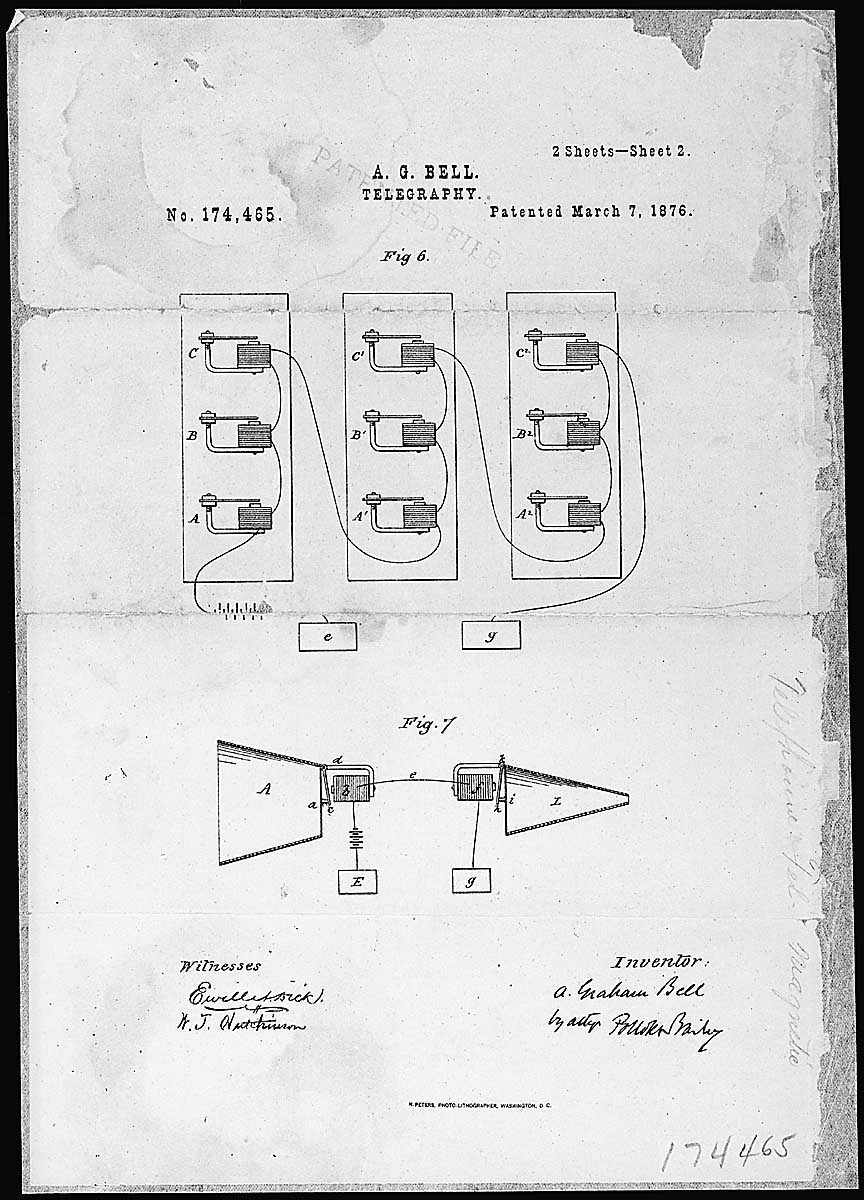
The telephone began with a patent and a summons. Alexander Graham Bell received United States patent 174,465, 'Improvement in Telegraphy', on 7 March 1876; three days later he spoke the first transmitted sentence to his assistant in another room: 'Mr Watson — come here — I want to see you.' The Smithsonian preserves his experimental telephones from that year, demonstrated at the Philadelphia Centennial Exposition. It sounds humble — one voice, one wire, one room away — but it abolished a limit as old as language: from 1876 onwards, being heard no longer required being present.
- 1979
Walkman
Connection is also about reaching your own world, anywhere. Sony's Walkman TPS-L2, launched in Japan on 1 July 1979, was a playback-only cassette player adapted from a journalists' recorder at co-founder Masaru Ibuka's request, so he could listen to stereo music while travelling. It had no speaker and, at first, two headphone sockets, so a friend could listen too. Sold for around 33,000 yen, it made recorded music private and portable for the first time. Every personal device since — including the next two stops — lives in the space the Walkman opened.
- 1989
Internet
The internet existed as a research network for years before the public could use it; what it lacked was a friendly face. That arrived at CERN, where Tim Berners-Lee proposed the World Wide Web in March 1989 to help scientists share information, and had the first web server and browser running by the end of 1990. The decisive act came on 30 April 1993, when CERN released the web royalty-free, free for anyone to build on. Pages, links and addresses turned a specialists' network into a public place — the world later stops on this trail would connect to.
- 1989
Game Boy
The Game Boy connected people sideways, through play. Nintendo launched it in Japan on 21 April 1989 with a deliberately modest monochrome screen, four AA batteries and a link cable that let two machines play each other — connection at arm's length, in the playground rather than down a wire. Bundled with Tetris in North America, it sold a million units within weeks of its American launch; its family sold 118.69 million. The Science Museum notes one even reached orbit with a Russian cosmonaut in 1993. A connection, it turned out, does not need a network — sometimes it needs a shared game.
- 2007
iPhone
The iPhone gathered every earlier stop into one object. Announced by Steve Jobs on 9 January 2007 as a phone, a widescreen iPod and an internet communicator in a single device, it replaced buttons with a multi-touch screen and put email, web browsing and maps into a pocket. On sale from 29 June 2007, it sold more than 1.4 million by November. The telephone's wire, the web's pages, the Walkman's private music and the Game Boy's games all ended up behind one sheet of glass — and connection became a default state, not an activity.
What the trail shows
Each stop on this trail removed a different kind of distance. The telephone removed the distance between voices; the web removed the distance between documents; the Walkman removed the distance between a listener and a library of music; the Game Boy removed the distance between players; and the iPhone removed the remaining distance between all of them and the person holding it. The direction of travel is consistent: from institutions to individuals, from fixed places to pockets, from appointments — a call booked, a letter awaited — to a connection that is simply always on.
It is worth noticing what did not change. Bell's first sentence was a request for someone's presence: come here, I want to see you. A century and a half of ingenious machinery has been devoted, in the end, to exactly that wish. The tools grew smaller, faster and cleverer; the reason people reach for them did not move at all.
Sources
- Smithsonian Institution — Alexander Graham Bell's Large Box Telephone
- CERN — A short history of the Web
- Apple Newsroom — Apple Reinvents the Phone with iPhone (9 January 2007)
- Science Museum Blog — Gaming tour at the Science Museum (Game Boy)
- Wikipedia — Walkman (TPS-L2 launch details)
- Wikipedia — Game Boy (launch and sales figures)
The facts on this page were checked against these sources on 18 November 2026. The History Trail's permanent pages are researched and written for this site; the live profiles elsewhere on The History Trail are assembled automatically from Wikipedia and Wikidata.
About the Author
Researched and written by the The History Trail Editorial Team — the accountable editorial function behind this site's permanent story pages. The team works from the published sources cited on each page; it does not invent historians, reviewers or credentials, and it corrects errors openly.
Fact Check
Every load-bearing fact on this page traces to one of the sources listed above, and significant claims link to their source in the text. Our checking method is described on the methodology page; errors can be reported via the corrections page.
Sources & Citations
Cite this page as: The History Trail Editorial Team, The History Trail — this article's title, publication and update dates are shown beneath its headline. The full source list appears under Sources above; the site's source standards are on the sources page.