
Things
Platinum
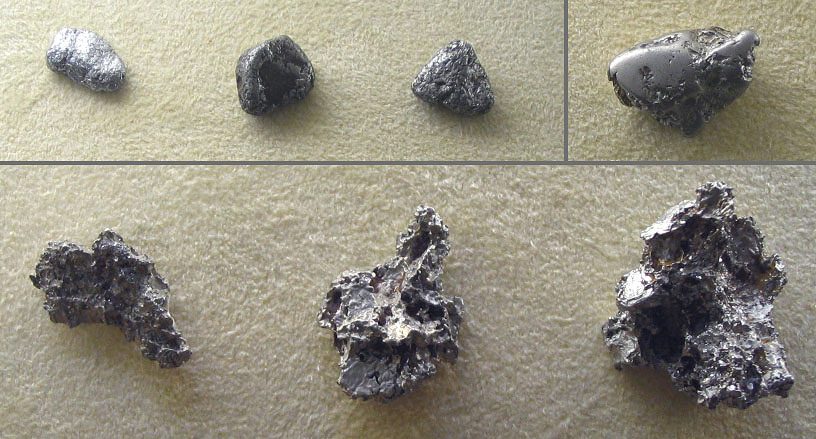
Platinum was worked in Ecuador more than a thousand years before Europe recognised it: the La Tolita smiths sintered its grains with gold because no furnace could melt it. Spanish miners later named it platina, little silver, and threw it aside; science claimed it only from 1748, and catalysis made it essential.
At a Glance
- First worked
- By the La Tolita culture of coastal Ecuador (about 590 BC - AD 350), who sintered platinum grains with gold at least 1,400 years before Europe worked it
- The name
- Platina, Spanish for 'little silver' - a dismissive miners' name for the unmeltable grains found in South American gold rivers
- European description
- Antonio de Ulloa's published account of 1748 is generally credited as the first description of platina in Europe
- Recognition
- Wood, Brownrigg and Watson brought it to the Royal Society by 1750; Scheffer argued in 1751 that it was a distinct precious metal
- Why it resisted
- Platinum's melting point lay beyond pre-industrial furnaces - La Tolita smiths worked around it by sintering, never melting it
- Modern role
- Catalysis: vehicle exhaust catalysts from the 1970s, plus refining, chemical manufacture, medicine and electronics
Introduction
Platinum's history runs backwards. Most metals were named, prized and only later understood; platinum was worked brilliantly by people who left no written account of it, thrown away as rubbish by miners who did write, and recognised as an element only in the eighteenth century - the last of the great noble metals to be understood, because it would not melt in any furnace Europe possessed.
This page follows the documented record: the pre-Columbian smiths of Ecuador who sintered platinum a millennium and a half before Europe could work it, the Spanish miners who named it platina - little silver - as an insult, the slow scientific recognition from 1748 and 1750, and the catalytic career that finally made the stubborn metal indispensable.
Ecuador: Platinum Worked Before Europe Knew It
The La Tolita culture of the Tumaco-Esmeraldas coast, in present-day northern Ecuador and southern Colombia (about 590 BC to AD 350 in one dating), produced the earliest sophisticated platinum work known. A metallurgical study by British Museum researchers of a La Tolita gold mask and pendant, published in Archaeometry, found a plating layer of platinum grains sintered with a gold-silver alloy, bonded onto gold sheet by hammering and heating. Sintering - fusing grains below the metal's melting point - was the key invention: platinum melts at a temperature no pre-industrial furnace could reach, so La Tolita smiths hammered single nuggets to shape, sintered fine alluvial platinum grains with a little gold into workable metal, and plated gold with platinum foil to set the prized white metal against yellow gold.
Cambridge-published research on La Tolita platinum-gold alloys confirms the method from the objects' microstructures: the smiths used gold to sinter together nuggets of native placer platinum, then alternately worked and annealed the result into adornments and small tools such as needles, tweezers and fishhooks, probably never heating the metal as high as 1100 degrees Celsius and never melting it at all. Platinum technology on this coast, the Archaeometry authors note, was in use at least 1,400 years before Europeans worked the metal.
Platina: The Metal Europe Threw Away
Europe met platinum as contamination. Spanish miners panning the gold rivers of the Choco region, in present-day Colombia, kept finding dense grey grains among the gold that would not melt or amalgamate, and dismissed them as platina del Pinto - little silver of the Pinto River, platina being a diminutive of plata, silver. The first European reference is usually given to Julius Caesar Scaliger in 1557, describing a metal between Darien and Mexico that no fire or Spanish artifice could liquefy. For two centuries the grains were a nuisance, at worst a fraud risk, since platina could be mixed into gold undetected by weight alone.
The turn came through science, not mining. Spanish naval officer Antonio de Ulloa, who had travelled to South America with a French geodesic expedition in the 1730s, published the first description of platina to appear in Europe in his Relacion historica del viaje a la America Meridional in 1748. Independently, Charles Wood brought specimens from Spanish America to England, and William Brownrigg presented them to the Royal Society; William Watson's papers of 1750 gave English science its first substantial account of the new semi-metal. Swedish chemist Henrik Scheffer showed in 1751 that platinum could be fused with arsenic and argued it was a distinct precious metal - the beginning of its recognition as an element in its own right rather than a defective silver or gold.
Recognition and the Long Road to Use
Recognition was not the same as usefulness. Through the later eighteenth century chemists including Torbern Bergman studied platinum's resistance to acids and heat, and Francois Chabaneau, working in Spain in the 1780s, produced malleable platinum in quantity. In the early 1800s William Hyde Wollaston developed a workable powder-metallurgy process in secret and, with Smithson Tennant, used crude platinum to identify new elements within it - palladium, rhodium, iridium and osmium - revealing that the nuisance grains were a whole family of metals. Percival Johnson later industrialised Wollaston's methods, founding the line that became Johnson Matthey, for a century the world's major supplier of platinum-group metals.
What finally made platinum matter was a property the Ecuadorian smiths never needed: catalysis. Platinum surfaces speed chemical reactions without being consumed, a power demonstrated in the 1820s when platinum sponge was shown to ignite hydrogen in air. Platinum catalysts entered petroleum refining and chemical manufacture in the twentieth century, and from the 1970s, under clean-air law in the United States, platinum-group catalysts in vehicle exhausts - commercialised at scale by Johnson Matthey from 1974 - became the metal's defining modern use, alongside laboratory crucibles, thermocouples, medical and electronic applications. The metal that would not melt turned out to be the metal that makes other things react.
Timeline
- About 590 BC - AD 350
The La Tolita culture of coastal Ecuador works platinum by sintering - the earliest sophisticated platinum technology known.
- 1557
Julius Caesar Scaliger gives the first European reference, to a metal in Central American mines that no fire could melt.
- 1730s-1748
Antonio de Ulloa encounters platina in South America and publishes Europe's first description of it in 1748.
- 1741-1750
Charles Wood brings specimens to England; William Brownrigg presents them, and William Watson's 1750 Royal Society papers introduce platina to English science.
- 1751
Henrik Scheffer fuses platinum with arsenic and argues it is a distinct precious metal - a step toward recognition as an element.
- 1780s
Francois Chabaneau in Spain produces malleable platinum in significant quantity.
- 1803-1804
Wollaston and Tennant, working crude platinum, identify palladium, rhodium, iridium and osmium within it.
- 1820s
Platinum sponge is shown to ignite hydrogen in air - an early, dramatic demonstration of platinum catalysis.
- 1974
Johnson Matthey opens production plants for vehicle exhaust catalysts; catalytic converters become platinum's defining modern use.
- Today
Platinum's main roles are catalytic - in vehicles and industry - with further uses in medicine, electronics and jewellery.
Significance
Platinum's significance is what it reveals about knowledge itself. The technically hardest metalworking of the ancient world - sintering a metal that cannot be melted - was achieved by an unwritten tradition in Ecuador and then lost to European view for centuries, while literate Europe, meeting the same metal, named it little silver and threw it back in the river. Platinum was not discovered once; it was solved twice, independently, and the second solution took chemistry a hundred years. Its modern career completes the reversal: the properties that made it useless to miners - unmeltable, unreactive, incorruptible - are precisely what make it valuable as a catalyst and laboratory metal.
Questions readers ask
Who discovered platinum? No single answer survives scrutiny, and this page does not give one. La Tolita smiths worked it first, more than a thousand years before Europeans; Scaliger mentioned it in print in 1557; Ulloa is generally credited with the first European description, published in 1748; Wood, Brownrigg and Watson brought it to the Royal Society by 1750; Scheffer advanced its claim to be a distinct metal in 1751. Johnson Matthey's own historical review notes the discovery date has often been debated and that current opinion favours Ulloa's claim over Wood's - while both men were describing what South American peoples already knew.
Why is it called platinum? From platina, Spanish for little silver - a dismissive name from miners who found the grains among gold in rivers such as the Pinto and could do nothing with them. The insult stuck, was Latinised, and became the name of element 78.
Legacy
Platinum's legacy sits in three places: in museum cases, where La Tolita masks still show white platinum set against gold by smiths who never melted either problem away; in the periodic table, where it arrived late and brought four sibling elements with it; and under almost every petrol and diesel vehicle on the road, where a few grams of the metal quietly clean the exhaust. Few materials have been valued, discarded, and valued again so completely - or for such different reasons each time.
Sources
- Johnson Matthey Technology Review - Platinum in the Eighteenth Century
- Johnson Matthey Technology Review - The First Experiments on Platinum: Charles Wood's Samples from Spanish America
- Archaeometry (British Museum researchers) - The Technology of Early Platinum Plating: A Gold Mask of the La Tolita Culture, Ecuador
- Cambridge University Press, MRS Proceedings - Fabrication of Platinum-Gold Alloys in Pre-Hispanic South America
- EBSCO Research Starters - Wollaston's Work on Metallurgy
The facts on this page were checked against these sources on 19 November 2026. The History Trail's permanent pages are researched and written for this site; the live profiles elsewhere on The History Trail are assembled automatically from Wikipedia and Wikidata.
About the Author
Researched and written by the The History Trail Editorial Team — the accountable editorial function behind this site's permanent story pages. The team works from the published sources cited on each page; it does not invent historians, reviewers or credentials, and it corrects errors openly.
Fact Check
Every load-bearing fact on this page traces to one of the sources listed above, and significant claims link to their source in the text. Our checking method is described on the methodology page; errors can be reported via the corrections page.
Sources & Citations
Cite this page as: The History Trail Editorial Team, The History Trail — this article's title, publication and update dates are shown beneath its headline. The full source list appears under Sources above; the site's source standards are on the sources page.