
Things
Silver
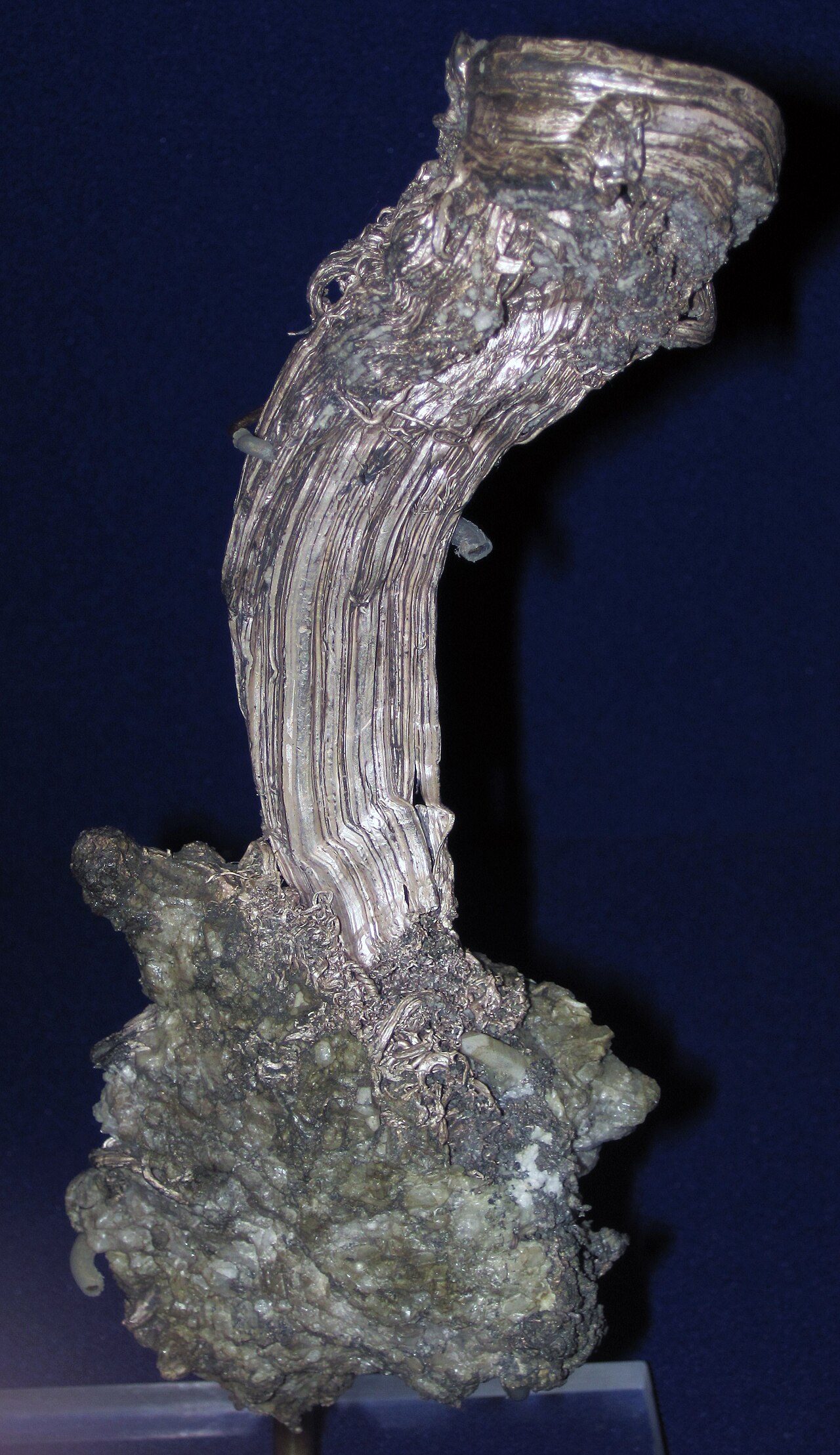
Silver, element Ag, was the world's working money for some five thousand years. Mined at Laurion it underwrote Athens' rise; mined at Potosi from 1545 it became the piece of eight, a coin trusted on every continent; and when governments demonetised it between 1873 and 1935, silver reinvented itself as the light-sensitive heart of photography and a modern industrial metal.
At a Glance
- What it is
- A metallic element, symbol Ag (from Latin argentum), atomic number 47; soft, white and lustrous, the best electrical conductor of all metals
- Known since
- About 4000 BCE, according to Britannica; separated from lead ores in Anatolia and the Aegean by the fourth millennium BCE
- Laurion
- The silver-lead mines of Attica, actively worked c. 500 BCE-100 CE, funded Athens' mint and - by tradition - its trireme fleet
- Potosi
- Cerro Rico, Bolivia, worked from 1545 under Spanish rule on coerced Indigenous labour; with Mexico it made Spanish America the world's silver source
- The world coin
- The Spanish dollar or piece of eight - about 27 grams of silver - trusted from Europe to China and legal tender in the US until 1857
- Photography
- Silver halide crystals made photography work, from the 1839 daguerreotype (silver iodide on silvered copper) to film emulsions
- Demonetisation
- Germany and the US turned from silver in 1873; China, the last holdout, left the silver standard in 1935; the US removed silver from dimes and quarters in 1965
Introduction
Silver is the money metal of most of recorded history. Gold was for kings and temples; silver was for paying soldiers, settling markets and buying bread. It is a soft, white, lustrous metal - element 47, symbol Ag from the Latin argentum - known since antiquity, separated from lead ores as early as the fourth millennium BCE, and turned into coinage by civilisation after civilisation. Britannica dates its discovery, after gold and copper, to about 4000 BCE, when it was used in jewellery and as a medium of exchange.
Because silver was money, its mines were strategic assets and its flows redrew maps. Silver from one Greek mining district helped make Athens a naval power. Silver from one Andean mountain, coined into pieces of eight, became the first world currency, accepted from Seville to Canton. And when, in the nineteenth century, the world's governments walked away from silver money, the metal found a second career recording light itself - in the silver chemistry of photography - before settling into its modern industrial life.
Laurion and the Owls of Athens
The best-known ancient silver mines were at Laurion, in Attica, southeast of Athens. Britannica records that the Laurium silver-lead deposit was actively mined from about 500 BCE to 100 CE, though the workings were far older. The ore was argentiferous lead: silver extracted by smelting and cupellation from galena dug by enslaved labour in a dense warren of shafts and galleries - more than 2,000 ancient shafts have been found in the district. Athens leased the mines and took the revenue; the metal fed the mint that struck the city's famous tetradrachms, the owls of Athens, trusted across the Greek world.
Historians have long connected Laurion's output to Athens' rise: a rich strike in the 480s BCE is traditionally said to have funded the fleet of triremes that defeated Persia at Salamis, and mining revenue underwrote the fifth-century Athenian state. That connection is an attribution made by ancient writers and modern historians alike, and the scale of the state's exact benefit is debated by scholars - but the direction of the story is not in doubt. In the ancient Mediterranean, to mine silver was quite literally to mine money, and Athens held one of the few great sources of it.
Potosi and the First World Currency
In 1545 Spanish colonisers began working the Cerro Rico, the silver mountain above Potosi in present-day Bolivia. The deposit was staggering in scale, and with Mexican mines such as Zacatecas it made Spanish America the world's great silver source: Britannica notes that these New World mines, much richer than Europe's, raised South and Central America to become the largest silver-producing region on Earth. The work rested on coerced Indigenous labour, including the mita draft, at terrible human cost - the mountain's wealth and its dead are inseparable parts of the same history.
The metal travelled in both directions around the planet. Coined at Potosi and Mexico City into Spanish dollars - pieces of eight, of roughly 27 grams of silver - it paid Spain's armies and creditors in Europe, and from 1571 the Manila galleons carried it across the Pacific to China, whose economy absorbed silver on an enormous scale and whose merchants accepted the Spanish dollar as a standard coin. The piece of eight circulated as trusted money on every continent, was legal tender in the young United States until 1857, and stood behind the very word dollar. No earlier money had ever been so nearly universal.
Timeline
- c. 4000 BCE
Silver is in use for jewellery and exchange, according to Britannica; slag heaps show it being separated from lead in Anatolia and the Aegean.
- c. 500 BCE - 100 CE
The Laurion (Laurium) silver-lead mines in Attica are actively worked, supplying Athens' coinage and revenue.
- 480s BCE
A rich Laurion strike is traditionally said to have funded Athens' trireme fleet, victorious over Persia at Salamis in 480 BCE.
- 1545
Spanish colonial mining begins at Cerro Rico above Potosi, in present-day Bolivia, relying heavily on coerced Indigenous labour.
- 1571
The founding of Spanish Manila opens the galleon route carrying American silver across the Pacific to China.
- 1839
Daguerre's daguerreotype process is published: images formed on silver-plated copper, sensitised with silver iodide.
- 1873
Germany moves to the gold standard and the United States' Coinage Act ends the standard silver dollar - the turn contemporaries' opponents called demonetisation.
- 1900
The US Gold Standard Act confirms gold as the sole standard; silver survives as token coinage.
- 1935
China, the last major economy on a silver standard, abandons it - the documented end of silver money's long reign.
- 1965
The US Coinage Act removes silver from dimes and quarters, ending silver's role in everyday American coinage.
Silver Learns to See: Photography
Silver's second act depended on a quirk: its compounds darken in light. Observers had noted as early as 1614 that sunlight blackens silver nitrate. In 1839 Louis Daguerre published the daguerreotype - a photograph on a silver-plated copper sheet, fumed with iodine to form light-sensitive silver iodide, exposed in a camera and developed with mercury vapour. Henry Fox Talbot's calotype worked on paper coated with silver salts, and the negative-positive principle behind it governed photography for the next century and a half. Film and photographic paper, into the digital age, were emulsions of silver halide crystals: light struck them, and metallic silver formed the image. For over a hundred years, photography was the largest single industrial use of silver, and the world's memory of the nineteenth and twentieth centuries is quite literally written in this metal.
Demonetisation
Silver money did not end in a day; it ended by legislation, country by country, over some sixty years. Britain had drifted onto a de facto gold standard in the eighteenth century and formalised it in 1821. The decisive turn came in the 1870s: Germany, newly unified and holding a gold indemnity from France, adopted the gold standard in 1873, and much of Europe followed. The same year, the United States' Coinage Act omitted the standard silver dollar - a change silver's supporters denounced as the Crime of 1873 - and the Gold Standard Act of 1900 completed the American move. China held out longest, abandoning its silver standard only in 1935. Circulating coinage shed its silver last of all: the United States removed it from dimes and quarters in 1965. The documented course is one of policy choices about what money should be, not of silver running out.
Legacy
Silver's legacy is written into the language of money itself - the Rio de la Plata, the pound sterling, the dollar descended from the thaler and the piece of eight. Its mines built Athens' fleet and financed a global trading system that linked Potosi to Manila to Canton three centuries before the word globalisation existed. Demonetised, it did not disappear: it became the medium of photography, and today it works in electronics, solar cells and medicine, prized for conducting electricity better than any other metal. The metal that was money for five thousand years now earns its place by what it does, rather than by what it is declared to be.
Sources
- Encyclopaedia Britannica - Potosi
- HowStuffWorks - Where Was Silver Discovered? Origins and Mining History
- CoinsWeekly - The Laurion silver
- Smithsonian Magazine - The National Portrait Gallery Wasn't Allowed to Acquire Photographs When It Opened in 1968
The facts on this page were checked against these sources on 19 November 2026. The History Trail's permanent pages are researched and written for this site; the live profiles elsewhere on The History Trail are assembled automatically from Wikipedia and Wikidata.
About the Author
Researched and written by the The History Trail Editorial Team — the accountable editorial function behind this site's permanent story pages. The team works from the published sources cited on each page; it does not invent historians, reviewers or credentials, and it corrects errors openly.
Fact Check
Every load-bearing fact on this page traces to one of the sources listed above, and significant claims link to their source in the text. Our checking method is described on the methodology page; errors can be reported via the corrections page.
Sources & Citations
Cite this page as: The History Trail Editorial Team, The History Trail — this article's title, publication and update dates are shown beneath its headline. The full source list appears under Sources above; the site's source standards are on the sources page.