
Things
Gold
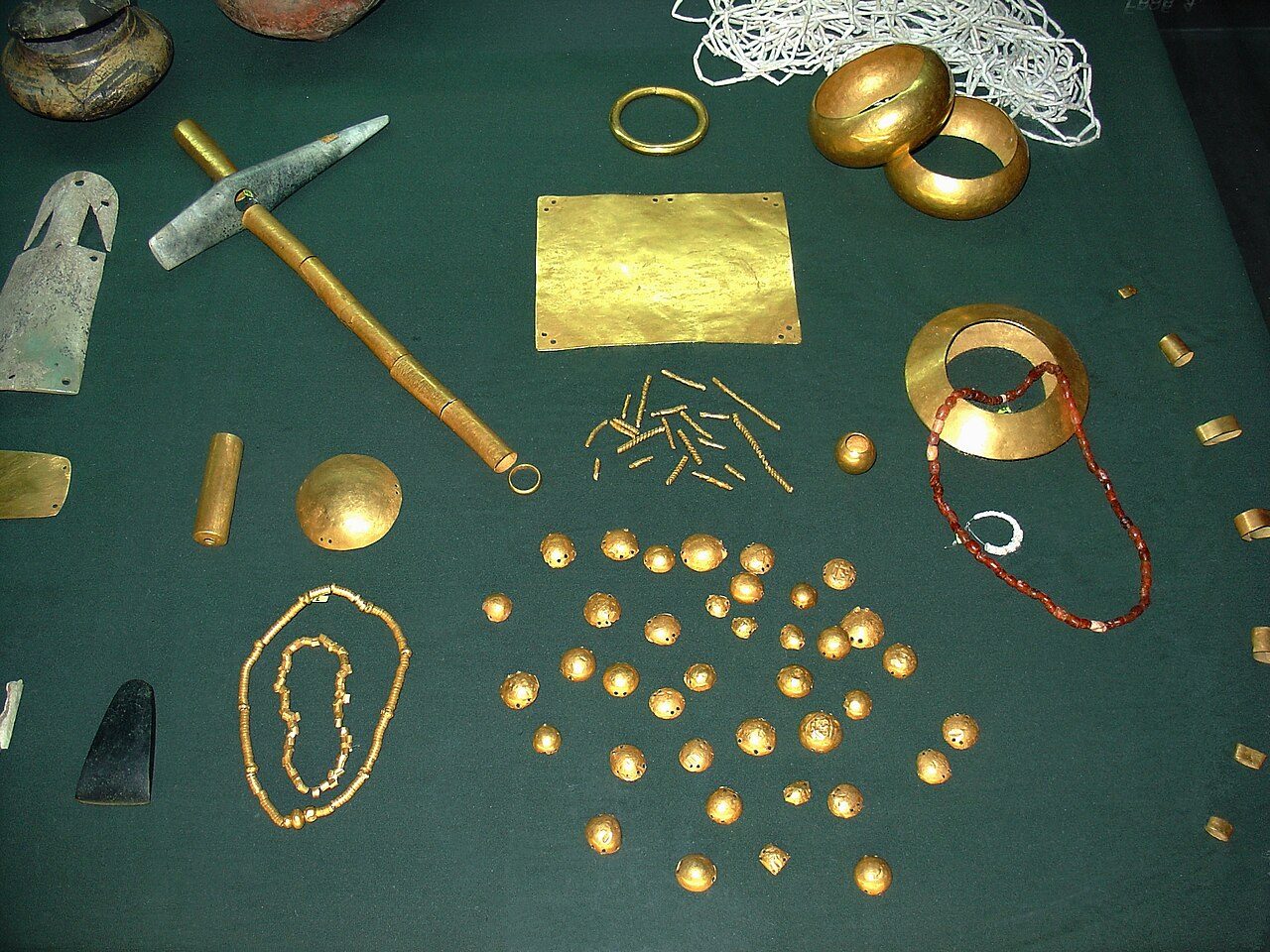
Gold was worked earlier than almost any other metal: the graves at Varna in Bulgaria, dated to about 4600 to 4200 BC, hold the oldest large gold treasure known. From there gold became Egypt's royal metal, Lydia's first coinage, the lure of the great nineteenth-century rushes, and for a century the standard behind the world's money.
At a Glance
- Oldest great treasure
- The Varna necropolis, Bulgaria (about 4600-4200 BC): some 3,000 gold objects weighing about 6 kilograms from 294 excavated graves
- Egypt
- Gold from the Eastern Desert and Nubia - whose name echoes nbw, the Egyptian word for gold - filled royal workshops and Tutankhamun's tomb
- First coins
- Lydia, late 7th century BC: electrum coins, then Croesus's pure gold and silver Croeseids, attributed by Herodotus and Xenophanes to the Lydians
- California
- Gold found at Sutter's Mill on 24 January 1848; more than 300,000 people came, and California became a state in 1850
- Witwatersrand
- The main reef was found in 1886 near what became Johannesburg; the basin became the world's largest goldfield
- Gold standard
- Britain operated it from 1821; most major economies followed by 1900, Britain left in 1931, and the last dollar link ended in 1971
Introduction
Gold does not rust, tarnish or rot, and it can be hammered thinner than paper. Those simple facts explain its long career. A gold bead buried five thousand years ago comes out of the ground shining, so gold became the material in which societies stored the things they most wanted to last: royal power, religious offering, and eventually money itself.
This page follows that career in the evidence: the first great gold treasure in prehistoric Bulgaria, the gold-rich kingdom of Egypt, the Lydian invention of coinage, the rushes that redrew California and South Africa, and the gold standard that tied modern currencies to the metal before the tie was cut in the twentieth century.
Varna and Egypt: Gold Before History Had Kings
In October 1972 an excavator operator, Raycho Marinov, uncovered gold objects while digging near Varna on Bulgaria's Black Sea coast. Excavations between 1972 and 1991 explored 312 graves dated to about 4600 to 4200 BC. Smithsonian Magazine reports about 13 pounds - roughly 6 kilograms - of gold in all, in pendants, bracelets, breastplates and beads. The wealth was sharply unequal: most graves held little, one in five held small gold objects, and just four graves held three quarters of the gold. Grave 43, a man in his forties buried with a gold-wrapped axe like a sceptre, held more gold than the rest of the world has yielded for that age. Archaeologists read Varna as early evidence of a ranked society - gold was marking rank within centuries of Europe's first farming.
Egypt made gold a system. The Metropolitan Museum of Art notes that Egypt drew gold from its Eastern Desert and from Nubia to the south, whose ancient name echoes nbw, the Egyptian word for gold. The hieroglyph for gold - a broad collar - appears from the First Dynasty, and surviving pieces run from fourth-millennium BC beads to the staggering quantity of gold found in Tutankhamun's tomb, the only relatively intact ancient Egyptian royal burial. Egyptian gold was usually left unrefined, still carrying its natural silver; where silver approached half the metal, the result was the pale alloy the Romans later called electrum.
Lydia: Gold Becomes Money
Coinage began with gold's less tidy cousin. In Lydia, in western Asia Minor, electrum - a natural gold-silver alloy - was panned from the Pactolus River, but its gold content varied too much for trustworthy payment. The Sardis expedition, Harvard's long-running excavation, describes the answer struck in the late seventh century BC: small stamped ingots of uniform weight - coins - whose value the issuing authority guaranteed. Herodotus wrote that the Lydians were the first people known to mint and use coinage of gold and silver, and Xenophanes likewise attributed the invention of coinage to Lydia; some of the earliest coins bear Lydian inscriptions, including WALWET, probably the name of King Alyattes (about 610-560 BC).
Around the middle of the sixth century BC, King Croesus reformed the system. By then refiners at Sardis could part electrum into its metals, and Croesus replaced electrum with a bimetallic coinage of pure gold and pure silver - the gold pieces known across the Greek world as Croeseids, stamped with the confronted heads of a lion and a bull. Unlike the overvalued electrum, the pure coins travelled widely as an international trade currency. The attribution is ancient and consistent, though scholars still debate the exact dating of the earliest electrum issues and whether Lydia or neighbouring Greek cities struck first.
The Rushes: California and the Witwatersrand
On 24 January 1848, carpenter James W. Marshall found gold flakes in the streambed at Sutter's Mill in Coloma, California. Britannica records that news brought more than 300,000 people to the territory, about 80,000 of them in 1849 alone - the forty-niners - and that an estimated 2 billion dollars of gold was extracted, though few prospectors grew rich. The rush hastened California's statehood in 1850 and built San Francisco, at heavy cost to the Native American population, most of the territory's roughly 160,000 people before the discovery.
In 1886 gold-bearing reefs were found on the Witwatersrand in South Africa, on the farm Langlaagte; credit for the main reef is traditionally given to George Harrison, though earlier prospectors such as Jan Gerrit Bantjes had found gold reefs there in 1884. Unlike California's loose placer gold, the Rand's gold lay in hard conglomerate rock, so the field quickly passed to deep-level mining companies. Johannesburg grew beside it, and the University of the Witwatersrand describes the basin as the world's largest gold deposit, with about 53,000 tonnes produced since 1886.
Timeline
- About 4600-4200 BC
The Varna necropolis in Bulgaria buries its dead with some 3,000 gold objects - the oldest large gold treasure known.
- 4th millennium BC
Egypt's earliest surviving gold artefacts, mostly beads, are made; the gold hieroglyph appears with the First Dynasty.
- Late 7th century BC
Lydia and its neighbours strike the first coins, in electrum panned from the Pactolus River.
- About 550 BC
Croesus of Lydia replaces electrum with pure gold and pure silver coinage - the Croeseids.
- 1821
Britain puts the gold standard into full operation, the first modern state to do so.
- 24 January 1848
James W. Marshall finds gold at Sutter's Mill, California; the rush peaks in 1852 and draws more than 300,000 people.
- 1886
The Witwatersrand main reef is found near the future Johannesburg; the world's largest goldfield develops.
- 1900
The United States Gold Standard Act makes gold the sole standard of the dollar; most developed economies are on gold.
- 1914
The First World War suspends the working international gold standard as belligerents halt free convertibility.
- 1931
Britain leaves the gold standard during the Great Depression; the United States follows in 1933.
- 15 August 1971
President Nixon announces the United States will no longer sell gold to foreign central banks, ending the Bretton Woods gold link.
Significance
Gold's significance is that one material successively carried three different kinds of trust. At Varna it certified rank in death. In Lydia its stamp certified value in exchange - the moment a state's guarantee began to matter more than the metal in the hand. Under the gold standard, from Britain's adoption in 1821 to its spread across the developed world by 1900, it certified whole currencies: paper money was a promise to pay gold. Each stage widened the circle of people who had to believe the same story about the same yellow metal, and each stage is documented in objects - grave goods, coins, and statutes - rather than in legend.
Myths and disputes
Was Croesus really the first to coin pure gold? The attribution is ancient - Herodotus credits the Lydians with the first gold and silver coinage, and the coins themselves were called Croeseids - but the exact sequence is still argued over. The Sardis evidence shows electrum coins came first, some possibly struck by Greek cities or local rulers rather than the Lydian king, and the dating of the earliest issues, anchored by the 1904-5 British Museum finds beneath the Temple of Artemis at Ephesus, remains debated. This page therefore says the first coins are attributed to Lydia, not that the case is closed.
Two other cautions belong here. Varna's gold is often called simply the oldest gold in the world; the precise claim the evidence supports is the oldest large, diverse gold treasure - individual older claims elsewhere are thinner. And the gold standard did not end on one date: Britain left in 1931, the United States ended domestic convertibility in 1933, and only in 1971 did the last official link, the Bretton Woods dollar rate of 35 dollars an ounce, disappear.
Legacy
No government now backs its currency with gold, yet the metal's historical roles survive in plain sight: central banks still hold gold reserves, the word Croesus still means a rich man, and Johannesburg still stands where the reef was found. Gold's history is unusual because its evidence is so durable - the Varna bracelets, the lion-head electrum and the Croeseids can still be handled in museums, unchanged, which is exactly the quality that made people trust gold in the first place.
Sources
- Smithsonian Magazine - Mystery of the Varna Gold
- The Metropolitan Museum of Art - Gold in Ancient Egypt
- Archaeological Exploration of Sardis - Coins of Sardis
- Encyclopaedia Britannica - California Gold Rush
- Encyclopaedia Britannica - Money: The Decline of Gold
- University of the Witwatersrand - Witwatersrand Gold: Where It Originated
The facts on this page were checked against these sources on 19 November 2026. The History Trail's permanent pages are researched and written for this site; the live profiles elsewhere on The History Trail are assembled automatically from Wikipedia and Wikidata.
About the Author
Researched and written by the The History Trail Editorial Team — the accountable editorial function behind this site's permanent story pages. The team works from the published sources cited on each page; it does not invent historians, reviewers or credentials, and it corrects errors openly.
Fact Check
Every load-bearing fact on this page traces to one of the sources listed above, and significant claims link to their source in the text. Our checking method is described on the methodology page; errors can be reported via the corrections page.
Sources & Citations
Cite this page as: The History Trail Editorial Team, The History Trail — this article's title, publication and update dates are shown beneath its headline. The full source list appears under Sources above; the site's source standards are on the sources page.