
Things
Copper
Copper was among the first metals humans ever worked. Native copper was hammered into beads and awls in Anatolia more than ten thousand years ago; smelting, casting and bronze followed, and an entire age - the Bronze Age - is named for copper's alloy. Five thousand years after iron demoted it, electricity made it indispensable again.
At a Glance
- What it is
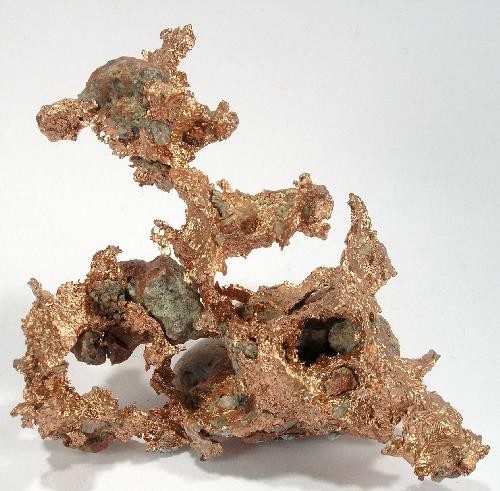
- A soft, reddish metal (element Cu) that sometimes occurs naturally in metallic form - native copper - ready to be hammered without smelting
- First use
- Coins and ornaments from about 8000 BC, the USGS records; annealed native copper work at Cayonu, Anatolia, by the late 9th millennium BC
- First smelting
- Earliest securely dated evidence at Belovode, Serbia, about 5000-4600 BC; the famous Catalhoyuk 'slag' has been re-examined and is now read as accidental
- The Copper Age
- The Chalcolithic, or Copper-Stone Age: copper used beside stone, known in eastern Anatolia by 6500 BC, widespread by 3000 BC
- Bronze
- Copper alloyed with tin makes bronze - harder and better-casting; the discovery, about 3000 BC, opens the Bronze Age
- The name
- From Latin cuprum, 'the Cyprus metal', after the island that supplied Rome - the root of 'copper' and the symbol Cu
- Second life
- The best common conductor of electricity after silver; telegraph, dynamo, telephone and the power grid rebuilt world demand from the 19th century
Introduction
Every age of human technology begins with copper. The United States Geological Survey calls it one of the first metals ever extracted and used by humans, and gives the arc in three dates: copper was first used in coins and ornaments starting about 8000 BC; at about 5500 BC copper tools helped civilisation emerge from the Stone Age; and copper alloyed with tin produced bronze, opening the Bronze Age at about 3000 BC. No other material runs unbroken from a Neolithic bead to the wiring of a modern power grid.
Copper could play that role because of a geological kindness: it sometimes occurs in nature as metal itself - native copper, ready to be picked up and hammered. A Stone Age craftworker needed no furnace to begin. Copper was soft enough to shape cold, tough enough to hold an edge for a while, and beautiful enough to wear. Everything else in metallurgy - smelting, casting, alloying, and eventually the electrical age - was learned on this one forgiving metal.
First Metal: Beads, Awls and the Anatolian Evidence
The earliest copper was not smelted but found. In the hills of eastern Anatolia and northern Iraq, people picked up nuggets of native copper and hammered them into small, precious things - beads, pendants, awls, hooks. A review of the metallic finds from Catalhoyuk, the great Neolithic town in central Anatolia, published from University College London, records that the earliest known annealed native copper work appears towards the end of the ninth millennium BC at Cayonu Tepesi in eastern Turkey, and that native copper beads dating to the eighth millennium BC have been recovered at Catalhoyuk itself. Britannica likewise dates copper's use in eastern Anatolia to 6500 BC, scarce at first and used only for small or precious objects.
For thousands of years that was copper's scale: ornaments and little tools, worked cold or gently heated to soften the metal - annealing - without ever melting it. The step from hammering found metal to extracting metal from stone, smelting, was the true invention of metallurgy, and it came later. The same UCL review notes that Belovode in eastern Serbia has produced the earliest securely dated evidence for copper smelting, at about 5000 to 4600 BC. Between the first hammered bead and the first smelted ingot lie some four thousand years of patient experiment.
The Copper Age and the Invention of Bronze
Archaeologists name the long transition the Chalcolithic - the Copper-Stone Age - when copper and stone tools were used side by side. By the middle of the fourth millennium BC, Britannica records, a rapidly developing copper metallurgy, with cast tools and weapons, was a factor leading to urbanisation in Mesopotamia; by 3000 BC copper was well known across the Middle East and spreading into Europe. The age's most famous artefact belonged to its most famous individual: Otzi, the iceman who died in the Alps around 3300 BC, carried an axe whose blade is almost pure copper.
Pure copper, though, is soft. The breakthrough that named an age was alloying: mix copper with tin and the result, bronze, is harder, casts better and keeps an edge. The USGS dates the Bronze Age to that discovery, about 3000 BC. During the second millennium BC, Britannica notes, true bronze greatly increased, fed in part by Cornwall's tin deposits. Copper also gave its name to an island: the Romans drew so much of it from Cyprus that its Latin name, cuprum, is 'the Cyprus metal' worn down - the root of 'copper' and of the symbol Cu.
Timeline
- c. 8000 BC
Copper is first used in coins and ornaments, the USGS records - native copper hammered cold in the Near East.
- Late 9th millennium BC
The earliest known annealed native copper work appears at Cayonu Tepesi in eastern Anatolia, among the first metalworking known anywhere.
- c. 6500 BC
Copper use is known in eastern Anatolia, Britannica records - scarce, and at first reserved for small or precious objects.
- c. 5500 BC
Copper tools help civilisation emerge from the Stone Age, in the USGS summary of the metal's early role.
- c. 5000-4600 BC
Belovode in Serbia yields the earliest securely dated evidence of copper smelting - metal extracted from ore by fire.
- c. 3300 BC
Otzi, the Alpine iceman, dies carrying an axe with a blade of almost pure copper.
- c. 3000 BC
Copper alloyed with tin produces bronze; the Bronze Age begins, and copper becomes the foundation metal of cities and armies.
- c. 1000 BC
Ironworking spreads and the Bronze Age ends, though bronze and copper remain in use for coinage, vessels and roofing.
- Late 19th century
Dynamos, electric motors, the telephone and electric light make copper the indispensable metal of electrification; demand transforms mining worldwide.
The Second Life: Electrification
For two thousand years after iron, copper lived a useful but secondary life - coins, kettles, bells, cannon, green-weathered roofs. Its return to the centre of history came from a property the ancients could not have used: it conducts electricity better than any other common metal, silver alone excepted, and it can be drawn into wire without breaking. The USGS lists the same qualities that explain both careers: copper is easily stretched, moulded and shaped, resists corrosion, and conducts heat and electricity efficiently.
The telegraph of the 1840s ran on copper wire; the telephone followed; and from around 1850, with the dynamo and the electric motor, copper became the preferred metal for electrical wire and the whole apparatus of electrification. Cities were rewired in it, then continents. The metal of the first tools became the metal of the grid, the motor and the circuit board - and, in the twenty-first century, of electric vehicles, wind turbines and solar farms, which are all machines for moving electricity through copper.
Significance
Copper's significance is that metallurgy itself was invented on it. Smelting, casting and alloying were all worked out on copper before they were applied to anything else, because copper forgave beginners: it occurs as metal, melts at temperatures a charcoal furnace can reach, and announces its ores - green malachite, blue azurite - in bright colours. The Bronze Age, the first age named for a metal technology, is copper's age under an alloy's name.
Its second significance is continuity. Stone was abandoned; bronze was demoted; iron rusts. Copper alone has been in continuous, growing use for ten thousand years, and the demand of the electrical age dwarfs everything the ancient world dug. The first metal turned out to be the one the future needed most.
Myths and disputes
Was Catalhoyuk the site of the world's first copper smelting? For decades, slag-like material from its seventh-millennium BC levels was hailed as exactly that. Recent re-examination, summarised in the scholarly literature, has shown that the material derives from accidental ore reduction - copper minerals caught in a fire - not deliberate smelting. This page therefore credits Catalhoyuk and Cayonu with what the evidence supports, very early working of native copper, and Belovode with the earliest securely dated smelting, around 5000 BC. The distinction matters: hammering metal you found is a craft; extracting metal from rock is an industry, and it began later than the old claim suggested.
Dates at this depth of prehistory are ranges, not birthdays. The USGS's round figures - ornaments about 8000 BC, tools about 5500 BC, bronze about 3000 BC - are the honest shape of the evidence, and this page's timeline follows them rather than inventing precision the archaeology does not have.
Legacy
Copper's legacy is written into language and landscape alike: an age called Chalcolithic, an element named for Cyprus, a Bronze Age that was really a copper-alloy age. Its artefacts anchor museums - Neolithic beads from Anatolia, Otzi's axe, the bronze hoards of three continents - and its modern form hides in plain sight: in walls, in motors, in the charger cable on a desk.
No other material has served both the first farmer with a copper awl and the engineer building a wind farm, without a break of ten thousand years. Copper was humanity's first metal. On the evidence of the electrical century, it may also prove the most durable idea the Stone Age ever had.
Sources
- U.S. Geological Survey - Copper: A Metal for the Ages (Fact Sheet 2009-3031)
- Encyclopaedia Britannica - Bronze Age
- University College London (Birch, Rehren and Pernicka) - The Metallic Finds from Catalhoyuk: A Review
- ScienceDirect Topics - Copper Metallurgy
The facts on this page were checked against these sources on 19 November 2026. The History Trail's permanent pages are researched and written for this site; the live profiles elsewhere on The History Trail are assembled automatically from Wikipedia and Wikidata.
About the Author
Researched and written by the The History Trail Editorial Team — the accountable editorial function behind this site's permanent story pages. The team works from the published sources cited on each page; it does not invent historians, reviewers or credentials, and it corrects errors openly.
Fact Check
Every load-bearing fact on this page traces to one of the sources listed above, and significant claims link to their source in the text. Our checking method is described on the methodology page; errors can be reported via the corrections page.
Sources & Citations
Cite this page as: The History Trail Editorial Team, The History Trail — this article's title, publication and update dates are shown beneath its headline. The full source list appears under Sources above; the site's source standards are on the sources page.