
Things
Carnival
Carnival is the feast before the fast: days of masks, parades and excess in the last hours before Lent's forty days of abstinence. Born obscurely, staged by popes, banned by empires, it now fills streets in more than fifty countries.
At a Glance
- What it is
- The festive season of merrymaking in the last days before Lent, in historically Roman Catholic countries
- Name origin
- Possibly medieval Latin carnem levare / carnelevarium — 'to remove meat'
- Climax
- Shrove Tuesday — Mardi Gras, 'Fat Tuesday' — before Ash Wednesday opens Lent's forty days
- Season opening
- Varies: Epiphany (6 January) in Munich and New Orleans; 11 November at 11:11 in Cologne
- Famous centres
- Venice (masks), Rio de Janeiro (samba schools), New Orleans (Mardi Gras krewes), Trinidad and Tobago
- Reach
- Celebrated today in more than 50 countries
Introduction
Carnival is the merrymaking that fills the last days and hours before Lent in many historically Roman Catholic countries — a final festivity of feasting, costume and street theatre before forty days of fasting begin. Its name possibly derives from the medieval Latin carnem levare or carnelevarium, 'to take away or remove meat', which fits its place in the calendar exactly: Carnival is the farewell to flesh, scheduled by the Church year and celebrated far beyond it.
In its long history Carnival has played a significant role in the development of popular theatre, vernacular song and folk dance. Its origins are obscure — possibly a primitive festival of the new year and nature's rebirth, possibly linked to the Saturnalia of ancient Rome — and its modern forms are gloriously local: masked Venice, samba Rio, the krewes of New Orleans, the steel pans of Trinidad.
Background
During the Middle Ages the Church combined Carnival's pagan and Christian strains into something new. From the mid-12th century the reigning pope travelled on horseback to Monte Testaccio in Rome to preside over the ludus carnevalarii, games of duels, jousting and bullfights between noble families. After Pope Paul II took office in 1464 he created the Renaissance Carnival, reviving Rome's ancient traditions with eight days of races — buffaloes, donkeys, children, the elderly — along the Via Lata, which took its present name, Via del Corso, from the racing. On the final night, Shrove Tuesday, masked crowds carrying candles stormed the street for the Festa dei Moccoletti, trying to snuff out one another's lights.
Rome was Carnival's early capital, but the festival's genius was export. Venice supplanted Rome as the main Italian site by the 18th century, its masks creating a temporary feeling of equality between rulers and ruled. Colonists carried the feast across the Atlantic, where Indigenous and African cultures remade it: in Rio, Portuguese roots fused with the cultures of Brazil's Indigenous peoples and of enslaved Africans to produce samba, feathered costume and dance; in Trinidad, Carnival became, in one scholar's words, both culture and resistance.
Timeline
- Ancient Rome
The Saturnalia, honouring Saturn, is one possible ancestor of Carnival; Britannica cautions that the festival's historical origin is obscure.
- Mid-12th century
Popes preside over the ludus carnevalarii at Monte Testaccio in Rome — jousts, duels and bullfights between noble families, with carts of live pigs thrown to the crowd.
- 1464
Pope Paul II creates the Renaissance Carnival in Rome: eight days of races down the Via Lata, the street later renamed Via del Corso for them.
- 1699
French explorer Pierre Le Moyne d'Iberville celebrates Shrove Tuesday some sixty miles from present-day New Orleans, introducing Mardi Gras to America, according to the Louisiana State Museum.
- By the 18th century
Venice supplants Rome as Italy's Carnival capital; its masks give rulers and ruled a temporary equality, and its season runs six weeks.
- 1797
Venice falls under Austrian rule; the Austrians ban Carnival and mask-wearing, and the tradition survives mainly among artists on Burano and Murano.
- 1857
The Mistick Krewe of Comus, a group of New Orleans businessmen, stages the first krewe parade, inventing a more organised Mardi Gras.
- 1881
Attempts to outlaw Trinidad's Cannes Brûlées, the cane-burning rite of enslaved Africans, spark the Canboulay riots; revellers adapt, replacing stick-fighting with bamboo instruments and later steel pan drums.
- 1970s
After bans upheld even under Mussolini, Venice's Carnival revives — the resurgence that produced the masked festival known worldwide today.
Significance
Carnival's cultural significance is inversion. For a bounded season, the normal order is licensed to turn upside down: masks erase rank in Venice, enslaved and emancipated people in Trinidad turn a colonists' feast into resistance, and everywhere the body is feasted precisely because the calendar is about to forbid it. The festival thus became a safety valve and a stage at once — popular theatre, song and dance developed inside it because it was the one time the street belonged to everyone.
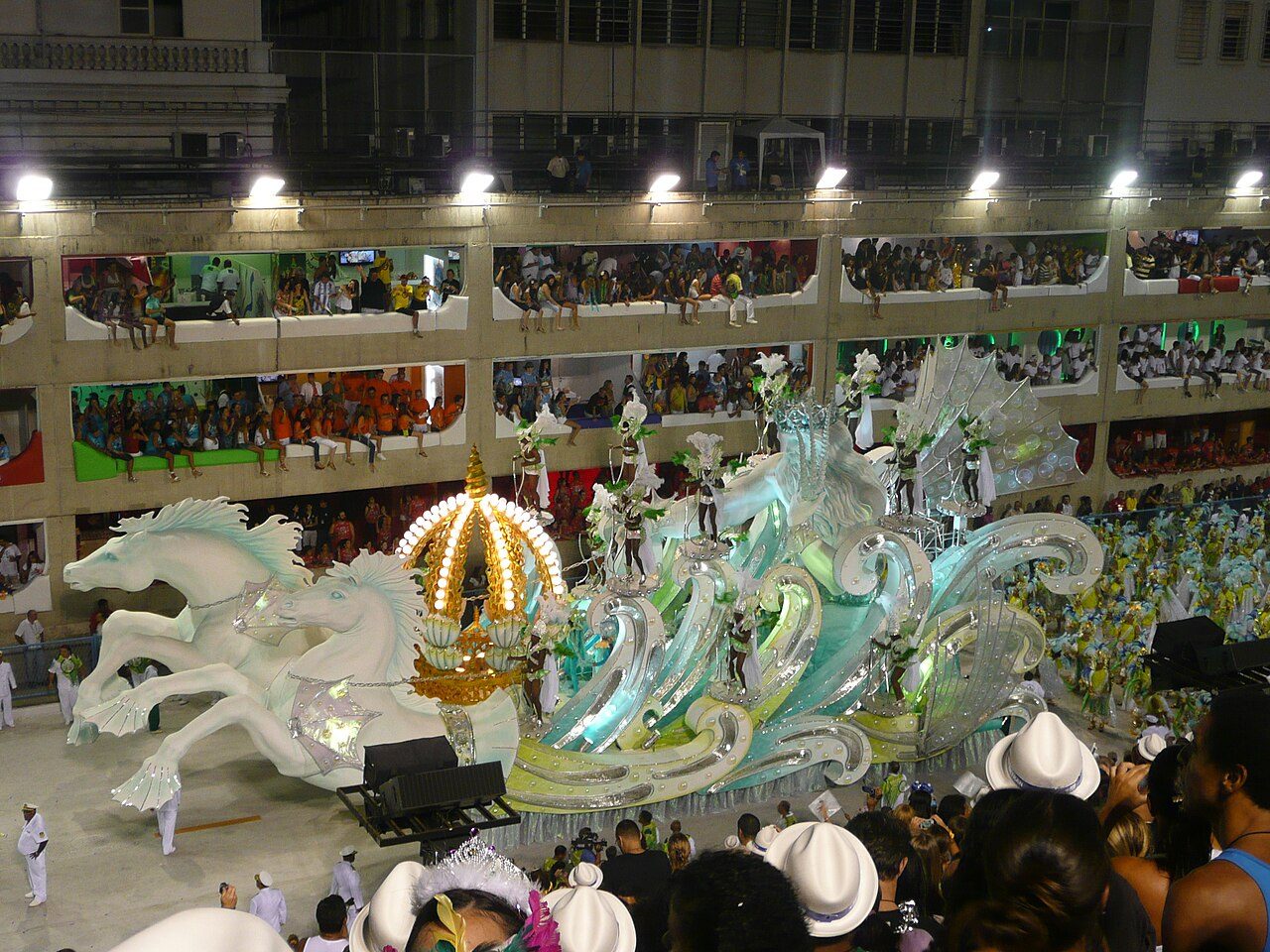
Its geography is now its glory. In the United States the principal celebration is New Orleans, where the season opens on Twelfth Night, 6 January, and climaxes with Mardi Gras — Fat Tuesday, named for using up the household's fats before Lent. The most famous modern Carnival is perhaps Rio's, where samba schools, community associations from across the city, parade in vibrant competition of music, dancing and elaborate costume. Quebec City answers with a winter carnival first held in 1894. One feast, fitted to every climate its carriers reached.
Legacy
Carnival's legacy is written into the world's calendar and its street culture: Mardi Gras in New Orleans, samba in Rio, steel pan in Trinidad, masked balls in Venice — each a local invention wearing a shared name and date. It showed, centuries before the word existed, how a festival travels: carried by churches, colonists and enslaved people, then indigenised everywhere it landed until the copies outshine the original.
It also survives its suppressions. Austrian bans, Fascist prohibitions and a pandemic all stopped Carnival — Rio's was cancelled for two years by Covid-19 before returning in 2023 — and each time it came back, because the need it answers, one sanctioned season of excess and equality before restraint, recurs every year with the calendar. Lent always comes. So, reliably, does Carnival first.
Sources
- Encyclopaedia Britannica — Carnaval
- Smithsonian Magazine — A Brief History of How Carnival Is Celebrated Around the World
- Wikipedia — Carnival
The facts on this page were checked against these sources on 19 November 2026. The History Trail's permanent pages are researched and written for this site; the live profiles elsewhere on The History Trail are assembled automatically from Wikipedia and Wikidata.
About the Author
Researched and written by the The History Trail Editorial Team — the accountable editorial function behind this site's permanent story pages. The team works from the published sources cited on each page; it does not invent historians, reviewers or credentials, and it corrects errors openly.
Fact Check
Every load-bearing fact on this page traces to one of the sources listed above, and significant claims link to their source in the text. Our checking method is described on the methodology page; errors can be reported via the corrections page.
Sources & Citations
Cite this page as: The History Trail Editorial Team, The History Trail — this article's title, publication and update dates are shown beneath its headline. The full source list appears under Sources above; the site's source standards are on the sources page.