
Things
Holi
Holi is Hinduism's spring festival of colours: a night of bonfires followed by a day when streets fill with people throwing coloured powder and water at everyone within reach. Beneath the riot of colour sit older stories — of a demoness burned, a god in love, and a world renewed.
At a Glance
- When
- The full-moon day of Phalguna (February–March) in the Hindu calendar
- Where
- India and Nepal, and now South Asian communities worldwide
- The night before
- Holika Dahan — bonfires mark the burning of Holika and the saving of Prahlad
- The main day
- Rangwali Holi — the throwing of coloured powder and water
- The colours
- Gulal (dry powder) and coloured water, squirted from pichkari water guns; traditionally made from flowers and herbs
- Braj special form
- Lathmar Holi at Barsana, where women beat men with staves and men defend with shields
- Celebrates
- The arrival of spring, the love of Krishna and Radha, and the triumph of good over evil
Introduction
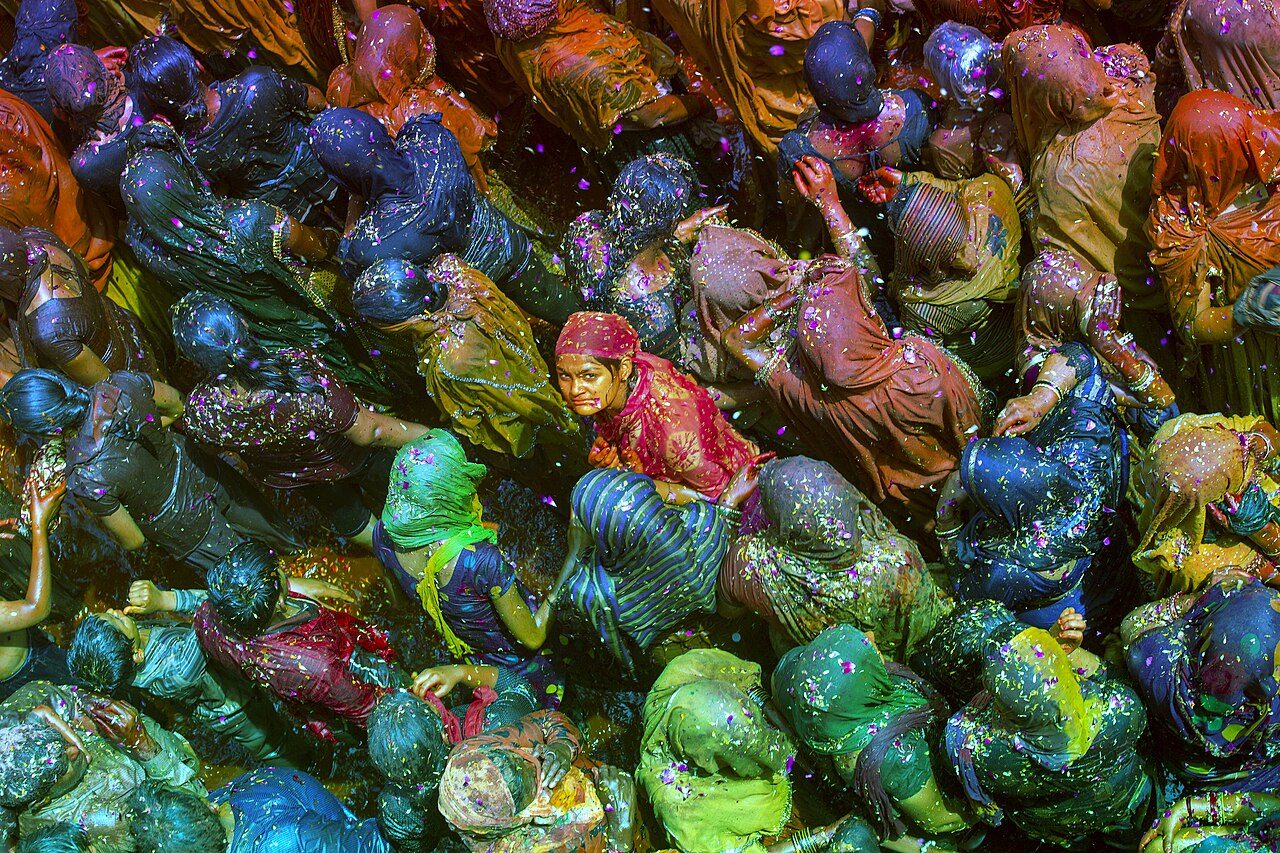
Holi is a Hindu spring festival celebrated in India and Nepal on the full-moon day of Phalguna, the Hindu calendar month that falls in February–March — and its public signature is colour. Participants throw coloured water and coloured powders, called gulal, over one another, in street celebrations where licence is given to set aside the usual rankings of caste, gender, status and age. For a day, layers of many colours cover everyone alike; then, when revellers have bathed and put on clean clothes, they visit friends, teachers and relatives, and the ordered patterns of society are reasserted and renewed.
The festival's classic form lasts a night and a day. The first evening is Holika Dahan, when large bonfires are lit in the streets. The day that follows, Rangwali Holi, is the day of colour play, loud music and shouts of 'Holi hai' — 'It's Holi!' Holi marks the start of spring, and within the traditions that carry it, it celebrates both the triumph of good over evil and the playful love of the god Krishna for Radha. It is at once a religious observance, a harvest-season celebration and a sanctioned day of misrule.
Origins
Two legends — told as sacred story, not as history — explain the festival's two halves. In the first, the demon king Hiranyakashipu demanded that his subjects worship him alone, but his son Prahlad remained devoted to the god Vishnu. The king enlisted his sister Holika, who was immune to fire, to sit with Prahlad on a pyre and burn him to death. Instead, because of Prahlad's devotion, the protection passed to the boy: Holika burned, Prahlad survived, and Vishnu, in his avatar as the man-lion Narasimha, later killed Hiranyakashipu. The bonfires of Holika Dahan commemorate that deliverance, and Holi takes its name from Holika.
The colour play is linked to a gentler legend. Krishna, an avatar of Vishnu, is depicted with dark blue skin; in the story, he worried that his beloved Radha, who was fair, would not accept the difference, until his mother playfully suggested he colour Radha's face — and his smearing of colour on her face is retold as the origin of Holi's colour-throwing, a symbol of the god's playfulness and of the mutual love between god and devotee. Whatever the age of the legends, the festival itself is old: Holi's spring festivities are documented in poems dating back to the early centuries CE, and the Braj region — Mathura and Vrindavan, where Krishna is said to have been born and to have grown up — remains its heartland.
Timeline
- Early centuries CE
Holi's spring festivities are documented in poems dating back to the early centuries CE, making it one of India's oldest recorded festivals.
- The night before
Holika Dahan: bonfires are lit to mark the burning of the demoness Holika and the protection of her nephew Prahlad, in the legend from which Holi takes its name.
- The main day
Rangwali Holi: crowds throw gulal and coloured water over everyone within reach; in the evening, washed and in clean clothes, families gather for a festive meal with many sweets.
- In Braj
Mathura and Vrindavan, where Krishna is said to have been born and to have grown up, are centres of the colour-throwing celebrations of northern India.
- At Barsana
Lathmar Holi, in the town of Barsana in Uttar Pradesh: women beat men with staves while the men defend themselves with shields.
- In the east
In West Bengal and Odisha, Holi is celebrated as Dolayatra, the Swing Festival, in which images of Krishna and Radha are placed on swings.
- Traditionally
Gulal is made from flowers and herbs, which in India's hot climate yield bright natural dyes; the colours carry meanings — blue for Krishna, green for new beginnings, red for love and fertility, yellow for turmeric.
- Today
Most gulal is now synthetically produced, though plant-based colours are increasingly promoted in India.
- Around the world
Holi has gained popularity far beyond India and is celebrated among South Asian communities in the United States, the United Kingdom, Caribbean countries and other countries with Indian populations.
Significance
Holi's deepest significance is social. Few festivals anywhere build a temporary suspension of hierarchy into their central act: at Holi, Britannica notes, licence is given to deviate from the usual societal norms and rankings of caste, gender, status and age, because under layers of many colours those differences cannot be read. The festival then completes the gesture — everyone bathes, dresses cleanly and pays visits, so that the social order is not abolished but renewed, its tensions discharged in play. Britannica also records the honest shadow of that licence: the breaking of boundaries can spill into harassment and brawls, and police in many places take precautionary measures.
The colours themselves are a language. In the Smithsonian's account, blue is the colour of Vishnu and of Krishna, a reminder that evil exists but can be contained through courage and right action; green is the colour of nature and happiness, linked to Prince Rama, who lived in exile in the forest; yellow, the colour of turmeric, is associated with knowledge, healing and the merchant caste; and red is the colour of weddings, life and festivals, of love and fertility. To throw colour at Holi is therefore not random decoration: it is to cover another person, briefly and joyfully, in meanings.
Legacy
Holi's legacy travels with the Indian diaspora. What began as a spring festival of northern India is now played in cities across the world, carried by South Asian communities to the United States, Britain, the Caribbean and beyond, and adopted there as a public celebration that neighbours of every background join. The images it produces — crowds suspended in clouds of pink, blue and yellow — have made it perhaps the most visually recognisable festival on earth, and its name has become a byword for joyful colour itself.
At home, its older meanings hold. Holi still opens the spring, still retells the burning of Holika and the love of Krishna and Radha, and still performs its annual experiment: one day in which rank is unreadable under the colours, followed by an evening in which society, washed and re-clothed, begins again. A festival that can hold devotion, harvest, love and misrule in a single handful of powder has no difficulty explaining its own survival.
Sources
- Encyclopaedia Britannica — Holi
- Encyclopaedia Britannica — Holi: Explaining the Festival of Colors
- Encyclopaedia Britannica — How do regional Holi celebrations differ across India?
- Smithsonian Magazine — The Meaning Behind the Many Colors of India's Holi Festival
- National Geographic — 9 things to know about Holi, India's most colorful festival
The facts on this page were checked against these sources on 19 November 2026. The History Trail's permanent pages are researched and written for this site; the live profiles elsewhere on The History Trail are assembled automatically from Wikipedia and Wikidata.
About the Author
Researched and written by the The History Trail Editorial Team — the accountable editorial function behind this site's permanent story pages. The team works from the published sources cited on each page; it does not invent historians, reviewers or credentials, and it corrects errors openly.
Fact Check
Every load-bearing fact on this page traces to one of the sources listed above, and significant claims link to their source in the text. Our checking method is described on the methodology page; errors can be reported via the corrections page.
Sources & Citations
Cite this page as: The History Trail Editorial Team, The History Trail — this article's title, publication and update dates are shown beneath its headline. The full source list appears under Sources above; the site's source standards are on the sources page.