
Things
Oktoberfest
Munich's Oktoberfest began not as a beer festival at all but as a public wedding party. In October 1810 the city celebrated the marriage of Bavaria's crown prince with horse races on a meadow outside the walls — and enjoyed it so much that it came back the next year, and almost every year since.
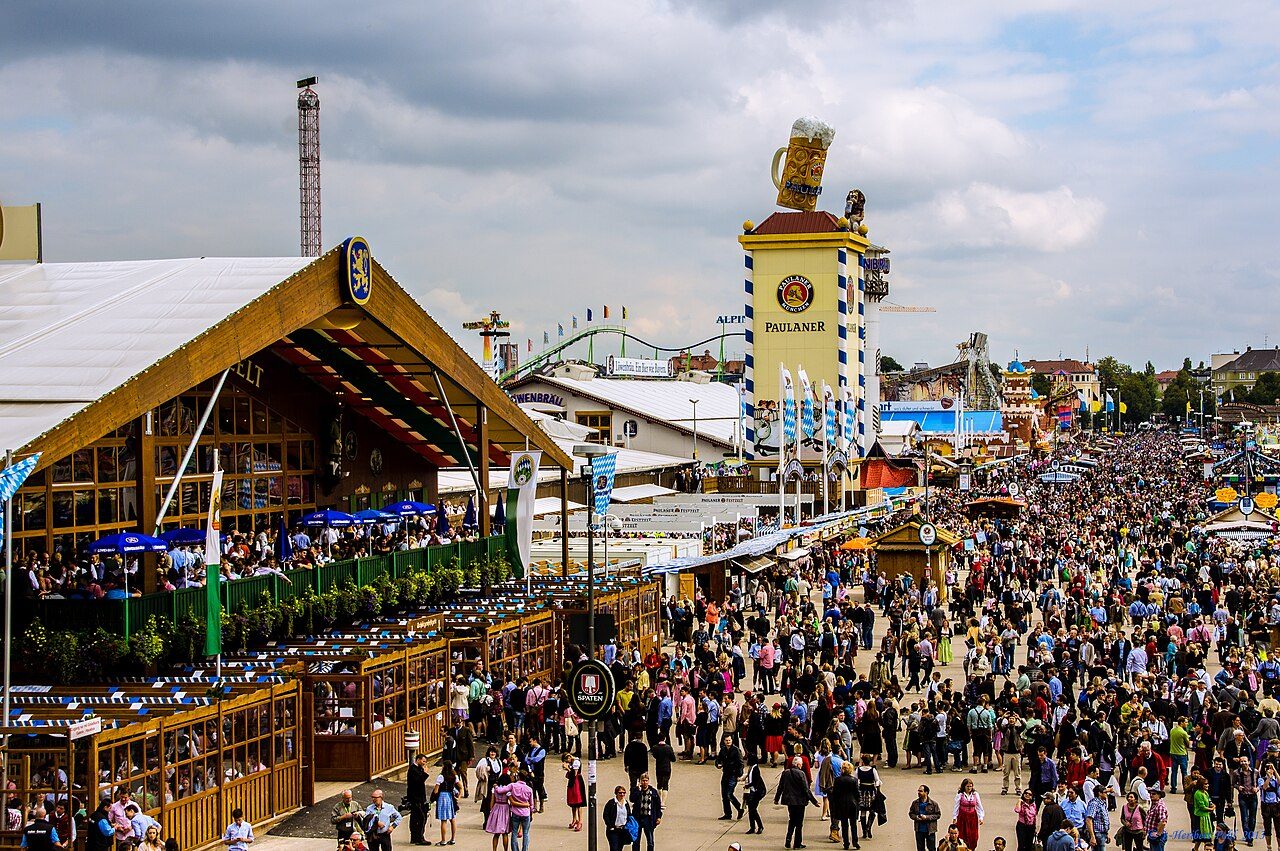
At a Glance
- First held
- 12 October 1810, Munich
- Occasion
- Marriage of Crown Prince Ludwig of Bavaria and Princess Therese of Saxe-Hildburghausen
- Site
- Theresienwiese ('Therese's meadow'), Munich
- Modern timing
- About two weeks, ending on the first Sunday in October
- Attendance
- More than six million visitors a year
- Beer served
- Upwards of 75,800 hectolitres (about 2 million gallons)
Introduction
Oktoberfest is the world's most famous beer festival: an annual fair in Munich, Germany, that runs for roughly two weeks and ends on the first Sunday in October. More than six million people attend each year, many of them visitors from abroad, and the city's breweries raise vast temporary beer halls — structures of plywood with balconies and bandstands, each seating around 6,000 people. The mayor of Munich taps the first keg to open the proceedings, and across the festival upwards of 75,800 hectolitres of beer, about two million gallons, are drunk.
Yet none of this was the original point. The first Oktoberfest, in 1810, was a celebration of a royal marriage, and its centrepiece was not beer but a horse race. Beer stalls, fairground rides and the great tents arrived gradually over the following decades. The festival's history is therefore a story of accretion: a wedding party that a city adopted, repeated, and slowly rebuilt in its own image, until the additions became the attraction.
Origins
The festival originated on 12 October 1810, in celebration of the marriage of the crown prince of Bavaria — the future King Louis I — to Princess Therese von Sachsen-Hildburghausen. The festivities concluded five days later with a horse race held on an open area outside the city, a ground that came to be called the Theresienwiese, 'Therese's green', after the bride. Munich still holds the festival on that same meadow, and locals still call it simply die Wiesn, 'the meadow'.
The race proved popular enough to repeat. The following year it was combined with a state agricultural fair, giving the event a second, practical purpose beyond celebration. In 1818 booths serving food and drink were introduced — the modest ancestors of the beer halls. Through the 19th century the fair grew with the city, surviving interruptions for war and cholera, and by the late 20th century the booths had developed into the large temporary beer halls that now define the festival's image around the world.
Timeline
- 12 October 1810
The first Oktoberfest celebrates the marriage of Crown Prince Ludwig of Bavaria and Princess Therese; the festivities close five days later with a horse race on the ground later named Theresienwiese.
- 1811
The horse race is repeated and combined with a state agricultural fair, giving the young festival an annual purpose.
- 1818
Booths serving food and drink are introduced — the first step from race meeting towards beer festival.
- 1854
The festival is cancelled during a cholera epidemic in Munich, one of several 19th-century interruptions for disease and war.
- Late 20th century
The serving booths develop into large temporary beer halls built by Munich's brewers, each seating some 6,000 people.
- 2010
Oktoberfest marks 200 years since the royal wedding that started it, with a historical fair evoking the early festivals.
- 2020–2021
The festival is cancelled because of the COVID-19 pandemic — its most recent interruption in more than two centuries of history.
Significance
Oktoberfest matters first as a feat of continuity. A one-off court celebration became a civic institution that Munich has maintained, with interruptions, for over 200 years — through the fall of the Bavarian monarchy whose wedding it marked, two world wars, and repeated epidemics. The meadow kept the bride's name long after the kingdom itself had gone. Few festivals anywhere can trace an unbroken line from a single dated event in 1810 to a modern crowd of six million.
It also became an export. A number of cities in the United States, particularly those with large German American populations, hold Oktoberfests modelled on Munich's, featuring beer and German food in an attempt to reproduce the Bavarian quality of gemütlichkeit — cordiality and good cheer. The Munich original thus turned into a template: lederhosen, brass bands, steins and pretzels now signal 'Oktoberfest' on several continents, whether or not Bavaria is anywhere nearby.
Legacy
Oktoberfest's legacy is the modern folk festival at full scale: part fair, part beer hall, part city branding exercise, drawing more than six million people a year to a single meadow. Its parades of beer wagons, floats and folk costumes, its games, rides, music and dancing, all grew out of additions made across two centuries to a five-day wedding celebration — proof that traditions are usually built, not born.
The festival also fixed an image of Bavaria in the world's imagination: convivial, traditional and fond of beer. That image is a construction — the first guests in 1810 came for a horse race — but it is now one of Germany's most recognisable cultural exports, renewed every autumn when the mayor taps the first keg on Therese's meadow.
Sources
- Encyclopaedia Britannica — Oktoberfest
- Encyclopaedia Britannica — History and Traditions of Oktoberfest Explained
- Wikipedia — Oktoberfest
The facts on this page were checked against these sources on 19 November 2026. The History Trail's permanent pages are researched and written for this site; the live profiles elsewhere on The History Trail are assembled automatically from Wikipedia and Wikidata.
About the Author
Researched and written by the The History Trail Editorial Team — the accountable editorial function behind this site's permanent story pages. The team works from the published sources cited on each page; it does not invent historians, reviewers or credentials, and it corrects errors openly.
Fact Check
Every load-bearing fact on this page traces to one of the sources listed above, and significant claims link to their source in the text. Our checking method is described on the methodology page; errors can be reported via the corrections page.
Sources & Citations
Cite this page as: The History Trail Editorial Team, The History Trail — this article's title, publication and update dates are shown beneath its headline. The full source list appears under Sources above; the site's source standards are on the sources page.