
On This Day
June 14 in History
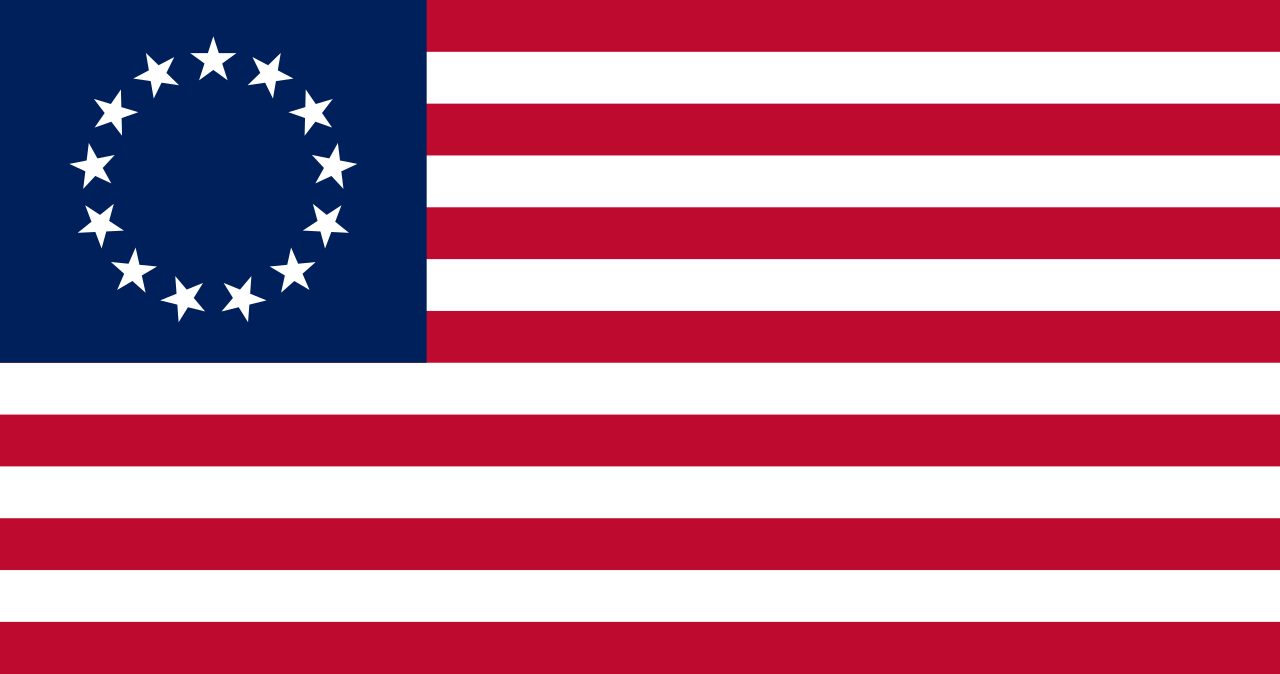
On 14 June 1777 the Continental Congress resolved that the flag of the United States should carry thirteen stripes and thirteen stars 'representing a new constellation' — creating, in a single sentence, one of the world's most recognisable emblems. June 14 is also the day the US Army was founded, Paris fell in 1940, and Anne Frank began her diary.
Choose another date: open the On This Day calendar to browse events, births and deaths for any day of the year.
At a Glance
- The resolution
- Passed by the Second Continental Congress at Philadelphia on 14 June 1777
- The words
- 'The flag of the thirteen United States be thirteen stripes, alternate red and white… thirteen stars, white in a blue field, representing a new constellation'
- The designer
- Unknown; tradition credits Betsy Ross, while Francis Hopkinson is the documented claimant
- The growth rule
- Settled in 1818: thirteen stripes forever, one star per state — the design has changed 27 times
- The present flag
- Fifty stars since 4 July 1960; the canton pattern was designed by schoolboy Robert Heft
- The commemoration
- Flag Day, observed on 14 June since 1877 and made permanent by Congress in 1949
Events on this day
- 1645Parliament's army under Cromwell and Fairfax crushes the king's forces at Naseby, the decisive battle of the English Civil War.
- 1658French and Spanish armies fight the Battle of the Dunes outside Dunkirk; England, France's ally, takes the port as its prize.
- 1775The Continental Congress creates the United States Army, authorising companies of riflemen for one year's service.
- 1777Congress adopts the Stars and Stripes as the flag of the United States — the featured story above.
- 1846American settlers proclaim the Bear Flag Republic in California, revolting against Mexican rule.
- 1877Henry Ossian Flipper, born into slavery, becomes the first Black graduate of West Point.
- 1919John Alcock and Arthur Brown take off from Newfoundland on the first nonstop transatlantic flight; they land in Ireland the next morning.
- 1940German troops enter and occupy Paris; the French government has fled the capital four days earlier.
- 1940The first transport of prisoners — 728 Poles — arrives at the new German camp at Auschwitz.
- 1942Anne Frank, two days past her 13th birthday, begins writing in the diary she received as a present.
- 1951UNIVAC I, the first commercially produced electronic computer in the United States, is dedicated at the Census Bureau.
- 1982Argentine forces in the Falkland Islands surrender to Britain, ending the 74-day Falklands War.
Born on this day
- 1811Harriet Beecher Stowe — American author of Uncle Tom's Cabin, the novel that set the slavery argument alight.
- 1864Alois Alzheimer — German psychiatrist who first described the disease that bears his name.
- 1868Karl Landsteiner — Austrian immunologist who discovered the human blood groups, making transfusion safe.
- 1928Che Guevara — Argentine-born physician who became the face of the Cuban Revolution and of guerrilla romanticism.
- 1946Donald Trump — American businessman and television personality who became the 45th and 47th president of the United States.
- 1969Steffi Graf — German tennis champion who won 22 Grand Slam singles titles and the 1988 Golden Slam.
Died on this day
- 1920Max Weber — German sociologist of The Protestant Ethic and the modern theory of bureaucracy, dead at 56.
- 1927Jerome K. Jerome — English comic writer, author of Three Men in a Boat, dead at 68.
- 1936G. K. Chesterton — English writer, creator of Father Brown and indefatigable defender of orthodoxy, dead at 62.
- 1994Henry Mancini — American composer of the Pink Panther theme and 'Moon River', dead at 70.
- 1995Rory Gallagher — Irish blues-rock guitarist, dead at 47 after a liver transplant.
The featured story: Congress adopts the Stars and Stripes, 14 June 1777
On Saturday 14 June 1777, in the middle of a war it was far from certain of winning, the Second Continental Congress in Philadelphia turned briefly from armies and money to cloth. Its journal records the whole business in one sentence: 'Resolved, that the flag of the thirteen United States be thirteen stripes, alternate red and white: that the union be thirteen stars, white in a blue field, representing a new constellation.' With those thirty-odd words the United States acquired the emblem it has carried ever since — changed many times in detail, never in idea.
The resolution said nothing about how the stars should be arranged, and early flags varied freely: circles, rows and scattered patterns all flew over the young republic. Tradition later fixed on the circle and attached it to the Philadelphia upholsterer Betsy Ross, who was said to have sewn the first flag at George Washington's request and demonstrated that a five-pointed star could be cut with a single snip of the scissors. Historians have never been able to prove or disprove the story, which surfaced only in 1870 through her grandson; the one documented claimant to the design is Francis Hopkinson, a signer of the Declaration who billed Congress for devising it — and was refused payment.
What Congress had created, almost casually, was a flag designed to grow. In 1795 two stars and two stripes were added for Vermont and Kentucky, but the 1818 Flag Act restored the thirteen stripes permanently and settled the rule that has held since: a star for every state, added on the July 4 following its admission. The flag has therefore been redesigned 27 times, most recently in 1960, when Hawaii's admission produced the present fifty-star canton — a pattern designed, famously, by a 17-year-old Ohio schoolboy, Robert Heft, as a homework project he was at first given a B-minus.
The date itself became a commemoration. The first official Flag Day observance came on 14 June 1877, the centenary of the resolution, and in 1949 Congress made Flag Day a permanent national observance. The flag the resolution described — thirteen stripes for the original colonies, a constellation for the union — is one of the oldest national flags in continuous use, and its founding text remains among the shortest consequential documents in American history.
Why this date matters
June 14 is a day of foundings and first crossings. An army and a flag were created on it two years apart; the first Black officer graduated on it; the Atlantic was first flown nonstop from it. But it is also shadowed by 1940, when on a single day Paris fell and the first prisoners entered Auschwitz — the century's catastrophe beginning on the same date as its most hopeful symbols. And between those poles sits a 13-year-old girl in Amsterdam, opening a checked-cloth notebook. The date holds, in miniature, the whole argument about what nations are for.
Sources
- Encyclopaedia Britannica — On This Day: June 14
- HISTORY — What Happened on June 14
- HISTORY — Congress adopts the Stars and Stripes
- GovInfo — Flag Day
- Wikimedia Commons — Betsy Ross flag

The facts on this page were checked against these sources on 19 November 2026. The History Trail's permanent pages are researched and written for this site; the live profiles elsewhere on The History Trail are assembled automatically from Wikipedia and Wikidata.
About the Author
Researched and written by the The History Trail Editorial Team — the accountable editorial function behind this site's permanent story pages. The team works from the published sources cited on each page; it does not invent historians, reviewers or credentials, and it corrects errors openly.
Fact Check
Every load-bearing fact on this page traces to one of the sources listed above, and significant claims link to their source in the text. Our checking method is described on the methodology page; errors can be reported via the corrections page.
Sources & Citations
Cite this page as: The History Trail Editorial Team, The History Trail — this article's title, publication and update dates are shown beneath its headline. The full source list appears under Sources above; the site's source standards are on the sources page.