
On This Day
June 20 in History
On 20 June 1789, locked out of their hall at Versailles, France's Third Estate deputies crowded into a royal tennis court and swore not to disband until the kingdom had a constitution — the Tennis Court Oath, the founding act of the French Revolution. June 20 is also the day Victoria became queen, West Virginia joined the Union, and Jaws opened.
Choose another date: open the On This Day calendar to browse events, births and deaths for any day of the year.
At a Glance
- The setting
- The royal tennis court in the Rue du Jeu de Paume, Versailles, after the Assembly's own hall was found locked
- The deputies
- 576 of the 577 Third Estate deputies took the oath; Joseph Martin-Dauch alone refused
- The words
- Never to separate, and to reassemble wherever circumstances required, until the constitution of the kingdom was established
- The president
- Jean-Sylvain Bailly, astronomer turned revolutionary, read the oath standing on a table
- The test
- Three days later the king ordered the estates apart; the Assembly refused to move, and the king gave way within the week
- The image
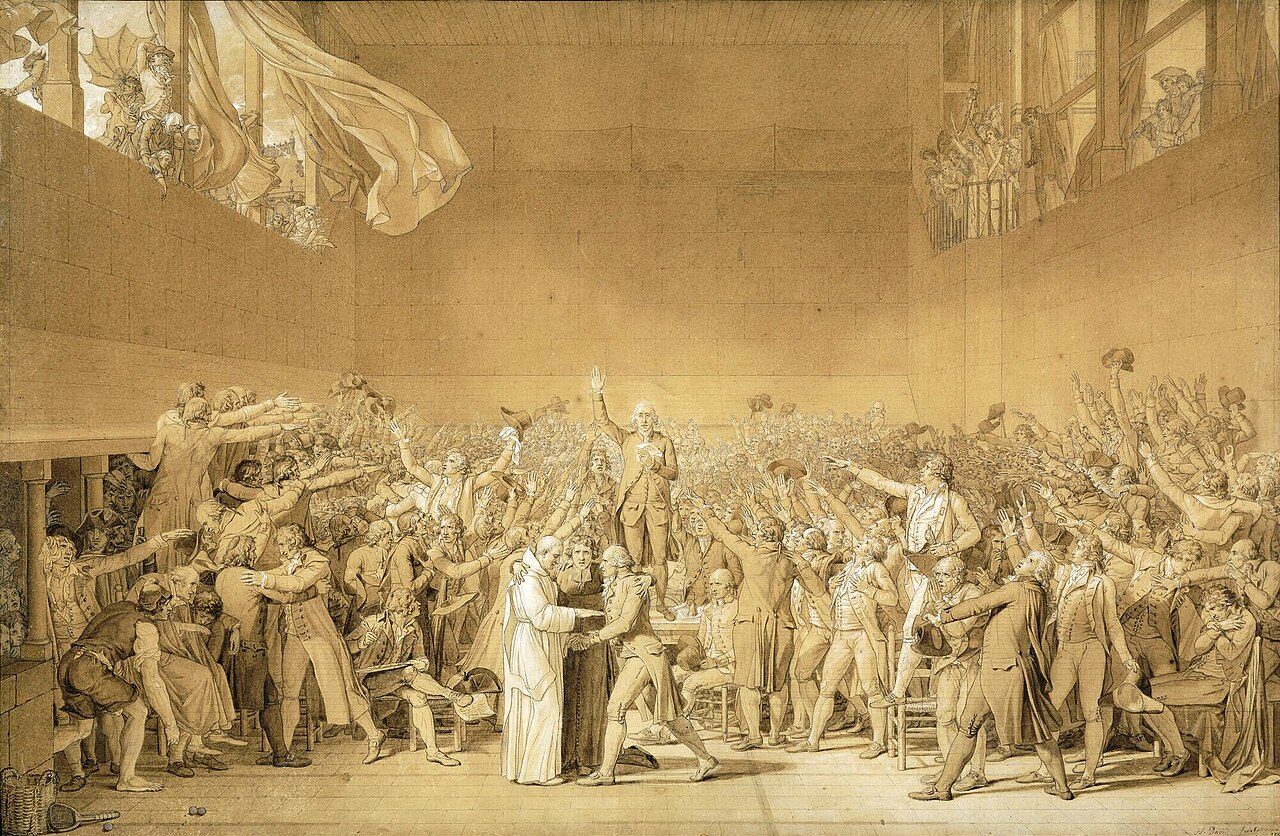
- Jacques-Louis David's great canvas of the scene was begun in 1790 and never finished; his drawing survives at Versailles
Events on this day
- 1789Deputies of the Third Estate swear the Tennis Court Oath at Versailles — the featured story above.
- 1791Louis XVI and his family slip out of Paris by night, beginning the Flight to Varennes that destroys trust in the king.
- 1819The SS Savannah reaches Liverpool, the first steam-assisted vessel to cross the Atlantic — though she sailed most of the way.
- 1837Victoria, 18 years old, succeeds her uncle William IV and becomes queen of the United Kingdom.
- 1840Samuel Morse receives his United States patent for the telegraph.
- 1863West Virginia is admitted to the Union as the 35th state, carved from Virginia by counties loyal to the Union cause.
- 1893A Massachusetts jury acquits Lizzie Borden of the axe murders of her father and stepmother after barely an hour's deliberation.
- 1900German minister Clemens von Ketteler is murdered in Beijing as Boxer rebels and imperial troops besiege the foreign legations.
- 1944The Battle of the Philippine Sea ends in decisive American victory, costing Japan three carriers and some 600 aircraft.
- 1963The United States and the Soviet Union sign the agreement creating the Moscow–Washington 'hotline' after the Cuban Missile Crisis.
- 1975Jaws opens in American cinemas and invents the summer blockbuster, terrifying a generation out of the water.
Born on this day
- 1861Frederick Gowland Hopkins — English biochemist whose work on accessory food factors founded the science of vitamins.
- 1910Howlin' Wolf — American blues singer and guitarist, a founding giant of the Chicago electric blues.
- 1928Eric Dolphy — American jazz multi-instrumentalist who pushed bebop toward the avant-garde.
- 1942Brian Wilson — American songwriter who led the Beach Boys' harmonies into Pet Sounds.
- 1949Lionel Richie — American singer, from the Commodores to a solo career of era-defining ballads.
- 1967Nicole Kidman — Australian actress, Oscar winner for The Hours and a defining screen presence of her generation.
Died on this day
- 1597Willem Barentsz — Dutch navigator who died seeking the Northeast Passage; Novaya Zemlya's sea bears his name.
- 1837William IV — king of the United Kingdom, whose death brought his niece Victoria to the throne the same day.
- 1875Joe Meek — American mountain man and frontier storyteller, dead on his Oregon farm at 65.
- 1947Bugsy Siegel — American mobster who bankrolled the Las Vegas Strip, shot dead in Beverly Hills at 41.
- 2005Larry Collins — American journalist and co-author of Is Paris Burning?, dead at 75.
The featured story: the Tennis Court Oath, 20 June 1789
On the morning of 20 June 1789, the deputies of the Third Estate arrived at their meeting hall in Versailles to find the doors locked and guarded. Three days earlier they had declared themselves the National Assembly — the representatives not of an estate but of the French nation — and the court, pleading preparations for a royal session, had closed their hall against them. In the rain, the deputies regrouped at the nearest large indoor space: the royal tennis court in the Rue du Jeu de Paume. There, standing on chairs and a table in the bare, high-windowed hall, all but one of the 577 deputies swore the oath that gives the day its name.
The text, proposed by Jean-Joseph Mounier and read out by the Assembly's president, Jean-Sylvain Bailly, was short and absolute: never to separate, and to reassemble wherever circumstances required, until the constitution of the kingdom was established on firm foundations. The deputies raised their arms and shouted their assent; the painter Jacques-Louis David later fixed the scene forever, Bailly standing on the table, arms outstretched, the crowd of deputies surging toward him with hands raised. Only one man, Joseph Martin-Dauch of Castelnaudary, refused, and signed the register 'opponent' — a small, brave footnote in his own right.
The oath was a deliberate act of constitutional defiance. Until that morning, legitimacy in France flowed downward from the king; the deputies now claimed it flowed upward from the nation, and that they, not Louis XVI, would decide when their work was done. The king tested the claim three days later, ordering the estates to separate and deliberate apart. The Assembly refused to move — it was here, Mirabeau told the king's messenger, by the will of the people, and would leave only at the point of a bayonet. Within a week the king capitulated and ordered the clergy and nobility to join the Assembly.
Three weeks later Paris stormed the Bastille, and the Revolution had its founding sequence: a locked door, a borrowed sports hall, and a promise. The constitution the deputies swore to write arrived in 1791, and the monarchy it was meant to limit was abolished the year after. But the oath's real legacy is the principle it enacted before it argued: that a people's representatives, once assembled, answer to the nation and not to the crown. Every constituent assembly since has, knowingly or not, repeated the gesture of the tennis court.
Why this date matters
June 20 is the calendar's day for improvised beginnings. A nation's constitution was vowed into existence in a sports hall because the proper room was locked; a teenage queen began a 63-year reign before breakfast; a state was admitted to a union its parent state was busy leaving; and cinema's modern era began with a mechanical shark that barely worked. Again and again the date shows institutions starting not with ceremony but with substitution — the tennis court for the assembly hall, the schoolboy solution for the official plan — and the substitute becoming the story.
Sources
- Encyclopaedia Britannica — On This Day: June 20
- HISTORY — What Happened on June 20
- Encyclopaedia Britannica — Tennis Court Oath
- Wikimedia Commons — Le Serment du Jeu de paume

The facts on this page were checked against these sources on 19 November 2026. The History Trail's permanent pages are researched and written for this site; the live profiles elsewhere on The History Trail are assembled automatically from Wikipedia and Wikidata.
About the Author
Researched and written by the The History Trail Editorial Team — the accountable editorial function behind this site's permanent story pages. The team works from the published sources cited on each page; it does not invent historians, reviewers or credentials, and it corrects errors openly.
Fact Check
Every load-bearing fact on this page traces to one of the sources listed above, and significant claims link to their source in the text. Our checking method is described on the methodology page; errors can be reported via the corrections page.
Sources & Citations
Cite this page as: The History Trail Editorial Team, The History Trail — this article's title, publication and update dates are shown beneath its headline. The full source list appears under Sources above; the site's source standards are on the sources page.