
On This Day
January 9 in History
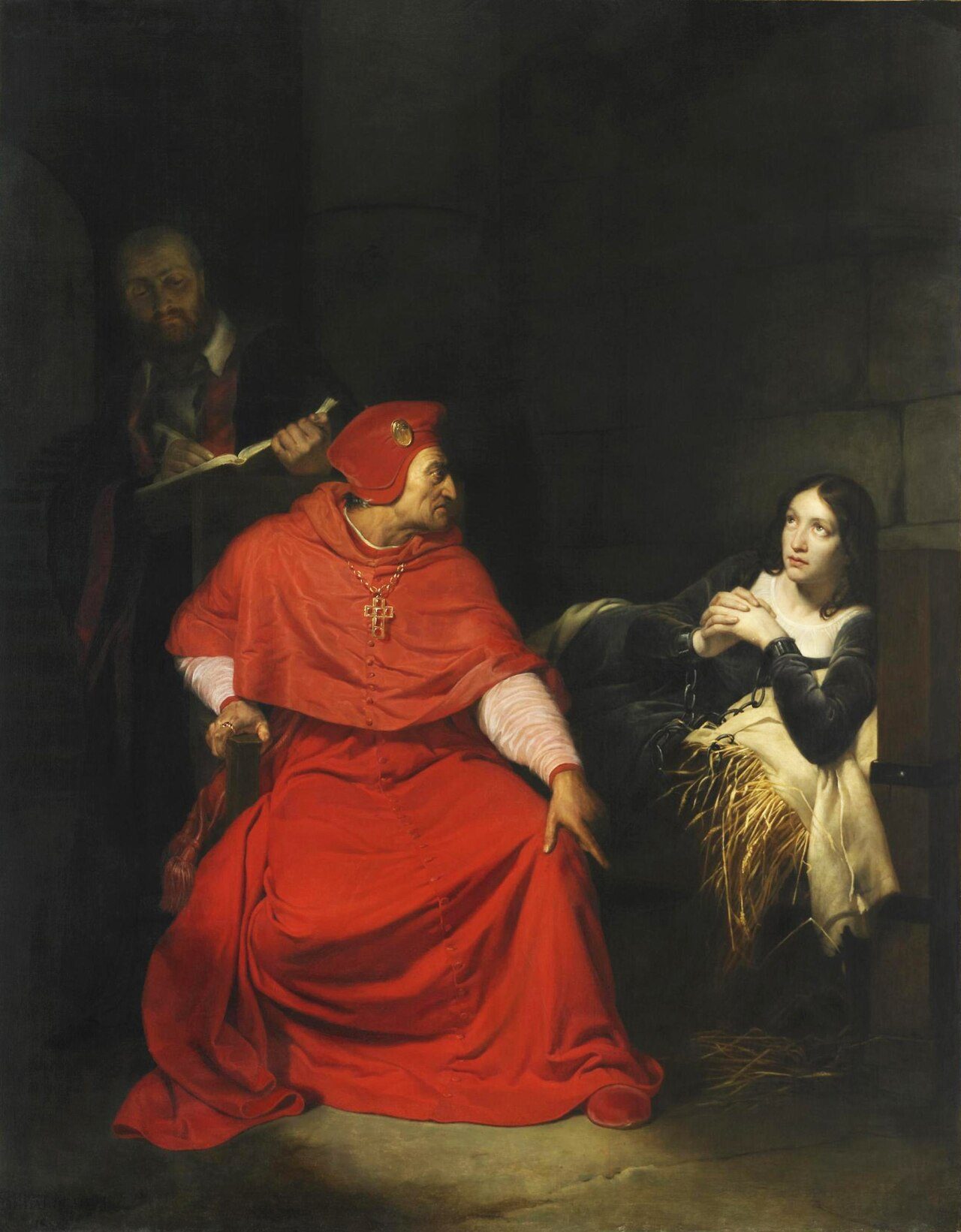
On 9 January 1431, in English-occupied Rouen, the ecclesiastical trial of Joan of Arc formally opened — the proceedings, run by Bishop Pierre Cauchon for the English cause, that would condemn the nineteen-year-old who had saved France and send her to the stake. January 9 is also the day Steve Jobs unveiled the iPhone in 2007 and Britain first levied income tax in 1799.
Choose another date: open the On This Day calendar to browse events, births and deaths for any day of the year.
At a Glance
- The opening
- Joan's trial opened at Rouen on 9 January 1431, presided over by Pierre Cauchon, bishop of Beauvais, with the vice-inquisitor Jean Lemaître
- How she got there
- Captured by Burgundian forces at Compiègne in May 1430, she was sold to the English for 10,000 francs and delivered to Cauchon's court by 3 January 1431
- The charges
- The accusations grew into 70 articles — heresy, witchcraft and wearing men's clothes among them — later reduced to 12 articles of accusation
- The questioning
- Her first public interrogation came on 21 February 1431; the surviving trial record preserves her answers, among the most remarkable documents of the Middle Ages
- The end
- Convicted, she abjured, then was judged relapsed for resuming male dress, and was burned at the stake in Rouen on 30 May 1431
- The reversal
- A rehabilitation trial annulled the verdict in 1456; Joan was canonised in 1920
Events on this day
- 1431The trial of Joan of Arc opens at Rouen — the featured story above.
- 1768Philip Astley stages a show of trick riding in London that is credited as the first modern circus.
- 1799Britain introduces income tax, levied by Pitt the Younger to pay for the war against revolutionary France.
- 1806Admiral Lord Nelson is buried in St Paul's Cathedral after a state funeral, three months after his death at Trafalgar.
- 1861South Carolina cadets fire on the Union steamer Star of the West in Charleston Harbor, an early shot of the coming Civil War.
- 1909Ernest Shackleton's Nimrod expedition plants the Union flag 112 miles from the South Pole — the closest any human has yet come.
- 1957Anthony Eden resigns as British prime minister, broken by the Suez Crisis.
- 2001Apple introduces iTunes, the software that reorganises the music industry around digital downloads.
- 2005Mahmoud Abbas is elected president of the Palestinian Authority, succeeding Yasser Arafat.
- 2007Steve Jobs unveils the first iPhone at Macworld in San Francisco, combining a phone, a music player and an internet device in a single touchscreen handset.
Born on this day
- 1859Carrie Chapman Catt — American suffragist who led the final campaign for the Nineteenth Amendment and founded the League of Women Voters.
- 1890Karel Čapek — Czech writer who gave the world the word 'robot' in his play R.U.R.
- 1908Simone de Beauvoir — French philosopher and author of The Second Sex.
- 1913Richard Nixon — thirty-seventh president of the United States, the only one to resign the office.
- 1941Joan Baez — American folk singer whose voice became the soundtrack of the civil-rights and anti-war movements.
- 1982Catherine Middleton — later Catherine, Princess of Wales, wife of the heir to the British throne.
Died on this day
- 1848Caroline Herschel — German-British astronomer, the first woman to discover a comet, dead at 97.
- 1873Napoleon III — emperor of the French, dead in exile at Chislehurst in England, two years after his fall in the Franco-Prussian War.
- 1878Victor Emmanuel II — first king of a united Italy, dead in Rome at 57.
The featured story: the trial of Joan of Arc opens, 9 January 1431
Joan of Arc arrived at her trial as the most inconvenient prisoner in Europe. A peasant girl from Domrémy, she had in 1429 — claiming guidance from heavenly voices — persuaded the dauphin Charles to give her troops, lifted the English siege of Orléans, and stood beside him at his coronation in Reims. In May 1430 Burgundian soldiers captured her outside Compiègne. The English, whose claim to France her victories had humiliated, bought her from her captors for 10,000 francs and arranged what they needed: not a ransom or a quiet murder, but a church trial that would brand her a heretic and her king's coronation a devil's trick.
The instrument was Pierre Cauchon, bishop of Beauvais — an English partisan driven from his own diocese, hoping, as contemporaries noted, for promotion to Rouen. Joan was delivered into his hands by 3 January 1431 and held, against canon law, in a secular castle tower at Rouen under English guards. On 9 January the proceedings formally opened in the castle chapel: Cauchon presiding, the vice-inquisitor Jean Lemaître beside him, and dozens of clerics assembled to build the case. The preliminary inquiry ran for weeks before Joan herself was publicly interrogated, from 21 February, in sessions whose transcripts still survive.
Those transcripts are why the trial is remembered. The charges were eventually drawn up in 70 articles — her voices, her male clothing, her refusal to submit to the Church's judgment — and then compressed into 12. Across weeks of questioning by trained theologians, the illiterate nineteen-year-old fenced with her judges, refusing their traps: asked the unanswerable question whether she was in God's grace, she replied in substance that if she was not, she prayed God would put her there, and if she was, she prayed He would keep her so. The court got its verdict anyway: she abjured under threat of the fire, then, resuming her soldier's clothes in prison, was judged relapsed. On 30 May 1431 she was burned in Rouen's old market square.
The trial's authors got twenty-five years of use from it, no more. In 1456, after Rouen was French again, a papal rehabilitation trial examined the record, found the proceedings corrupt and the verdict unjust, and annulled it. Joan's reputation rose with the centuries: she became France's national heroine, and in 1920 the Church that burned her canonised her as a saint. The proceedings that opened on 9 January 1431 survive almost in full — the prosecution's own paperwork — and they remain the fullest record we have of any medieval life, kept by the men who were trying to end it.
Why this date matters
January 9 is a day of reckonings conducted in public. A teenage visionary was called to account by a court that wrote everything down — and was vindicated by its own transcript. Britain's taxpayers were called to account for the first time by an income tax meant to be temporary. A prime minister resigned to account for Suez; a Palestinian electorate chose the man to account for Arafat's legacy. Even the iPhone's unveiling was a kind of accounting, a company showing its workings to the world. The date's habit is exposure: trials, taxes, resignations and launches — moments when someone must stand up and present their case.
Sources
- Encyclopaedia Britannica — On This Day: January 9
- HISTORY — What Happened on January 9
- Encyclopaedia Britannica — St. Joan of Arc
- HISTORY — Steve Jobs debuts the iPhone
- Office of the Historian — Death of Victor Emmanuel II (FRUS, 1878)
The facts on this page were checked against these sources on 19 November 2026. The History Trail's permanent pages are researched and written for this site; the live profiles elsewhere on The History Trail are assembled automatically from Wikipedia and Wikidata.
About the Author
Researched and written by the The History Trail Editorial Team — the accountable editorial function behind this site's permanent story pages. The team works from the published sources cited on each page; it does not invent historians, reviewers or credentials, and it corrects errors openly.
Fact Check
Every load-bearing fact on this page traces to one of the sources listed above, and significant claims link to their source in the text. Our checking method is described on the methodology page; errors can be reported via the corrections page.
Sources & Citations
Cite this page as: The History Trail Editorial Team, The History Trail — this article's title, publication and update dates are shown beneath its headline. The full source list appears under Sources above; the site's source standards are on the sources page.