
Things
European Union
The European Union is a political and economic union of 27 European countries, built step by step from a 1951 decision by six countries to run their coal and steel industries together so that war between them would become, in practice, impossible.
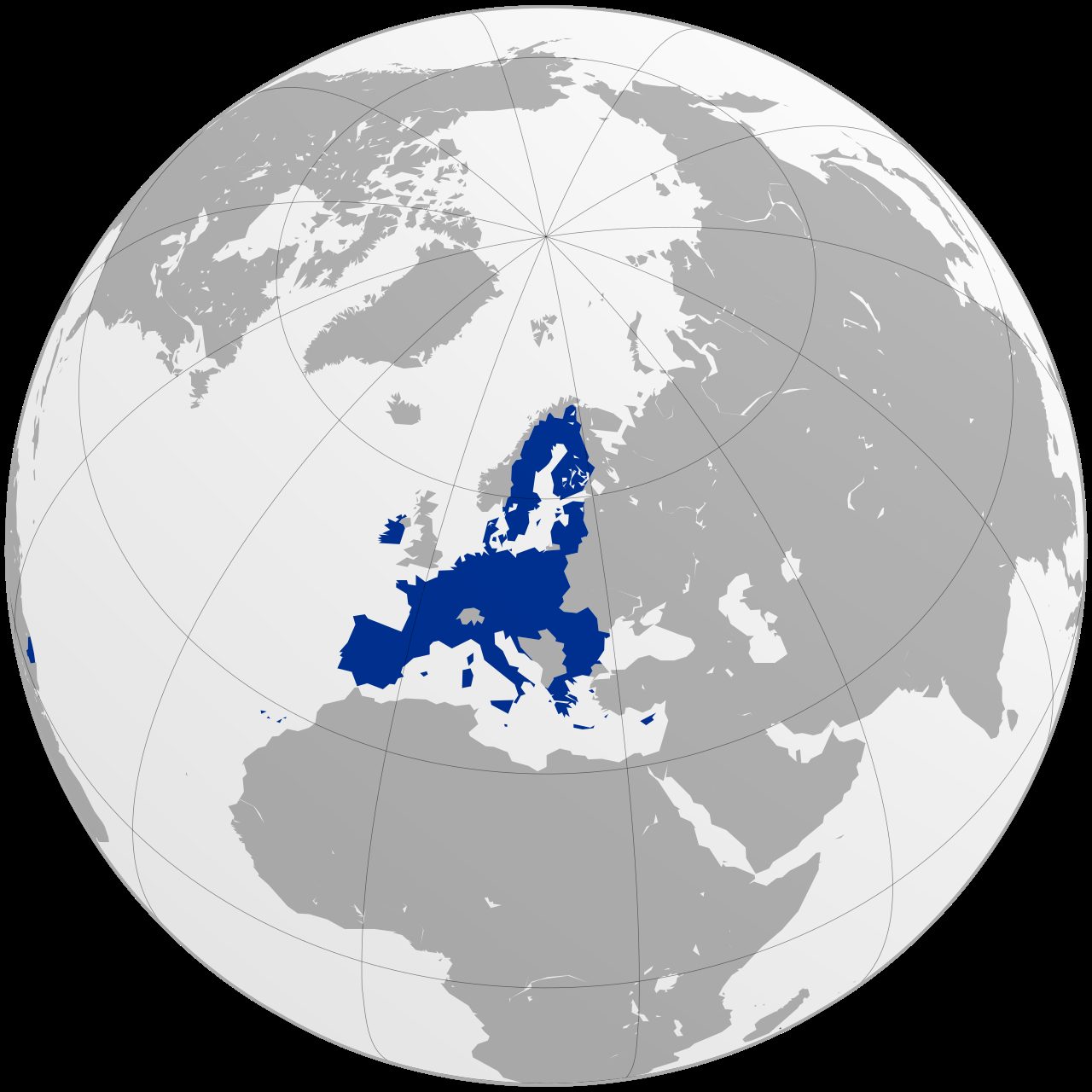
At a Glance
- Founded as the EU
- By the Maastricht Treaty — signed 7 February 1992, in force 1 November 1993
- First step
- Schuman Declaration, 9 May 1950, proposing pooled coal and steel production
- Founding six
- Belgium, France, Italy, Luxembourg, the Netherlands and West Germany
- Members today
- 27 countries, after the United Kingdom's departure on 31 January 2020
- Single currency
- The euro — launched for financial transactions in 1999, notes and coins from 2002, used by only some members
- Institutions in brief
- European Commission proposes, the European Parliament and Council legislate, the European Council sets direction, the Court of Justice interprets EU law
Introduction
The European Union is a union of 27 European countries that make many laws, trade rules and policies together while remaining separate states. It has its own parliament elected directly by its citizens, its own court, its own currency — the euro, used by part of its membership — and a single market in which people, goods, services and money are meant to move freely across internal borders. No other organisation of states goes as far in pooling sovereignty, and it was built deliberately, treaty by treaty, over more than seventy years.
It began with coal and steel. On 9 May 1950 France's foreign minister, Robert Schuman, proposed that France and Germany place their coal and steel production under a common authority, open to other European countries. Coal and steel were the raw materials of war. Pooling them was meant to make another Franco-German war not merely unthinkable but materially impractical — and to start, as Schuman put it, building Europe step by step rather than all at once.
Origins: Six Countries and Two Treaties
The Schuman Declaration led directly to the Treaty of Paris, signed on 18 April 1951 by six countries — Belgium, France, Italy, Luxembourg, the Netherlands and West Germany — creating the European Coal and Steel Community, which came into being in 1952. For the first time, European states handed real power over a sector of their economies to a common institution above national governments. The experiment worked well enough that the same six widened it.
On 25 March 1957 they signed the Treaties of Rome, creating the European Economic Community, aimed at a common market, and the European Atomic Energy Community, Euratom. Both came into force on 1 January 1958. The first meeting of the European Parliamentary Assembly, forerunner of today's European Parliament, followed in Strasbourg that March. Enlargement began in 1973, when Denmark, Ireland and the United Kingdom joined, and continued through the 1980s with Greece, Spain and Portugal, turning a western European club into a continental project.
Timeline
- 9 May 1950
The Schuman Declaration proposes pooling French and German coal and steel under a common authority. The date is now celebrated as Europe Day.
- 18 April 1951
Six countries sign the Treaty of Paris creating the European Coal and Steel Community; it comes into being in 1952.
- 25 March 1957
The Treaties of Rome create the European Economic Community and Euratom, in force from 1 January 1958.
- 1973
Denmark, Ireland and the United Kingdom join — the first enlargement beyond the founding six.
- 7 February 1992
The Maastricht Treaty, formally the Treaty on European Union, is signed, creating the European Union and setting the path to a single currency.
- 1 November 1993
The Maastricht Treaty enters into force. The single market, with free movement of people, goods, services and money, is launched the same year.
- 1995
Austria, Finland and Sweden join, bringing membership to 15.
- 1 January 1999
The euro is introduced in 11 countries for commercial and financial transactions; notes and coins follow on 1 January 2002.
- 2004–13
Ten countries join in 2004, Bulgaria and Romania in 2007, and Croatia in 2013, taking membership to 28.
- 23 June 2016
The United Kingdom votes in a referendum to leave the European Union.
- 31 January 2020
The United Kingdom leaves, the first country to do so. Membership returns to 27, where it stands today.
Significance: More Than a Trade Bloc
Maastricht changed the project's nature. Alongside the economic community it created European Union citizenship, cooperation in foreign policy and justice and home affairs, and a timetable for economic and monetary union that produced the euro. The Lisbon Treaty of 2009 later streamlined the structure, but the direction was set in 1992: the union would be political as well as economic. Its institutions reflect that hybrid character — a Commission that proposes laws and guards the treaties, a Parliament elected by citizens and a Council of national ministers that together pass them, a European Council of heads of government that sets overall direction, and a Court of Justice whose rulings bind member states.
The practical effects reach into daily life. The single market lets an engineer from Poland work in Germany without a permit and a company in Portugal sell in Poland without tariffs. Schengen arrangements removed passport checks across much of the continent, though not all members take part and some non-members do. The euro removed exchange-rate friction for its users while tying their economies to a common central bank — a benefit in stable times and a constraint, as the debt crisis after 2009 showed, when a member's finances fail.
Questions readers ask
Is every EU country in the euro? No. The euro was launched in 1999 in 11 countries and is now used by only part of the membership. Denmark has a formal opt-out, and several other members still use their own currencies, so a traveller crossing the union may still need more than one kind of money.
Did Brexit end the EU's growth? No, but it changed it. The United Kingdom's departure on 31 January 2020 was the first time a member state had left, reducing the union from 28 members to 27. Candidate countries in the Balkans and eastern Europe continue to negotiate membership, so the map is not settled — enlargement has simply become slower and more politically contested than in 2004.
Is the European Union a country? No. Its members remain sovereign states with their own governments, armies and foreign policies, and they can leave, as the United Kingdom demonstrated. But in the areas covered by the treaties, EU law takes precedence over national law, and members accept binding judgements of the Court of Justice — which is why the union is usually described as something between an international organisation and a federation.
Why does the EU have several seats? History and compromise. The European Parliament sits in Strasbourg and Brussels, the Commission and Council are based mainly in Brussels, and the Court of Justice is in Luxembourg — an arrangement inherited from the communities of the 1950s and preserved by treaty rather than designed from scratch.
Myths and disputes
Is the EU a superstate? The word is often used of it, but it does not match the treaties. The union can act only in areas its member states have conferred on it; everything else remains with national governments, which keep their own parliaments, armies and foreign policies, and can withdraw, as the United Kingdom did in 2020. Treaty change and enlargement require every member's agreement. Within the conferred areas, though, EU law takes precedence over conflicting national law, and the Court of Justice's rulings bind member states. That combination - limited fields, strong powers inside them - makes the superstate label misleading in both directions.
The democratic-deficit debate is a genuine scholarly argument rather than a myth. Critics argue that power has moved from national parliaments to EU institutions citizens cannot easily hold to account: the Commission, which proposes laws, is not directly elected, the Council is not directly elected as a body, and the European Parliament was long the weakest of the three. Defenders answer that Parliament is directly elected and now passes laws jointly with the Council, that Council members are ministers of elected national governments, and that the Commission takes office only with Parliament's approval and can be dismissed by it. The verdict depends on the benchmark: measured against a national parliament the union falls short; measured against any other international organisation, its parliamentary scrutiny is unmatched.
Legacy: An Unfinished Building
The union's deepest achievement is the one its founders aimed at: war between France and Germany, three times in seventy years before 1945, has become a historical subject rather than a strategic possibility, and former enemies now settle disputes in committee rooms. Integration also made Europe a single regulatory and trading power whose rules — on competition, data, food and the environment — shape products and policies far beyond its borders.
Its future remains open by design. Schuman's method was to build Europe through concrete achievements that create solidarity step by step, and the union still advances that way, crisis by crisis — through a debt emergency, a pandemic and a war on its eastern border. Whether it ends as a federation, stays a hybrid, or loosens again is a question its treaties deliberately leave to its citizens and governments.
Sources
- European Union — History of the EU (official)
- European Union — History of the EU, 1945–59 (official)
- European Union — History of the EU, 1990–99 (official)
- European External Action Service — Key milestones in the history of the European Union
- Encyclopaedia Britannica - Brexit
- House of Lords Library - European Union (Withdrawal Agreement) Bill: Briefing for Lords Stages
- Oxford University Press - Complete EU Law: Does the EU Have a Democratic Deficit?
The facts on this page were checked against these sources on 19 November 2026. The History Trail's permanent pages are researched and written for this site; the live profiles elsewhere on The History Trail are assembled automatically from Wikipedia and Wikidata.
About the Author
Researched and written by the The History Trail Editorial Team — the accountable editorial function behind this site's permanent story pages. The team works from the published sources cited on each page; it does not invent historians, reviewers or credentials, and it corrects errors openly.
Fact Check
Every load-bearing fact on this page traces to one of the sources listed above, and significant claims link to their source in the text. Our checking method is described on the methodology page; errors can be reported via the corrections page.
Sources & Citations
Cite this page as: The History Trail Editorial Team, The History Trail — this article's title, publication and update dates are shown beneath its headline. The full source list appears under Sources above; the site's source standards are on the sources page.