
On This Day
January 25 in History
On 25 January 2011 protests organised online erupted across Egypt against Hosni Mubarak's thirty-year rule; eighteen days later he was gone, and the '25 January Revolution' had changed the Arab world. January 25 is also the day Claudius became emperor of Rome, the first Emmy Awards were held, JFK took live questions on television, and Russia's nuclear briefcase was switched on by mistake.
Choose another date: open the On This Day calendar to browse events, births and deaths for any day of the year.
At a Glance
- The day
- 25 January 2011 — National Police Day in Egypt, chosen by protesters as the 'Day of Anger'
- Organised by
- Youth networks communicating through social media, outside the established opposition parties
- The target
- President Hosni Mubarak, in power since 1981 under a continuous state of emergency
- The centre
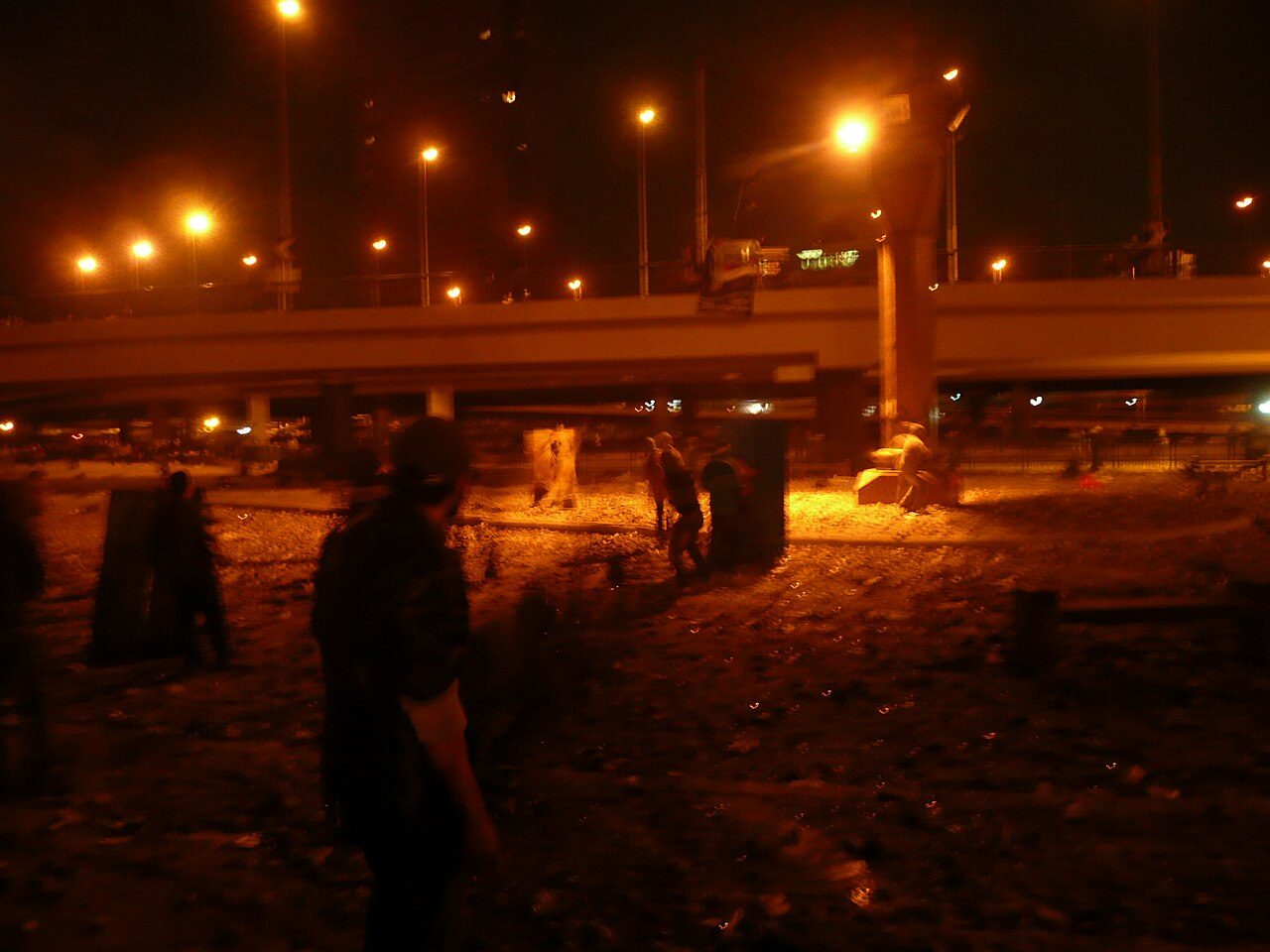
- Tahrir Square, Cairo, occupied by protesters and defended against pro-regime attacks
- The turning point
- 31 January 2011 — the army announces it will not use force against demonstrators
- The outcome
- Mubarak resigns on 11 February 2011, after 18 days of protest; power passes to the Supreme Council of the Armed Forces
Events on this day
- 41Claudius is proclaimed Roman emperor by the Praetorian Guard, a day after the assassination of his nephew Caligula.
- 1554Jesuit missionaries found a mission settlement on the plateau between two rivers in Brazil — the seed of the city of São Paulo.
- 1919Delegates at the Paris Peace Conference formally approve a commission to create the League of Nations, with Woodrow Wilson as its chairman.
- 1942Thailand, under Japanese domination, declares war on the United States and the United Kingdom.
- 1949The first Emmy Awards are presented at the Hollywood Athletic Club, honouring excellence in the new medium of television; only six awards are given.
- 1961John F. Kennedy holds the first live televised presidential news conference, answering reporters' questions before a national audience.
- 1971In Los Angeles, Charles Manson and three followers are convicted of the Tate–LaBianca murders of 1969.
- 1971Army commander Idi Amin seizes power in Uganda in a military coup while President Milton Obote is abroad.
- 1979A factory worker, Robert Williams, is struck and killed by an industrial robot at a Ford plant in Michigan — the first recorded death of a person by a robot.
- 1995Russia's early-warning system mistakes a Norwegian scientific rocket for a missile; President Yeltsin's nuclear briefcase is activated for the first time before the alarm is understood to be false.
- 2011Protests erupt across Egypt against the rule of Hosni Mubarak, beginning the 25 January Revolution — the featured story above.
Born on this day
- 1759Robert Burns — Scotland's national poet, whose birthday is still celebrated with Burns suppers of haggis and verse.
- 1874W. Somerset Maugham — English novelist and playwright, author of Of Human Bondage.
- 1882Virginia Woolf — English novelist of Mrs Dalloway and To the Lighthouse, a central figure of literary modernism.
- 1933Corazon Aquino — Filipino democracy leader who became president of the Philippines in 1986, ending the Marcos dictatorship.
- 1938Etta James — American singer whose voice carried blues, soul and the standard 'At Last'.
Died on this day
- 1947Al Capone — Chicago's Prohibition crime boss, dead at 48 in Florida, his mind and health destroyed after prison and illness.
- 1990Ava Gardner — American film star of The Killers and Mogambo, dead in London at 67.
- 2005Philip Johnson — American architect of the Glass House and the Seagram Building, dead at 98.
- 2017Mary Tyler Moore — American actress who redefined television comedy in the 1970s, dead at 80.
The featured story: Egypt rises — the 25 January Revolution begins, 25 January 2011
On 25 January 2011, thousands of Egyptians did something that, under thirty years of emergency rule, had been close to unthinkable: they marched on their own government and stayed in the streets. Protests organised online by youth networks — deliberately set for National Police Day, a public holiday honouring the police — drew crowds far larger than anyone expected into downtown Cairo, Alexandria, Suez and other cities, chanting against corruption, poverty, repression and the regime of President Hosni Mubarak, who had ruled Egypt since 1981. In Cairo the demonstrators broke through police cordons and reached Tahrir Square — Liberation Square — and a revolution had its home.
The spark had come from next door and from within. Days earlier, Tunisia's uprising had driven President Ben Ali into exile, proving an Arab strongman could fall. At home, anger had been building for years over rigged elections, food prices, low wages and police brutality — symbolised by Khaled Said, a young man beaten to death by police in Alexandria in 2010, whose name became a rallying cry. As Britannica's account of the unrest records, the protests of 25 January appeared to have been organised by networks of individuals communicating through social media, bypassing Egypt's established opposition parties entirely — a new kind of revolution, assembled by people the regime did not know how to arrest.
The regime answered first with force, then with concessions that came too late. On 28 January, the 'Friday of Anger', protesters battled police across the country and the army deployed onto the streets; Mubarak sacked his government and, for the first time in his presidency, appointed a vice president. On 31 January the army announced it would not fire on demonstrators — the moment the regime's survival began to depend on negotiation rather than obedience. Mubarak promised not to stand again in September's election; the crowds in Tahrir, now numbering in the hundreds of thousands and organising their own food, medicine and security, answered that promises were not the demand. The demand was that he go.
On 11 February 2011, eighteen days after the first march, Vice President Omar Suleiman read a brief statement: Mubarak had resigned and handed power to the Supreme Council of the Armed Forces. Tahrir Square erupted. Egypt's longer story since — an elected Islamist president, Mohamed Morsi, in 2012; his removal by the army in 2013; and the return of military-led rule under Abdel Fattah el-Sisi — has dimmed many of the hopes of January 2011. But the eighteen days remain the hinge of modern Egyptian history: the moment the region's most populous nation discovered, in the streets, that a president of thirty years could be unmade by the people he ruled. Egyptians still call it simply 'the 25 January Revolution'.
Why this date matters
January 25 is a date of transfers of power, orderly and otherwise. A palace guard makes an emperor in Rome; a general seizes Uganda at a stroke; and in 2011 the largest Arab nation transfers power the slowest and hardest way — from a square full of citizens to a president's resignation letter, eighteen days later. The day also marks quieter revolutions in who holds attention: a president submits to live television questions in 1961, television gets its own awards in 1949, and in 1995 the machinery of nuclear war briefly stirs over a weather rocket. Authority, and the tools that check it, are this date's twin themes.
Sources
- Encyclopaedia Britannica — On This Day: January 25
- HISTORY — What Happened on January 25
- Encyclopaedia Britannica — Egypt: Unrest in 2011 and the January 25 Revolution
The facts on this page were checked against these sources on 19 November 2026. The History Trail's permanent pages are researched and written for this site; the live profiles elsewhere on The History Trail are assembled automatically from Wikipedia and Wikidata.
About the Author
Researched and written by the The History Trail Editorial Team — the accountable editorial function behind this site's permanent story pages. The team works from the published sources cited on each page; it does not invent historians, reviewers or credentials, and it corrects errors openly.
Fact Check
Every load-bearing fact on this page traces to one of the sources listed above, and significant claims link to their source in the text. Our checking method is described on the methodology page; errors can be reported via the corrections page.
Sources & Citations
Cite this page as: The History Trail Editorial Team, The History Trail — this article's title, publication and update dates are shown beneath its headline. The full source list appears under Sources above; the site's source standards are on the sources page.