
On This Day
December 10 in History
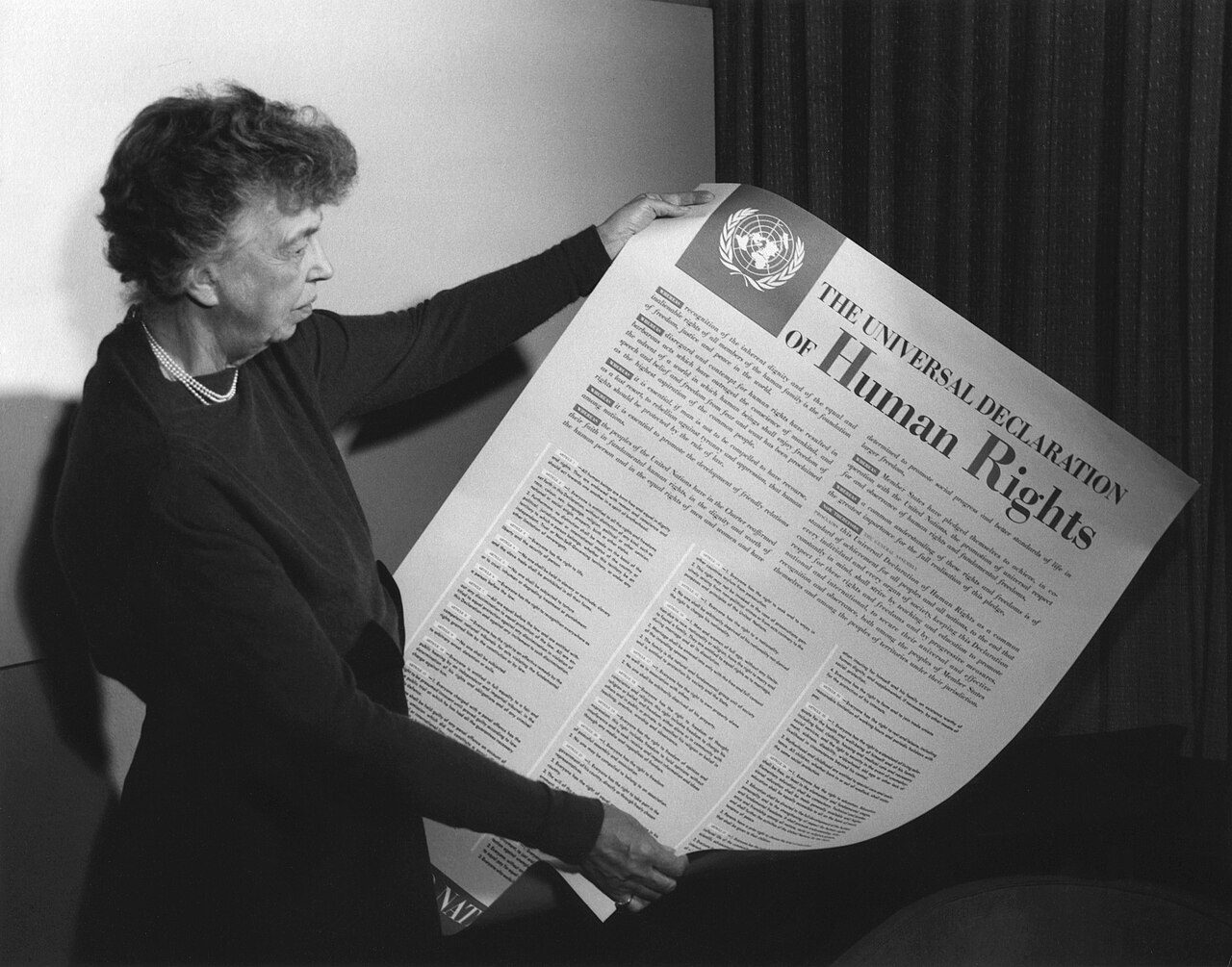
On 10 December 1948, in the Palais de Chaillot in Paris, the United Nations General Assembly adopted the Universal Declaration of Human Rights — thirty articles proclaiming, for the first time in history, the rights belonging to every person on earth simply for being human. Drafted under the chairmanship of Eleanor Roosevelt in the shadow of the Second World War, it passed with 48 votes in favour, none against and eight abstentions. The date is now Human Rights Day. December 10 is also the anniversary of Alfred Nobel's death, and so the day his prizes are given, every year, in Stockholm and Oslo.
Choose another date: open the On This Day calendar to browse events, births and deaths for any day of the year.
At a Glance
- Adopted
- 10 December 1948, Palais de Chaillot, Paris — UN General Assembly resolution 217A
- The vote
- 48 in favour, none against, eight abstentions — the Soviet bloc of six, plus Saudi Arabia and South Africa
- The chair
- Eleanor Roosevelt, who steered the drafting commission and called the Declaration a 'Magna Carta for all mankind'
- The drafters
- Principal first draft by Canadian jurist John Peters Humphrey; reshaped by France's René Cassin, with delegates from China, Lebanon, Chile and others
- The content
- Thirty articles — from life, liberty and equality before the law to work, rest, education and freedom of thought and speech
- The status
- A declaration, not a treaty — legally non-binding, yet the foundation of the modern human-rights system and, per Guinness, the most translated document in the world
Events on this day
- 1869The Wyoming Territory enacts the first law in the United States granting women the vote on equal terms with men — fifty years before the Nineteenth Amendment.
- 1898The Treaty of Paris ends the Spanish-American War: Spain cedes the Philippines, Puerto Rico and Guam to the United States and recognises Cuban independence, and the U.S. emerges as a Pacific power.
- 1901The first Nobel Prizes are awarded in Stockholm and Christiania (Oslo), exactly five years after Alfred Nobel's death — Röntgen takes Physics, van 't Hoff Chemistry, von Behring Medicine, Sully Prudhomme Literature, and Dunant and Passy share Peace.
- 1936King Edward VIII signs the Instrument of Abdication at Fort Belvedere, giving up the British throne to marry Wallis Simpson; the abdication takes legal effect the next day.
- 1948The UN General Assembly adopts the Universal Declaration of Human Rights in Paris — the featured story above.
- 1964Martin Luther King, Jr., at 35 the youngest recipient to that date, receives the Nobel Peace Prize in Oslo for his nonviolent campaign for civil rights.
- 1983Raúl Alfonsín is inaugurated as president of Argentina, restoring democracy after seven years of military junta rule — and takes office, fittingly, on Human Rights Day.
- 2009Barack Obama accepts the Nobel Peace Prize in Oslo, awarded for his 'extraordinary efforts to strengthen international diplomacy', eleven months into his presidency.
Born on this day
- 1815Ada Lovelace — English mathematician, Byron's daughter, whose notes on Babbage's Analytical Engine contain what is recognised as the first computer algorithm.
- 1830Emily Dickinson — American poet of Amherst, who published barely a dozen poems in her lifetime and left nearly 1,800 in her bureau drawer.
- 1851Melvil Dewey — American librarian who devised the Dewey Decimal Classification that still organises the world's libraries.
- 1908Olivier Messiaen — French composer whose Quartet for the End of Time, written in a prisoner-of-war camp, fused birdsong, faith and rhythm into a new musical language.
Died on this day
- 1896Alfred Nobel — Swedish inventor of dynamite and holder of 355 patents, whose will endows the prizes first awarded on this date five years later.
- 1936Luigi Pirandello — Italian playwright of Six Characters in Search of an Author and Nobel laureate in Literature, dead two years after his prize.
- 1968Karl Barth — Swiss theologian, the leading Protestant thinker of the twentieth century and principal author of the Barmen Declaration against the Nazi-aligned church.
- 2006Augusto Pinochet — Chilean dictator who seized power in 1973, dead in Santiago at 91 while under indictment for human-rights abuses — on Human Rights Day.
The featured story: the Universal Declaration of Human Rights is adopted, 10 December 1948
The Declaration was written in the ruins. When the UN Commission on Human Rights began work in 1947, the world had just inventoried the crimes of the Second World War — the Holocaust, the fire-bombings, the gulags, the atomic bombs — and the new United Nations Charter had promised 'fundamental human rights' without ever saying what they were. The commission's job was to say it. Its chair was Eleanor Roosevelt, the late president's widow, chosen, as she suspected, partly as a courtesy; she turned the post into the engine of the whole project, chairing drafting sessions with a schoolteacher's discipline and a politician's sense of the possible. The first full draft came from the Canadian legal scholar John Peters Humphrey, who distilled hundreds of pages of the world's constitutions and rights traditions into a single list; the French jurist René Cassin gave it its architecture of preamble and articles.
What emerged was deliberately universal and deliberately unenforceable. Thirty articles move from the bedrock — all human beings are born free and equal in dignity and rights; no slavery, no torture, no arbitrary arrest — through the civil freedoms of speech, religion, assembly and fair trial, and on to the social rights that the socialist delegates insisted on and the West accepted: work, rest, education, an adequate standard of living. It bound no one in law. Cassin compared it to the portico of a temple: a proclamation of the faith, on which binding covenants could later be built. The drafting took two years of argument among delegates from Confucian, Islamic, Marxist and liberal traditions — the Chinese philosopher-diplomat P. C. Chang repeatedly steering the committee away from purely Western justifications toward a genuinely shared text.
The General Assembly, meeting in Paris, took the Declaration up in the autumn of 1948, debated it through 183 meetings and some 168 proposed amendments, and voted in the Palais de Chaillot shortly after midnight on 10 December. The result: 48 in favour, none against, eight abstentions — the six Soviet-bloc states, Saudi Arabia and apartheid's founding government in South Africa. Roosevelt, who had lobbied wavering delegations to the end, received a standing ovation and told the Assembly she hoped the document would become 'the international Magna Carta of all men everywhere.' The date of the vote is now observed worldwide as Human Rights Day.
Measured against its century, the Declaration's record is double. The horrors it was written to prevent have recurred on every continent, and its articles are violated daily by governments that voted for them. Yet no subsequent argument about human dignity has been able to ignore it. It seeded the two great covenants of 1966, the European and American conventions, the constitutions of most new nations, and the very idea — once genuinely novel — that how a state treats its own citizens is the world's business. It is the most translated document on earth. A declaration that binds no one has ended up binding everyone's conscience, which may be the more durable kind of law.
Why this date matters
No date in the calendar carries its own commemoration so neatly inside itself. The rights declared on 10 December 1948 are honoured every 10 December as Human Rights Day; the prizes endowed by a man who died on 10 December 1896 are handed out every 10 December in Stockholm and Oslo — which is how Martin Luther King and Barack Obama came to receive them on this date, and how Raúl Alfonsín chose it to restore Argentine democracy. It is the day the modern world annually re-reads its own promises, and measures the distance to them.
Sources
- Encyclopaedia Britannica — On This Day: December 10
- HISTORY — What Happened on December 10
- United Nations — The Universal Declaration of Human Rights (history of the document)
- Nobel Prize — From the first Nobel Prize award ceremony, 10 December 1901
- HISTORY — First Nobel Prizes awarded (December 10, 1901)
The facts on this page were checked against these sources on 19 November 2026. The History Trail's permanent pages are researched and written for this site; the live profiles elsewhere on The History Trail are assembled automatically from Wikipedia and Wikidata.
About the Author
Researched and written by the The History Trail Editorial Team — the accountable editorial function behind this site's permanent story pages. The team works from the published sources cited on each page; it does not invent historians, reviewers or credentials, and it corrects errors openly.
Fact Check
Every load-bearing fact on this page traces to one of the sources listed above, and significant claims link to their source in the text. Our checking method is described on the methodology page; errors can be reported via the corrections page.
Sources & Citations
Cite this page as: The History Trail Editorial Team, The History Trail — this article's title, publication and update dates are shown beneath its headline. The full source list appears under Sources above; the site's source standards are on the sources page.