
On This Day
August 28 in History
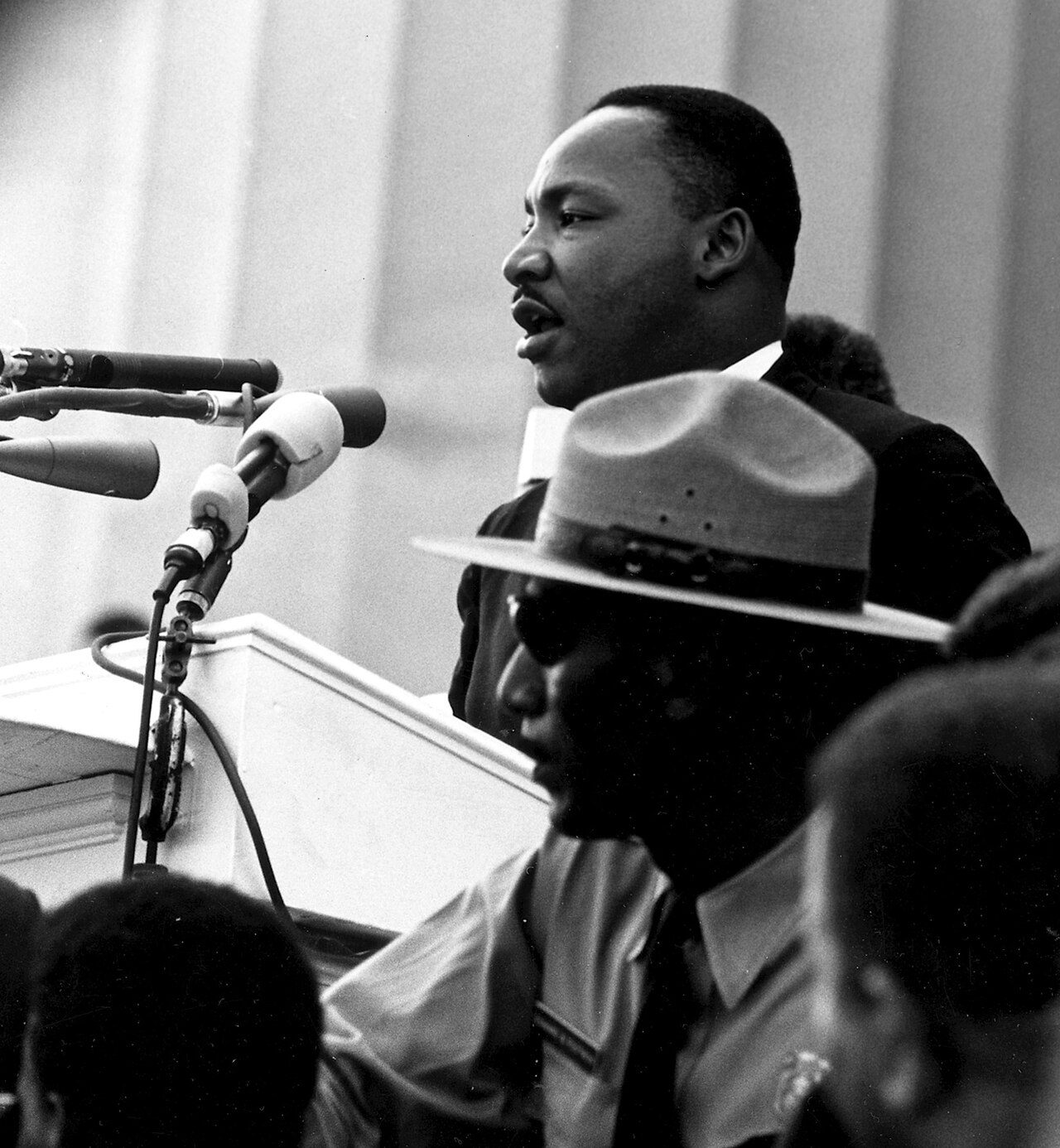
On 28 August 1963 some 250,000 people joined the March on Washington for Jobs and Freedom, where Martin Luther King Jr. delivered his I Have a Dream speech from the steps of the Lincoln Memorial. August 28 is also the day slavery was abolished across the British Empire in law, Emmett Till was murdered in 1955, and Goethe was born.
Choose another date: open the On This Day calendar to browse events, births and deaths for any day of the year.
At a Glance
- The march
- The March on Washington for Jobs and Freedom, 28 August 1963, organised by A. Philip Randolph and Bayard Rustin
- The crowd
- An estimated 250,000 people, the largest demonstration the capital had seen
- The speaker
- King was the sixteenth and final speaker of the day
- The setting
- The steps of the Lincoln Memorial, a century after the Emancipation Proclamation
- The demands
- Civil rights legislation, desegregation, fair employment, a higher minimum wage and an end to police brutality
- The legacy
- Momentum for the Civil Rights Act of 1964 and the Voting Rights Act of 1965; the speech was ranked the century's greatest American address
Events on this day
- 1833The Slavery Abolition Act receives royal assent, ending slavery across most of the British Empire.
- 1845The first issue of Scientific American is published, beginning the oldest continuously published magazine in the United States.
- 1862The Second Battle of Bull Run begins in Virginia, ending two days later in a major Confederate victory.
- 1955Emmett Till, a 14-year-old from Chicago, is murdered in Mississippi, galvanising the civil rights movement.
- 1957Senator Strom Thurmond begins the longest solo filibuster in Senate history, speaking 24 hours 18 minutes against a civil rights bill.
- 1963The March on Washington culminates in King's I Have a Dream speech — the featured story above.
- 1968Police and anti-war protesters clash violently outside the Democratic National Convention in Chicago.
- 1988Three Italian jets collide at the Ramstein air show in West Germany, killing 70 people.
- 1996The marriage of Charles, Prince of Wales, and Diana, Princess of Wales, is formally dissolved.
- 2005New Orleans orders a mandatory evacuation as Hurricane Katrina bears down on the city.
- 2008Barack Obama accepts the Democratic presidential nomination in Denver, 45 years to the day after King's speech.
Born on this day
- 1749Johann Wolfgang von Goethe — German writer of Faust and the defining figure of German literature.
- 1728John Stark — American general of the Revolutionary War, who coined New Hampshire's Live Free or Die motto.
- 1952Rita Dove — American poet and former United States poet laureate.
- 1957Ai Weiwei — Chinese artist and activist.
- 1962David Fincher — American director of Se7en, Fight Club and The Social Network.
- 1965Shania Twain — Canadian singer who became country music's best-selling female artist.
- 1969Jack Black — American actor and musician.
- 1982LeAnn Rimes — American country singer who broke through at thirteen.
- 1986Florence Welch — English singer of Florence and the Machine.
Died on this day
- 1818Jean Baptiste Point du Sable — Haitian-born trader regarded as the founder of Chicago.
- 1955Emmett Till — 14-year-old murder victim whose open-casket funeral forced America to look at lynching.
- 1968John Gordon Mein — United States ambassador to Guatemala, the first American ambassador assassinated in the line of duty.
- 2020Chadwick Boseman — American actor who played Black Panther and Jackie Robinson, dead of colon cancer at 43.
The featured story: the March on Washington and I Have a Dream, 28 August 1963
On 28 August 1963 Washington filled with people before it filled with sound. An estimated quarter of a million Americans, roughly a quarter of them white, walked from the Washington Monument to the Lincoln Memorial in summer heat for the March on Washington for Jobs and Freedom. It was the largest assembly for a redress of grievances the capital had ever seen, organised in barely two months by the veteran labour leader A. Philip Randolph, who had first threatened such a march in 1941, and by Bayard Rustin, the logistics genius the movement kept half-hidden because he was gay and a former communist.
The march had a programme, and the programme had demands: comprehensive civil rights legislation, desegregated schools, protection against police brutality, a federal jobs programme and a two-dollar minimum wage. President Kennedy, who had tried to talk the leaders out of marching at all, watched from the White House, fearing violence that never came. Instead the day produced music, Mahalia Jackson, Joan Baez, Bob Dylan, and a procession of speakers from every major civil rights organisation, with the young John Lewis's speech toned down at the last minute to hold the coalition together.
Martin Luther King Jr. spoke last, sixteenth of the day, to a crowd that had been standing for hours. His prepared text, worked on the night before, framed America's promise as a bad cheque returned unpaid. Then, partway through, he set the script aside. Mahalia Jackson, seated behind him, called out, Tell them about the dream, Martin, a theme he had road-tested in earlier speeches, and King began to improvise the passage that would define him: a dream that one day his four little children would be judged not by the colour of their skin but by the content of their character.
The march did not pass a law by itself, but it changed what was politically possible. Within a year came the Twenty-fourth Amendment abolishing the poll tax and the Civil Rights Act of 1964; within two, the Voting Rights Act. Scholars of public address later ranked the speech the greatest American oration of the twentieth century. The date carries a deliberate echo the organisers understood: exactly eight years earlier, on 28 August 1955, Emmett Till had been murdered in Mississippi, the crime that had radicalised the generation now marching.
Why this date matters
No date in the American calendar argues with itself like August 28. In 1955 it is the day a child was murdered for a whistle he may never have blown; in 1963, exactly eight years later, it is the day a quarter of a million people answered that murder with the most hopeful speech in the nation's history, on the steps of the memorial to the president who had freed the slaves a century before. Add abolition in the British Empire in 1833 and Obama's nomination in 2008, and the date reads like a single long sentence about freedom: promised, denied, demanded, and still unfinished.
Sources
- Encyclopaedia Britannica — On This Day: August 28
- HISTORY — What Happened on August 28
- HISTORY — Martin Luther King Jr. delivers I Have a Dream speech at the March on Washington
- HISTORY — How Emmett Till's Murder Led to I Have a Dream
- Wikimedia Commons — Martin Luther King, March on Washington (Rowland Scherman)

The facts on this page were checked against these sources on 19 November 2026. The History Trail's permanent pages are researched and written for this site; the live profiles elsewhere on The History Trail are assembled automatically from Wikipedia and Wikidata.
About the Author
Researched and written by the The History Trail Editorial Team — the accountable editorial function behind this site's permanent story pages. The team works from the published sources cited on each page; it does not invent historians, reviewers or credentials, and it corrects errors openly.
Fact Check
Every load-bearing fact on this page traces to one of the sources listed above, and significant claims link to their source in the text. Our checking method is described on the methodology page; errors can be reported via the corrections page.
Sources & Citations
Cite this page as: The History Trail Editorial Team, The History Trail — this article's title, publication and update dates are shown beneath its headline. The full source list appears under Sources above; the site's source standards are on the sources page.