
Things
London
London is the capital of the United Kingdom and one of the oldest of the world's great cities, its history spanning nearly two millennia. It began as Londinium, a Roman settlement on the River Thames founded after the invasion of 43 CE, was burned by Boudica, rebuilt behind a stone wall, destroyed again by the Great Fire of 1666, grew into the largest city in the world in the 19th century, and endured the Blitz of 1940-41.
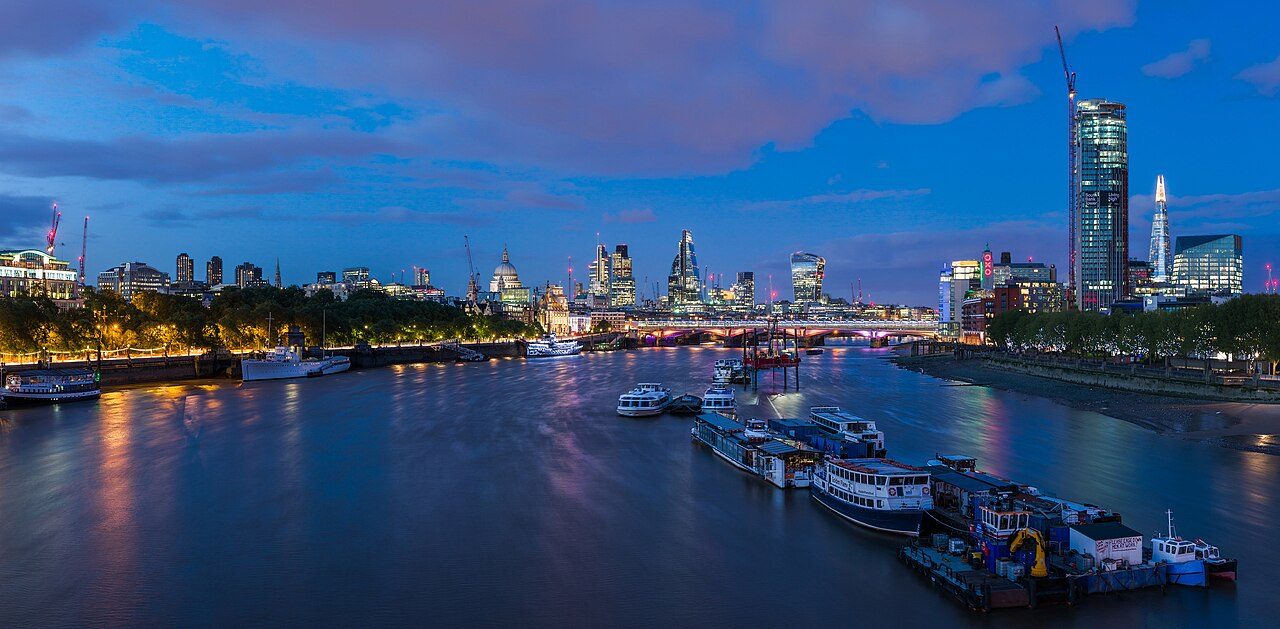
At a Glance
- Founded
- As Londinium, after the Roman invasion of Britain in 43 CE; first definite mention by Tacitus in 60 CE (Britannica)
- The river
- The Thames, some 50 miles (80 km) upstream from its North Sea estuary; the crossing point decided the site
- Roman London
- Burned by Boudica's forces in 60 CE, rebuilt, and enclosed by a stone wall around 200 CE
- Great Fire
- 2-5 September 1666: about 13,000 houses, 87 parish churches and old St Paul's Cathedral destroyed (Britannica)
- Growth
- Population passed one million by 1800 and reached about 6.5 million a century later (Britannica)
- The Blitz
- September 1940 to May 1941: sustained German bombing; more than 70,000 buildings destroyed in London (Britannica)
- Today
- Capital of the United Kingdom; Greater London was formed in 1965 and covers 607 square miles (1,572 sq km) (Britannica)
Introduction
London grew from three distinct centres, as Britannica describes them: the walled Roman settlement on the north bank of the Thames, now the City of London; the suburb of Southwark across the bridge; and, a mile upstream, Westminster, seat of government. Those three seeds - commerce, the river crossing and power - explain almost everything that followed. London was never a planned capital. It was a port that became a financial centre, a court that grew up beside it, and suburbs that eventually swallowed both.
Its history is also one of destruction and rebuilding. Fire has remade London at least three times - in 60 CE, in 1666 and in 1940-41 - and each time the city was rebuilt largely on its old lines, which is why a Roman wall line, a medieval street plan and a modern financial district still coexist within a few streets.
Londinium: The Roman City
Britannica traces London's founding to 43 CE, when Roman armies under Emperor Claudius began the occupation of Britain and established a settlement called Londinium just north of the marshy Thames valley, where two low hills stood beside a point the river could be bridged. The first definite mention of the place is by the historian Tacitus, writing about the year 60 CE - and what he records is a catastrophe. In that year Boudica, queen of the Iceni, led a revolt against Roman rule and burned Londinium to the ground.
The city was rebuilt in stone and prospered as a trading port. Around 200 CE the Romans enclosed it with a stone wall, whose line still marks the boundary of the old City. When Roman rule in Britain ended in the early 5th century, Londinium shrank almost to abandonment, and the next settlement, Saxon Lundenwic, grew up to the west, around what is now Covent Garden.
Medieval and Tudor London
King Alfred restored the old walled city in 886, moving London back inside the Roman walls for safety against Danish raids. After the Norman Conquest of 1066, William the Conqueror added the White Tower - begun in 1078, the first part of the Tower of London - at the wall's eastern end, as much to overawe the Londoners as to defend them. Westminster Abbey was consecrated in 1065, and Westminster became the permanent seat of royal government, fixing the two-centre pattern of City and court.
Medieval London grew rich on trade, above all wool and cloth, and governed itself through its guilds and its Lord Mayor. By the time Henry VIII was king, its population was at least 100,000. It was still a city of timber, plaster and narrow lanes - prosperous, crowded and dangerously flammable, as the 17th century would prove.
Plague, Fire and Rebuilding
Disaster struck first in 1665, when the Great Plague killed about 100,000 Londoners, in HISTORY's estimate - roughly a quarter of the city. A year later came the Great Fire. Britannica dates it 2-5 September 1666 and calls it the worst fire in London's history. It began accidentally in the house of the king's baker in Pudding Lane near London Bridge, and a violent east wind drove it through the wooden city for three days. It destroyed most of the civic buildings, old St Paul's Cathedral, 87 parish churches and about 13,000 houses. Samuel Pepys recorded it in his Diary.
Within days, Christopher Wren, John Evelyn and Robert Hooke each presented plans to rebuild London on regular streets. None was adopted, and the city rose again on its old lines - but in brick and stone, under new building rules. Wren's great work was the new St Paul's Cathedral and the parish churches around it. The Monument, erected in the 1670s near Pudding Lane, still commemorates the fire. In 1694 the Bank of England was founded, anchoring London's rise as a financial centre.
Timeline
- 43 CE
Roman armies invade Britain under Claudius; the settlement of Londinium is established on the north bank of the Thames.
- 60 CE
Boudica's forces burn Londinium during the revolt against Roman rule; Tacitus gives the first definite mention of the city.
- c. 200 CE
The Romans enclose Londinium in a stone wall whose line still bounds the old City of London.
- 886
King Alfred restores the walled city as a defence against Danish raids.
- 1066-1078
After the Norman Conquest, William the Conqueror begins the White Tower, the first part of the Tower of London.
- 1665
The Great Plague kills about 100,000 Londoners, roughly a quarter of the city, in HISTORY's estimate.
- 2-5 September 1666
The Great Fire destroys about 13,000 houses, 87 parish churches and old St Paul's Cathedral (Britannica).
- 1694
The Bank of England is founded, anchoring London's rise as an international financial centre.
- By 1800
London's population passes one million; a century later it reaches about 6.5 million (Britannica).
- September 1940 - May 1941
The Blitz: sustained German bombing devastates large parts of the City and the East End.
- 1965
Greater London is formed, uniting the City and the surrounding metropolitan county under one authority.
Empire, Industry and the Blitz
In the 19th century London became the largest city in the world and the capital of an empire. Its population, already over one million by 1800, reached 6.5 million a century later. Railways, the Underground (opened in 1863) and the great docks carried its growth, while cholera and overcrowding exposed the cost of building a metropolis faster than its sewers. The Victorian answer - embankments, main drainage and municipal government - is the infrastructure the modern city still stands on.
The 20th century tested it again. In the Second World War, London suffered intense aerial bombardment during the Blitz, from September 1940 to May 1941. Britannica records that more than 70,000 buildings were destroyed and many more damaged, yet the campaign failed to break Britain and the attacks were abandoned. Rebuilding after the war brought the Barbican on a bomb-flattened site, a green belt that halted sprawl, and, from the 1980s, a second financial district at Canary Wharf in the old docklands.
Myths and disputes
Was London founded in 43 CE or about 47 CE? Sources differ by a few years. Britannica traces the founding to the invasion of 43 CE under Claudius, while other accounts date the developed settlement of Londinium to about 47-50 CE, once the Thames bridge and port were built. The honest statement is that Londinium arose in the years immediately after 43 CE; no foundation charter survives to fix a single year.
How many died in the Blitz? Estimates in reputable sources differ, and this page does not hide it. Britannica's London article gives an estimated 43,000 dead in its question summary, while HISTORY puts the London Blitz toll at about 30,000 residents. The figures count different things - different areas and date ranges for the bombing - which is why attributed ranges, not a single confident number, are the right way to report them.
Did the Great Fire end the Great Plague? The popular story says the fire burned out the plague of 1665. In fact plague deaths were already falling before September 1666, and the fire destroyed the City centre while the plague had raged across a much wider London. Historians treat the fire-ends-plague claim as a myth: a coincidence of timing that hardened into folklore.
Legacy
London's legacy is continuity through catastrophe. The Roman wall still underlies the City's boundary, Wren's St Paul's still crowns the skyline the fire created, and the street plan the fire's planners failed to replace still carries a global financial district. Few cities have been burned, bombed and rebuilt so often and kept so much of their earlier selves.
It is also a standing lesson in how cities actually grow: not by master plans, which London rejected in 1666, but by accretion - a port, a court, a suburb, a railway, a docklands reborn as a financial district - each layer laid over the last, and each disaster absorbed into the pattern rather than erasing it.
Sources
- Encyclopaedia Britannica - London
- Encyclopaedia Britannica - Great Fire of London
- HISTORY - London: A History
- Historic Royal Palaces - A Chronology of the Tower of London (Google Arts & Culture)
The facts on this page were checked against these sources on 19 November 2026. The History Trail's permanent pages are researched and written for this site; the live profiles elsewhere on The History Trail are assembled automatically from Wikipedia and Wikidata.
About the Author
Researched and written by the The History Trail Editorial Team — the accountable editorial function behind this site's permanent story pages. The team works from the published sources cited on each page; it does not invent historians, reviewers or credentials, and it corrects errors openly.
Fact Check
Every load-bearing fact on this page traces to one of the sources listed above, and significant claims link to their source in the text. Our checking method is described on the methodology page; errors can be reported via the corrections page.
Sources & Citations
Cite this page as: The History Trail Editorial Team, The History Trail — this article's title, publication and update dates are shown beneath its headline. The full source list appears under Sources above; the site's source standards are on the sources page.