
Things
BBC
The BBC - the British Broadcasting Corporation - is Britain's publicly financed national broadcaster, operating under Royal Charter. It began on 18 October 1922 as the British Broadcasting Company, a private firm of radio manufacturers, and was refounded on 1 January 1927 as a public corporation under John Reith, whose mission for it - to inform, educate and entertain - defined public service broadcasting for the world.
At a Glance
- Founded
- 18 October 1922, as the British Broadcasting Company, Ltd., by a consortium of wireless manufacturers including Marconi
- First broadcast
- 14 November 1922, from station 2LO at Marconi House, London
- Became the Corporation
- 1 January 1927, when a Royal Charter replaced the private company with a public corporation
- First Director-General
- John Reith (later Lord Reith), general manager from 1922 and Director-General 1927-1938, who defined public service broadcasting: inform, educate, entertain
- World Service
- Began in 1932 as the Empire Service on shortwave; first foreign-language service (Arabic) in 1938; by the early 21st century in more than 40 languages
- Television first
- 2 November 1936 - the world's first regular high-definition television service, from Alexandra Palace, London
- Funding and charter
- Largely financed by the television licence fee; operates under Royal Charter, carries no advertising, and is required to be impartial
Introduction
The BBC began as a company formed to sell radio sets. On 18 October 1922, a consortium of wireless manufacturers - Marconi among them - founded the British Broadcasting Company, and on 14 November 1922 its London station, 2LO, began daily broadcasts. Nobody involved could have predicted that within five years the company would be abolished and refounded as something new in the world: a public corporation, funded by its audience, independent of both advertisers and direct government control, and charged not merely with entertaining the public but with informing and educating it.
That invention - public service broadcasting - is the BBC's real history. The programmes, from the Empire Service to the world's first regular television service, from wartime broadcasts heard in secret across occupied Europe to the World Service in more than 40 languages, are what the invention produced.
A Company to Sell Radios, 1922-1927
The first British radio initiatives after the First World War came from commercial firms, for whom broadcasting was a way to create demand for receivers. The British Broadcasting Company, Ltd., established in 1922, was a private corporation in which only British manufacturers were permitted to hold shares. Its first broadcasts came from Marconi House in London, and within weeks stations followed in Birmingham, Manchester and Newcastle. At the end of 1922 the company appointed as its general manager a 33-year-old Scottish engineer, John Reith - the man who would define what the BBC was for.
Reith believed broadcasting was a public service, not a trade. On the recommendation of a parliamentary committee, the company was liquidated, and on 1 January 1927 a public corporation, the British Broadcasting Corporation, replaced it under a Royal Charter. Reith became its first Director-General, serving until 1938. Britannica credits him with developing radio broadcasting throughout the British Isles, inaugurating the Empire shortwave service, and directing the development of the world's first regular television service. His concept of public service broadcasting - summed up in the mission to inform, educate and entertain - prevailed in Britain and influenced broadcasting in many other countries.
Broadcasting House, Empire and Television, 1927-1939
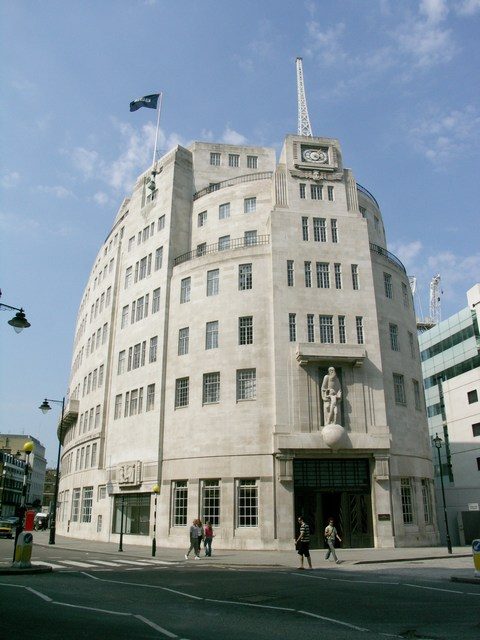
The young Corporation built itself a home and a world. In 1932 the BBC moved into Broadcasting House on Portland Place in London, the Art Deco headquarters designed by G. Val Myer. The same year it launched the Empire Service, broadcasting on shortwave from Daventry to listeners across the British Empire - the service that became the World Service. On Christmas Day 1932, King George V became the first monarch to deliver a Christmas message by radio, heard simultaneously across that Empire. Foreign-language broadcasting followed in 1938, beginning with an Arabic service, created in part to counter Italian propaganda in the Mediterranean.
Television came next. After years of experiments, including broadcasts using John Logie Baird's mechanical system, the BBC opened the world's first regular high-definition television service on 2 November 1936, from Alexandra Palace in London. Britannica notes the original charter gave the BBC a monopoly covering all phases of broadcasting in Britain - a monopoly of television it held until 1954, and of radio until 1972.
Timeline
- 18 October 1922
The British Broadcasting Company is formed by a consortium of wireless manufacturers, including Marconi, to broadcast and to sell radio sets.
- 14 November 1922
Daily broadcasting begins from station 2LO at Marconi House, London; Birmingham and Manchester follow within days.
- December 1922
John Reith, a 33-year-old Scottish engineer, is appointed the company's general manager.
- 1 January 1927
The Company is replaced by the British Broadcasting Corporation, a public corporation under Royal Charter; Reith becomes its first Director-General.
- 1932
The BBC moves into Broadcasting House in London and launches the Empire Service on shortwave - the forerunner of the World Service.
- 25 December 1932
King George V delivers the first royal Christmas message by radio, broadcast on the Empire Service.
- 2 November 1936
The BBC opens the world's first regular high-definition television service, from Alexandra Palace.
- 1938
The first foreign-language service, in Arabic, begins - the start of broadcasting in languages other than English.
- 1 September 1939
Television is suspended for the duration of the Second World War; it resumes in 1946.
- 1939-1945
BBC radio becomes a lifeline across occupied Europe, broadcasting news in many languages to listeners who risk punishment to hear it.
- 1964 and 1967
The BBC launches its second television channel in 1964 and introduces the first regular colour television service in Europe in 1967.
- 1991 and 1997
World Service Television begins in 1991; the 24-hour news channel BBC News 24 follows in 1997, taking the BBC into the continuous-news era.
The War: A Voice Across Occupied Europe
The Second World War made the BBC's reputation abroad. Television closed down on 1 September 1939, but radio expanded into the war's most contested territory: the airwaves of a continent under occupation. The BBC broadcast to Europe in a growing number of languages, and its strategy - noted by historians of its wartime Portuguese service among others - was credibility: to report British defeats as well as victories, so that listeners who could check nothing else would trust what London said. Exiled governments and resistance movements were given airtime, and the famous V for Victory campaign of 1941, launched on the European Service, turned a letter and a rhythm into a symbol chalked on walls across Europe.
People listened at real risk. In occupied countries, tuning to London could bring imprisonment or worse, yet audiences in the millions followed the broadcasts through the Blitz - during which Broadcasting House itself was bombed - to the end of the war. The trust earned in those years is the foundation on which the postwar World Service was built: regrouped after 1945, broadcasting in more than 40 languages by the early 21st century to roughly 120 million people, in Britannica's figures.
Significance
The BBC's significance is institutional before it is programmatic. It proved that a broadcaster could be publicly funded yet editorially independent - answerable ultimately to Parliament, as Britannica puts it, while enjoying virtually complete independence in the conduct of its activities, barred by its charter from advertising and from broadcasting opinions of its own on current affairs. That model, Reith's model, was copied, adapted and argued with by public broadcasters around the world. Within Britain, the BBC's monopolies shaped the culture for decades: television until 1954, radio until the early 1970s, and a shared national experience - coronations, wartime news, Christmas messages - that a commercial system would not have produced in the same form.
Questions readers ask
Was the BBC always a corporation? No. From 1922 to 1927 it was the British Broadcasting Company, a private firm owned by radio manufacturers; the Corporation dates from 1 January 1927 and the first Royal Charter. The distinction matters, because the change of one word marks the change of the whole idea - from selling sets to serving the public.
Who pays for the BBC? Principally, its audience: Britannica records that the BBC is largely financed by annual television licence fees paid by those who own television sets or watch live television on other devices. The World Service was historically funded separately, by government grant, reflecting its role abroad - one reason its history runs alongside Britain's foreign policy as well as its broadcasting.
Legacy
A century on, the BBC is the world's oldest national broadcaster still in its founding form, and its initials remain among the most recognised on earth. Its legacy is double: a library of programming exported worldwide, from Doctor Who to the natural-history films narrated by David Attenborough, and an idea - that a nation can fund a broadcaster precisely so that no advertiser and no government of the day controls it. Every argument about the licence fee, the Charter and impartiality is an argument about whether Reith's 1927 settlement still holds. That the argument continues, on the BBC's own airwaves among other places, is itself part of the legacy.
Sources
- Encyclopaedia Britannica - British Broadcasting Corporation
- Gale, In Context: World History - BBC
- Ditsong Museums of South Africa - The Founding of the British Broadcasting Corporation (BBC): Its Impact and Influence in the World Wars
- Transdiffusion Broadcasting System - 1922 BBC 1962: From Our Archive
- British Historical Society of Portugal - BBC Broadcasts to Portugal during the Second World War: Balancing Credibility with Political Objectives
The facts on this page were checked against these sources on 19 November 2026. The History Trail's permanent pages are researched and written for this site; the live profiles elsewhere on The History Trail are assembled automatically from Wikipedia and Wikidata.
About the Author
Researched and written by the The History Trail Editorial Team — the accountable editorial function behind this site's permanent story pages. The team works from the published sources cited on each page; it does not invent historians, reviewers or credentials, and it corrects errors openly.
Fact Check
Every load-bearing fact on this page traces to one of the sources listed above, and significant claims link to their source in the text. Our checking method is described on the methodology page; errors can be reported via the corrections page.
Sources & Citations
Cite this page as: The History Trail Editorial Team, The History Trail — this article's title, publication and update dates are shown beneath its headline. The full source list appears under Sources above; the site's source standards are on the sources page.