
Things
Zeus
Zeus is the chief god of ancient Greek religion, a figure of belief and myth known from the poems of Homer and Hesiod and from the sanctuaries his worshippers built across the Greek world. The god belongs to mythology; his cult is documented history - its temples, games, oracle tablets and statues survive, and at Olympia it produced one of the Seven Wonders of the Ancient World.
At a Glance
- Role
- Chief deity of the Greek pantheon; sky and weather god, sender of thunder, lightning, rain and winds, and ruler and protector of gods and humans
- Symbols
- The thunderbolt, his traditional weapon; the eagle was sacred to him
- Home
- Mount Olympus, Greece's highest mountain, where the twelve Olympians resided under his rule
- Main sources
- Homer's Iliad and Odyssey, and Hesiod's Theogony (about 700 BCE), the fullest early account of the origin of the gods
- Greatest sanctuary
- Olympia, where the Olympic Games were held in his honour every four years from 776 BCE; his temple (470-456 BCE) housed Phidias' colossal gold-and-ivory statue, one of the Seven Wonders
- Oldest oracle
- Dodona in Epirus, where the god was consulted through a sacred oak; over 4,100 inscribed lead question tablets survive
- Roman form
- Jupiter, also called Jove, chief god of the Roman state; his name survives in the planet Jupiter and the word 'jovial'
Introduction
Zeus was, in Britannica's summary, regarded as the sender of thunder and lightning, rain and winds, and called the father of gods and men - 'father' meaning ruler and protector. From the summit of Mount Olympus he was thought to see everything, govern all, reward good conduct and punish evil. He was the protector of cities, the home, property, strangers, guests and supplicants, and the guarantor of oaths and justice. No Greek god had so wide a brief, and none left so wide a trail in stone.
Yet he had no scripture and no church. Greek religion was carried by poets, festivals, sacrifices and local cults, and its chief god could be honoured at a household altar as Zeus Herkeios, guardian of the house, or at the greatest sanctuary of the Greek world.
The Sources: Homer and Hesiod
The fifth-century BCE historian Herodotus remarked that Homer and Hesiod gave the Olympian gods their familiar characteristics. Hesiod's Theogony, written about 700 BCE, is the fullest early account of the origin of the gods: a genealogy that begins with Chaos and Earth and ends with Zeus's order. In it, Cronus, king of the Titans, swallows each of his children at birth, because one is fated to dethrone him; his wife Rhea saves the sixth, Zeus, by giving Cronus a stone wrapped in swaddling clothes, and the child is hidden in a cave on Crete.
Grown, Zeus forces Cronus to disgorge his siblings, defeats the Titans with his brothers Hades and Poseidon, and divides the world with them: Zeus takes the sky, Poseidon the sea, Hades the underworld. From the Cyclopes he receives the thunderbolt. Homer's Iliad and Odyssey, the other foundation, show the finished king: presiding over the quarrelling Olympians, steering the Trojan War, sending omens to mortals. The poets did not always agree - Homer makes Aphrodite a daughter of Zeus and Dione, against the Hesiodic tradition - because there was no authorised version to agree with.
The Cult in Stone and Oak: Olympia and Dodona
Olympia, in the western Peloponnese, became a centre for the worship of Zeus in the tenth century BCE, and from 776 BCE the Olympic Games were held there every four years as part of his festival, until the Roman emperor Theodosius I abolished pagan festivals at the end of the fourth century CE. The sanctuary, the Altis, filled with temples, altars and votive offerings, and its Temple of Zeus, built between 470 and 456 BCE, was the largest building on the site.
Inside it stood the Wonder. Phidias, fresh from the Parthenon, spent about eight years making a seated Zeus almost twelve metres high: ivory plates for the flesh, gold panels over a wooden framework, on a cedarwood throne ornamented with ebony, ivory, gold and precious stones, a figure of Victory in his right hand and a sceptre topped by his eagle in his left. Ancient writers ranked it among the Seven Wonders of the World. The statue is lost and no accurate copy survives, but archaeology found its birthplace: the remains of Phidias' workshop at Olympia, excavated in the 1950s where the traveller Pausanias had said it stood, confirmed the statue's date of about 430 BCE.
His other great address was Dodona in Epirus, in the north-west of Greece - in Herodotus's words, the most ancient oracle in Greece, and in prestige second only to Delphi. The god spoke through a sacred oak, and priests and priestesses who went barefoot, never washed their feet and slept on the ground interpreted the rustling of its leaves, the calls of its doves and the ringing of bronze cauldrons set around it. From the late sixth century BCE, questioners wrote their questions - about health, money, work and family - on thin lead tablets, and more than 4,100 of these tablets have been excavated; they joined UNESCO's Memory of the World Register in 2023.
Zeus Becomes Jupiter
The Romans regarded Jupiter - also called Jove - as the equivalent of Zeus, and made him the chief deity of the Roman state throughout the Republic and the Empire; his great temple stood on the Capitoline Hill in Rome. In Latin literature and Roman art, the myths and iconography of Zeus were retold and adapted under Jupiter's name. The two names are themselves cousins: Jupiter means 'sky father', and Britannica notes that Zeus's name may be related to that of Dyaus, the sky god of the ancient Indian Rigveda - both descend from the same old Indo-European sky god.
Timeline
- End of 2nd millennium BCE
The cult of Zeus is argued to have replaced an earlier earth-goddess cult at Dodona, the site of his sacred oak.
- c. 700 BCE
Hesiod composes the Theogony, the fullest early account of the birth of the gods and of Zeus's rise to power.
- 776 BCE
The Olympic Games are first held at Olympia, as part of the festival of Zeus; they will repeat every four years for more than a millennium.
- Late 6th century BCE
Questioners at Dodona begin writing their questions to Zeus on lead tablets; more than 4,100 will survive.
- 470-456 BCE
The Temple of Zeus is built at Olympia, the largest building in the sanctuary.
- c. 430 BCE
Phidias completes the gold-and-ivory statue of Zeus, later counted among the Seven Wonders of the Ancient World.
- 391 CE
Theodosius bans pagan divination and shrines; the sacred oak at Dodona is cut down and the oracle ends.
- 426 CE
The temples at Olympia are destroyed under Theodosius II; Phidias' statue may have perished then, or later in a fire at Constantinople.
- 1875-81
German excavations clear the sacred precinct at Olympia and reveal the plan of a great Greek sanctuary for the first time.
- 1954-58
Phidias' workshop at Olympia is rediscovered, confirming the statue's date.
- 1989
Olympia is inscribed as a UNESCO World Heritage site.
Significance
Zeus shows how Greek religion organised a world. He was the divine form of its central ideas: that power should answer to order, that oaths bind, that guests and strangers stand under protection, and that justice - his daughter Dike - watches human affairs. Because his cult was pan-Hellenic, shared by all Greeks rather than owned by one city, Olympia could serve as common ground where the whole Greek world met every four years in his honour - the nearest thing the warring city-states had to a shared institution.
Questions readers ask
What happened to the statue at Olympia? Nobody knows. Britannica lists the possibilities: it may have been ruined with its temple in 426, destroyed in the temple clearances ordered in 435, shaken down by sixth-century earthquakes, or carried to Constantinople and burned in a palace fire. No accurate copy survives; its appearance is known from ancient descriptions and from its image on coins.
Is the Artemision Bronze a statue of Zeus? Probably, but not certainly. The over-life-size bronze recovered from the sea off Cape Artemision in 1926-28 holds its right hand empty: a thunderbolt would make it Zeus, a trident Poseidon. Most scholars lean to Zeus, but the statue, now in Athens' National Archaeological Museum, keeps its question open.
Legacy
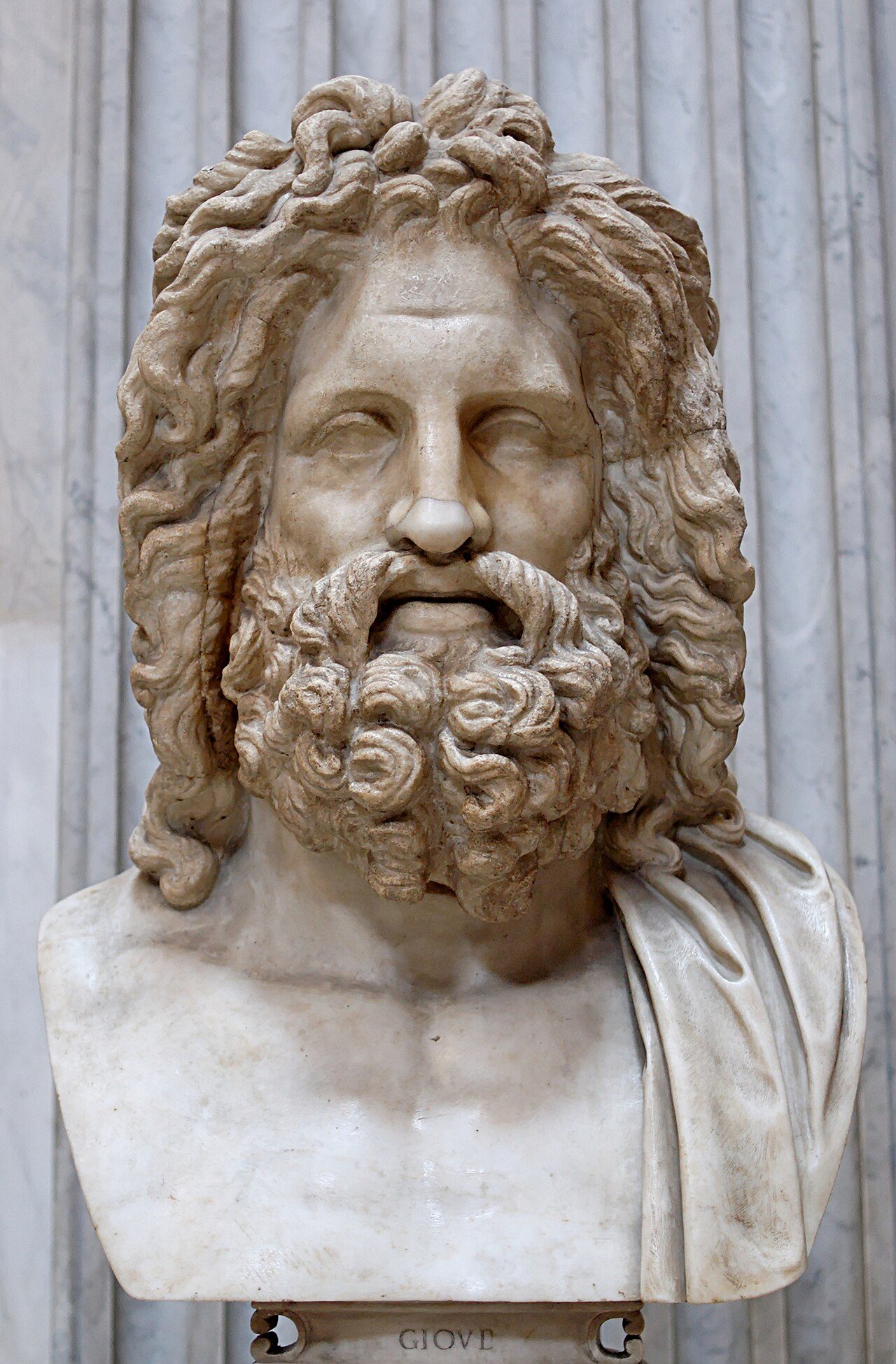
Zeus never stopped being pictured. The marble Zeus of Otricoli - a Roman copy after a fourth-century BCE Greek original, found in 1775 and now in the Vatican Museums - became so standard a face of divine authority that a Baroque sculptor copied its head for God the Father on a church in Warsaw. Renaissance and Baroque artists took up his myths again and again, and the bearded thunderer remains the template for depicting supreme power in Western art.
His Roman name is in the sky and in the dictionary: the largest planet is Jupiter. People born under that planet were once thought cheerful, which is why 'jovial', from Jove, means good-humoured. 'By Jove!' survives from the Roman practice of swearing by him in the law courts. And Thursday in French and Italian - jeudi and giovedi - still descends from dies Jovis, Jupiter's day.
Sources
- Encyclopaedia Britannica - Zeus
- Encyclopaedia Britannica - Statue of Zeus
- Encyclopaedia Britannica - Olympia
- Greek Ministry of Culture, Egnatia Cultural Route - Dodona
The facts on this page were checked against these sources on 19 November 2026. The History Trail's permanent pages are researched and written for this site; the live profiles elsewhere on The History Trail are assembled automatically from Wikipedia and Wikidata.
About the Author
Researched and written by the The History Trail Editorial Team — the accountable editorial function behind this site's permanent story pages. The team works from the published sources cited on each page; it does not invent historians, reviewers or credentials, and it corrects errors openly.
Fact Check
Every load-bearing fact on this page traces to one of the sources listed above, and significant claims link to their source in the text. Our checking method is described on the methodology page; errors can be reported via the corrections page.
Sources & Citations
Cite this page as: The History Trail Editorial Team, The History Trail — this article's title, publication and update dates are shown beneath its headline. The full source list appears under Sources above; the site's source standards are on the sources page.