
Things
Heracles
Heracles - Hercules to the Romans - is a hero of Greek myth, not a documented historical person, and his twelve labours are stories, not events. What is real and documented is everything around the stories: one of the widest hero-cults of the ancient world, temples and festivals across Greece, his Roman life as Hercules, and an image in art that runs from Greek vases to Disney's film of 1997.
At a Glance
- Who he is in the myth
- Son of Zeus and the mortal Alcmene; the strongest of the Greek heroes, persecuted all his life by Hera
- The labours
- Twelve tasks imposed by King Eurystheus as atonement - from the Nemean lion to Cerberus, fetched up from the underworld
- Why twelve
- The cycle began as ten; Eurystheus disallowed two, the Hydra and the Augeas stables, and demanded two more
- The cult
- Worshipped across the Greek world as both hero and god, patron of gymnasia and young men; centre at Thebes
- The Roman name
- Hercules, worshipped in Italy as a god of merchants and traders and adopted as a model by Roman emperors
- The statue
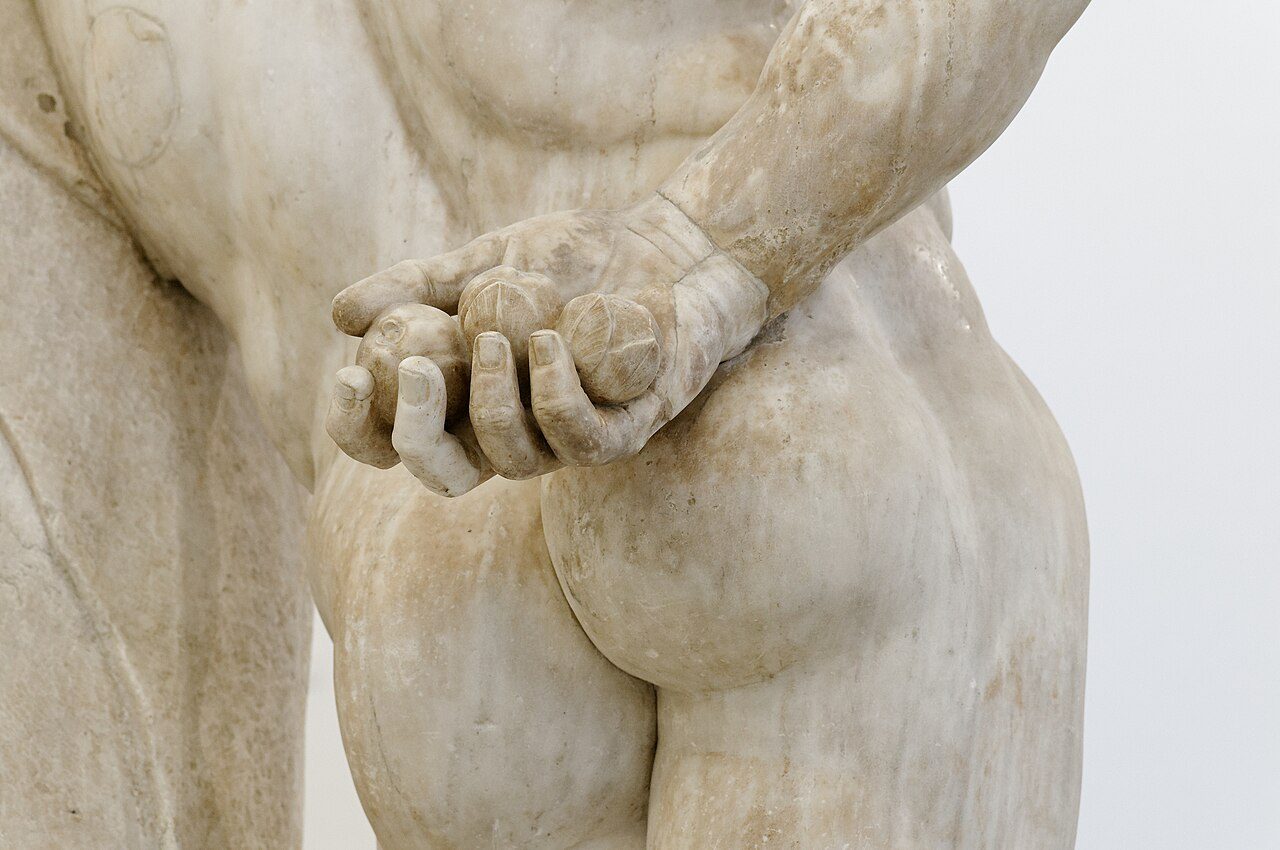
- The Farnese Hercules, signed by Glykon about AD 216, after a 4th-century BC bronze by Lysippos; now in Naples
- The film
- Disney's animated Hercules (1997) retells the myth under his Roman name, with the story much altered
Introduction
Heracles, one of the most famous Greco-Roman legendary heroes, was traditionally the son of Zeus, chief of the Greek gods, and the mortal Alcmene. Britannica recounts how Zeus's wife Hera, his persecutor for life, sent two serpents to kill him in his cradle - and the infant strangled them with his bare hands. From that first story everything follows: superhuman strength, a life of violence done and suffered, and unmatched fame.
He is a figure of myth, not of history, and this page treats him that way. The twelve labours are stories. But the worship of Heracles was real religious practice, documented in sanctuaries, festivals and sacrifices across the Greek world; the Romans really did adopt him as Hercules; and his image in art, from painted vases to a colossal Roman statue to a Disney cartoon, is a matter of record.
The Twelve Labours
Grown to manhood, Heracles married Megara, daughter of the king of Thebes, but in a fit of madness sent by Hera he killed her and their children. To atone, Britannica explains, he consulted the oracle at Delphi and was told to become the servant of King Eurystheus, his cousin and destined master. It was Eurystheus who imposed the famous labours, later arranged in a cycle of twelve.
The usual list runs: the Nemean lion, whose impenetrable skin he thereafter wore; the nine-headed Hydra of Lerna; the hind of Arcadia; the boar of Mount Erymanthus; the Augean stables, cleansed in a single day; the man-eating birds of Stymphalus; the bull of Crete; the mares of Diomedes; the girdle of Hippolyte, queen of the Amazons; the cattle of the three-bodied giant Geryon in the far west; the golden apples of the Hesperides at the world's end; and, last, Cerberus, the triple-headed dog of the underworld, fetched up alive. The count began at ten: Eurystheus refused the Hydra, because Heracles had help, and the stables, because he took payment, and demanded two more.
A Hero Who Was Really Worshipped
Unlike most heroes, Heracles had no single tomb, and Greek cities argued over whether he was a dead hero, a god, or both at once. The travel writer Pausanias, describing Sicyon in the 2nd century AD, records a festival at which the Sicyonians sacrificed to Heracles in both ways in a single rite: they burned the lamb's thighs on the altar as for a god, and offered the rest as for a hero. Pindar's phrase for him was heros theos - hero-god.
The cult was everywhere. Thebes, his birthplace in the myth, was its centre, with a sanctuary, gymnasium and racecourse named after him. Athens kept the festival of the Heracleia at the Cynosarges gymnasium, where he was honoured as patron of young men and of athletic training; gymnasia across Greece placed him beside Hermes as their guardian. In Italy, Britannica notes, he was worshipped as a god of merchants and traders, and others prayed to him for good luck and rescue from danger.
Roman Hercules and the Long Life in Art
Rome took the hero over early and made him Hercules, adapting his cult to Roman ground. Roman story tied him to the city itself: returning with Geryon's cattle, he killed the fire-breathing robber Cacus on the Aventine hill, and his great altar, the Ara Maxima, stood in Rome's cattle market, the Forum Boarium. Later, Roman emperors such as Commodus and Maximian identified themselves publicly with Hercules, borrowing his club and lion skin as imperial costume.
Artists never let him rest. Athenian vase-painters of the 6th century BC returned again and again to the Nemean lion fight; the metopes of the Temple of Zeus at Olympia carved the twelve labours in stone; and the Farnese Hercules, signed by Glykon about AD 216 for the Baths of Caracalla in Rome, copied a lost bronze by Lysippos and fixed the hero's weary physique in the European imagination. The line runs unbroken to Walt Disney's animated Hercules of 1997, which used the Roman name, kept the superhuman strength, and rewrote nearly everything else for a family audience.
Timeline
- About 570-560 BC
A Laconian drinking cup paints the apotheosis of Heracles - Athena leading the hero, now a god, to the enthroned Zeus.
- About 540 BC
Athenian black-figure vase-painters, among them the painters of the Metropolitan Museum's amphora, make Heracles wrestling the Nemean lion a favourite subject.
- About 450-440 BC
A red-figure calyx-krater shows Heracles in the underworld on the last labour, the fetching of Cerberus.
- Classical Greece
The labours are arranged in the canonical cycle of twelve, carved among other places on the Temple of Zeus at Olympia.
- Every year, late July or early August
Athens celebrates the Heracleia, the festival of Heracles, at the Cynosarges gymnasium outside the city walls.
- 2nd century AD
Pausanias describes Heracles sanctuaries and the Sicyonian rite that sacrifices to him as both god and hero; Roman sarcophagi carve the labours in marble.
- About AD 216
Glykon signs the colossal marble Farnese Hercules, made for the Baths of Caracalla in Rome after a bronze by Lysippos.
- 1546
The Farnese Hercules is excavated at the Baths of Caracalla and passes into the Farnese collection.
- 1787
The statue is moved with the Farnese collection to Naples, where it remains in the National Archaeological Museum.
- 27 June 1997
Disney releases its animated musical Hercules, directed by John Musker and Ron Clements - the myth retold, and much altered, for children.
Significance
Heracles was the most popular hero of the ancient world because his story joined two things Greek religion usually kept apart: the suffering mortal and the god. He was strong enough to cleanse the earth of monsters, yet he was also a murderer of his own family, a servant to a lesser king, and a man destroyed at last by a poisoned shirt. His cult let ordinary people - athletes, travellers, merchants, the sick at healing springs - claim that such a figure watched over them. Royal houses claimed descent from him, the Heracleidae, and cities from Thebes to Rome built their identities around his shrines.
He also set the pattern every later strongman hero follows: the impossible tasks, the signature weapons - club, bow and lion skin - and the death that is not quite an ending, since in the myth his mortal part burned on the pyre on Mount Oeta while his divine part ascended to Olympus, where he was reconciled to Hera and married Hebe.
Myths and disputes
Was Heracles a real man? There is no evidence that he was. Later ancient writers sometimes read him euhemeristically, as a historical strongman whose deeds grew in the telling, but no inscription, grave or contemporary record supports a historical Heracles, and the stories themselves - a baby strangling serpents, a nine-headed Hydra, a descent to fetch the dog of the dead - declare their own kind. What is historical is the cult: temples, festivals and sacrifices are documented facts of Greek and Roman religion.
Even the labours are less fixed than they look. Ancient authors do not all give the same order, and the cycle's neat dozen was an arrangement made over time - ten tasks, two disallowed, two added. Disney's film shows how far retelling can go: it makes Hercules the son of Zeus and Hera, turns Hades into the villain, and removes the madness and the killing of Megara and the children altogether. It is a film loosely based on the myth, and this page treats it as the latest retelling, not as a source for the story.
Legacy
Hercules is now a common noun and an adjective - a herculean task needs no explanation in any European language - and a constellation bears his Roman name. His labours remain the West's standard image of heroic endurance, endlessly repainted, carved, filmed and parodied. The hero himself never lived; but few historical figures of the ancient world can match the evidence he left behind, because his evidence is of a different kind: not bones and inscriptions of a man, but temples, festivals, statues and stories that real people made, paid for and believed in for well over a thousand years.
Sources
- Encyclopaedia Britannica - Heracles
- Encyclopaedia Britannica - Labours of Hercules
- The Metropolitan Museum of Art - Terracotta Vase Fragment with Figure of Hercules
- Uppsala University, Digital Periegesis - Pausanias, Description of Greece, on the Cult of Heracles at Sicyon
- Wikipedia - Hercules (1997 film)
The facts on this page were checked against these sources on 19 November 2026. The History Trail's permanent pages are researched and written for this site; the live profiles elsewhere on The History Trail are assembled automatically from Wikipedia and Wikidata.
About the Author
Researched and written by the The History Trail Editorial Team — the accountable editorial function behind this site's permanent story pages. The team works from the published sources cited on each page; it does not invent historians, reviewers or credentials, and it corrects errors openly.
Fact Check
Every load-bearing fact on this page traces to one of the sources listed above, and significant claims link to their source in the text. Our checking method is described on the methodology page; errors can be reported via the corrections page.
Sources & Citations
Cite this page as: The History Trail Editorial Team, The History Trail — this article's title, publication and update dates are shown beneath its headline. The full source list appears under Sources above; the site's source standards are on the sources page.