
Things
Medusa
Medusa is a figure of Greek myth, not a historical person. In the earliest surviving account, Hesiod's, she is one of three Gorgon sisters, and the only one who could die. The Medusa most people now know - a beautiful woman wronged, punished and beheaded - comes from a Roman poet writing seven centuries later. This page separates the versions, following her face through Greek temples, Renaissance art and a fashion logo.
At a Glance
- Status
- A figure of Greek myth, not a historical person; she is known only from ancient texts and artworks
- In Hesiod
- The earliest account (8th century BC): one of three Gorgon sisters, daughters of Phorcys and Ceto, and the only mortal one
- In Ovid
- A much later Roman version (about AD 8): a beautiful maiden whose hair Minerva turned to snakes after Neptune came to her in Minerva's temple
- Killed by
- Perseus, in the myth, who beheaded her while watching her reflection in a polished shield; Pegasus and Chrysaor sprang from her neck
- The gorgoneion
- Her isolated face, used across ancient Greek art and architecture as a protective, evil-averting emblem - including on Athena's aegis
- Famous artworks
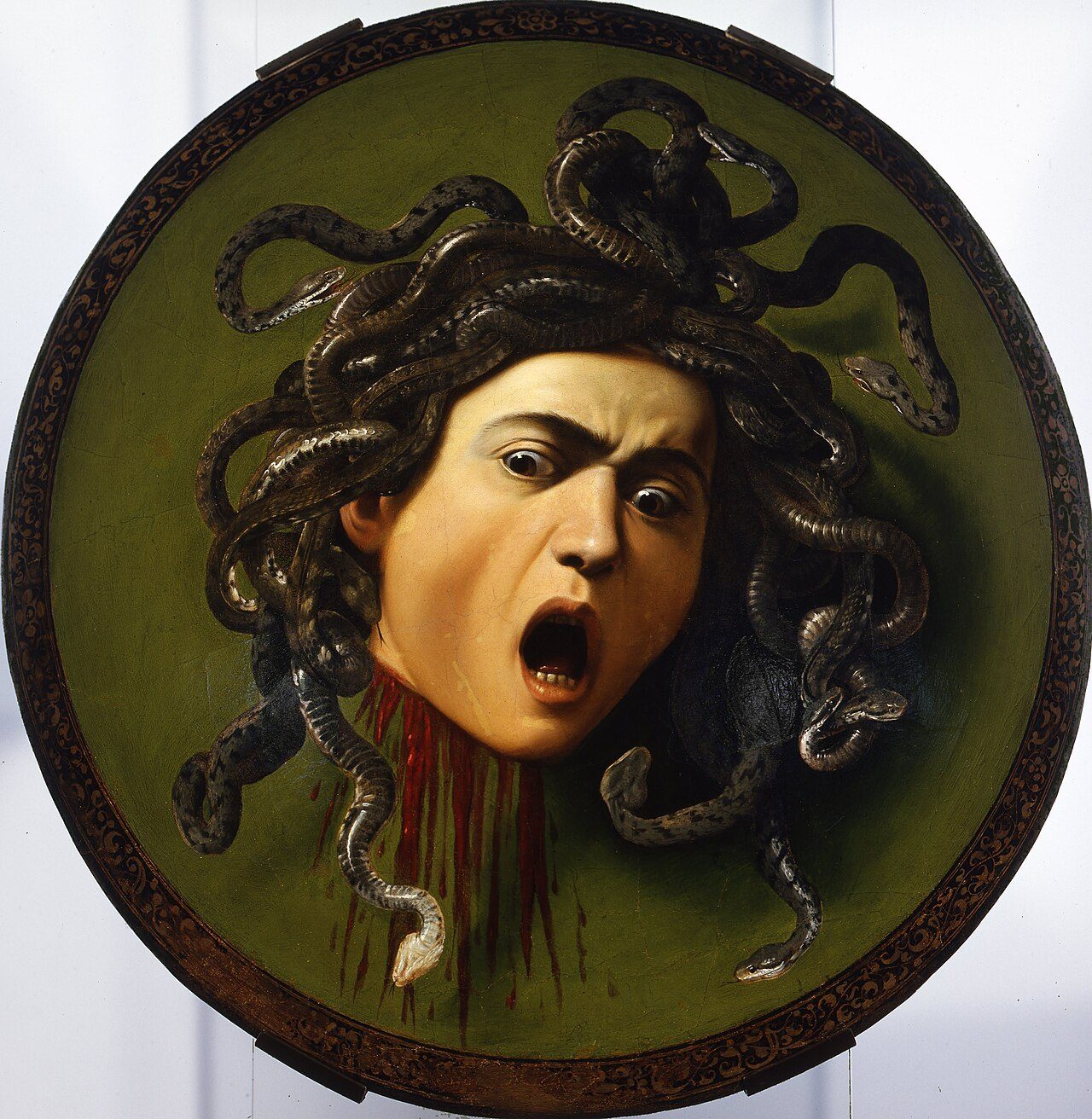
- Cellini's bronze Perseus with the Head of Medusa (1545-1554) in Florence, and Caravaggio's Medusa painted on a shield (about 1597), now in the Uffizi
- Modern emblem
- The Versace fashion house's logo since 1993, and, reversed in Luciano Garbati's 2008 statue, a debated symbol of the MeToo era
Introduction
In the myth, Medusa is one of three sisters called the Gorgons. Her hair is a nest of living snakes, and anyone who looks directly at her is turned to stone. The hero Perseus, sent to fetch her head, beheads her while she sleeps by watching her reflection in a polished shield. From her neck spring Pegasus and Chrysaor. The head keeps its power after death: Perseus uses it against his enemies, then gives it to Athena, who sets it on her shield. It is only a story, and the ancient sources do not agree on its shape.
That disagreement is the subject of this page. There is no single ancient account of Medusa. In the earliest surviving telling she is a monster from birth, one sister among three. In a Roman retelling written some seven centuries later she begins as a beautiful, wronged mortal. Since then her face has been carved on temples, painted on cups, cast in bronze, repainted by Caravaggio, adopted as a fashion logo and recast, in our own century, as a symbol in arguments about sexual violence. Her documented history is the history of those tellings and images.
The Earliest Medusa: Hesiod's Gorgon
The Greek poet Hesiod, writing in the eighth century BC, gives Medusa her earliest surviving biography, and it is brief. In his Theogony she is one of three Gorgon sisters - Stheno, Euryale and Medusa - daughters of the sea gods Phorcys and Ceto. Her sisters are immortal; Medusa alone can die, which is why her head can be taken at all. Poseidon lies with her in a meadow; Perseus cuts off her head, and Pegasus and Chrysaor spring from her body. That is nearly all: no beauty, no offence, no punishment - she is a Gorgon from the start.
Later Greek writers added colour without changing that outline: Pindar told how Athena invented the flute to imitate the wailing of Medusa's sisters over her body. Greek artists made her face monstrous in a standard way: round, staring, wide-mouthed, with protruding tongue, tusks and sometimes a beard.
Ovid's Medusa: The Wronged Mortal
The version most people now know comes from the Roman poet Ovid, whose Metamorphoses was completed around AD 8 - roughly seven hundred years after Hesiod. In Ovid, Perseus himself explains why Medusa's hair is snakes. She had once been a beautiful maiden, famous above all for her hair. Neptune, the Roman Poseidon, came to her in the temple of Minerva, the Roman Athena; the goddess, turning her own eyes away, punished the violation of her temple by changing Medusa's hair into serpents. Modern retellings often call the temple episode a rape, as does the Smithsonian's account; the structure is not in dispute: the god acts, and the woman carries the punishment, before being killed by Perseus as a monster.
Two honest cautions belong here. First, Ovid is a late, literary retelling: his beautiful, punished Medusa is no more a fact than Hesiod's born monster, and neither poet was recording history. Second, popular versions add details Ovid does not give - that Medusa was a priestess of Athena, for instance. Ovid says no such thing. Keeping the versions apart matters, because most of what is said about Medusa today depends on which telling is silently being used.
The Gorgoneion: A Face Put to Work
Whatever the poets said, the ancient world mostly met Medusa as an image. The Metropolitan Museum of Art explains the gorgoneion - the isolated head or face of Medusa - as an apotropaic device: a dangerous face displayed to ward off danger, an image of evil used to repel evil. It was everywhere. On Temple C at Selinunte in Sicily, built around 540 BC, monumental gorgoneia dominated the pediments. Smaller gorgoneia covered temple roof tiles across the Greek world. Her face was painted inside drinking cups, worked into jewellery, and carried on shields and helmets.
Most powerful of all, the gorgoneion sat on the aegis of Athena herself: her great Parthenon statue carried Medusa's head on both aegis and shield. The image also changed with the centuries. Archaic Medusas are grotesque, bearded and gaping; by the classical period the face softens into a beautiful woman's, keeping the wild hair, later the snakes, and always the frontal, unflinching stare - almost alone in Greek art, Medusa looks straight out at the viewer.
Renaissance Faces: Cellini and Caravaggio
Renaissance Florence gave the myth two famous objects. Between 1545 and 1554 Benvenuto Cellini cast his bronze Perseus with the Head of Medusa for the Loggia dei Lanzi, where it still stands: the hero holds the snake-haired head high over Medusa's body. Around 1597 Caravaggio painted Medusa at the instant of beheading, eyes wide and mouth open in a scream, on an actual convex ceremonial shield. Cardinal del Monte commissioned it as a gift for Grand Duke Ferdinando I de' Medici; it is now in the Uffizi Gallery. Caravaggio is widely said to have given Medusa his own face.
Timeline
- 8th century BC
Hesiod's Theogony names the three Gorgon sisters; Medusa alone is mortal.
- About 540 BC
Temple C at Selinunte in Sicily is built with monumental gorgoneia on its pediments.
- About 450-440 BC
An Athenian vase attributed to Polygnotos shows Perseus beheading the sleeping Medusa, depicted as beautiful.
- About AD 8
Ovid completes the Metamorphoses: Medusa was a beautiful maiden punished by Minerva after Neptune came to her in the temple.
- 1545-1554
Cellini casts his bronze Perseus with the Head of Medusa, still in Florence's Loggia dei Lanzi.
- About 1597
Caravaggio paints Medusa on a ceremonial shield, a gift for Grand Duke Ferdinando I; now in the Uffizi.
- 1993
Gianni Versace adopts the head of Medusa as the Versace fashion house's logo.
- 2008
Luciano Garbati sculpts Medusa with the Head of Perseus, reversing Cellini's composition.
- 2020
Garbati's statue is installed in New York, opposite the courthouse where Weinstein was tried, as a debated MeToo symbol.
Significance
Medusa's significance is double. In the ancient world her face was protective technology, reproduced for centuries on temples, armour and objects of daily use because it was believed to work: the Metropolitan Museum calls her truly ubiquitous, present in every medium Greek art possessed. She also shows that myths have no fixed text: Hesiod's monster, Ovid's wronged maiden, the archaic gargoyle and the classical beauty are all Medusa, each belonging to the age that made her. Modern scholars, Britannica notes, increasingly read her as a tragic, even feminist figure - a reading unrecognisable to Hesiod, resting almost entirely on Ovid.
Questions readers ask
Was Medusa real? No. She is a figure of Greek myth, known only from ancient poems and artworks; no evidence supports a historical person behind her. Was she always a monster? That depends on the source: in Hesiod, the earliest account, yes - she is a Gorgon from birth. In Ovid, written centuries later, no - she was a beautiful woman transformed as a punishment. Neither version is a report of fact; they are different tellings, and honest accounts keep them separate. Was she a priestess of Athena? Ovid does not say so; the detail is a later embellishment. Did her head turn people to stone? Within the myth, yes - hence the special bag Perseus carried it in, and Athena's shield.
Legacy
The modern legacy runs in two directions at once. In 1993 Gianni Versace made Medusa's head the logo of his fashion house. The house's own telling traces the choice to a Medusa mosaic in the ruins of Reggio Calabria, where Gianni played as a child - the petrifying gaze as a brand. Luciano Garbati's Medusa with the Head of Perseus (2008) deliberately reversed Cellini: his Medusa stands with sword in hand and Perseus's head in the other, determined rather than triumphant. Installed in New York in 2020 opposite the courthouse where Harvey Weinstein had been tried, the statue was embraced as a MeToo emblem and criticised in the same breath - by viewers who asked why Medusa holds Perseus's head rather than Poseidon's. Three thousand years on, she is still the face people reach for in arguments about beauty, blame and power.
Sources
- The Metropolitan Museum of Art - Medusa in Ancient Greek Art
- Encyclopaedia Britannica - Medusa
- Smithsonian Magazine - Why a New Statue of Medusa Is So Controversial
- Uffizi Galleries - Caravaggio and the 17th century
- Encyclopaedia Britannica - Perseus (sculpture by Cellini)
- Rosenthal - Versace Medusa: meaning of the Medusa head
The facts on this page were checked against these sources on 19 November 2026. The History Trail's permanent pages are researched and written for this site; the live profiles elsewhere on The History Trail are assembled automatically from Wikipedia and Wikidata.
About the Author
Researched and written by the The History Trail Editorial Team — the accountable editorial function behind this site's permanent story pages. The team works from the published sources cited on each page; it does not invent historians, reviewers or credentials, and it corrects errors openly.
Fact Check
Every load-bearing fact on this page traces to one of the sources listed above, and significant claims link to their source in the text. Our checking method is described on the methodology page; errors can be reported via the corrections page.
Sources & Citations
Cite this page as: The History Trail Editorial Team, The History Trail — this article's title, publication and update dates are shown beneath its headline. The full source list appears under Sources above; the site's source standards are on the sources page.