
Things
Odin
Odin is the chief god of Norse mythology, known from medieval Icelandic texts - the Poetic Edda and Snorri Sturluson's Prose Edda - which recorded a pre-Christian religion's stories two centuries after Scandinavia had converted. Odin himself is a figure of belief and myth, not of documented history; what history documents is his worship in the Viking Age, the poems that preserve him, and the marks he left on language and art.
At a Glance
- Role
- Chief of the Aesir, the main family of Norse gods; god of war, wisdom, poetry, magic, runes and the dead
- Main sources
- The Poetic Edda, older poems preserved in an Icelandic manuscript of about 1270, and Snorri Sturluson's Prose Edda of about 1220
- Other names
- Woden in Old English, Wotan in German - the forms behind Wednesday, 'Woden's day'
- Companions
- The ravens Huginn ('thought') and Muninn ('memory'), the wolves Geri and Freki, and the eight-legged horse Sleipnir
- His hall
- Valhalla, where the valkyries bring half of those slain in battle to feast and train for Ragnarok
- His price for wisdom
- One eye, given in exchange for wisdom; in the Havamal he hangs wounded on the world tree for nine nights to win the runes
Introduction
The Odin we know is a literary survivor. No scripture of the old Norse religion was ever written down by its believers; the fullest accounts come from Iceland in the thirteenth century, when the island had been Christian for over two hundred years and the old gods survived as poetry, history and entertainment. What those texts describe is a god unlike the distant high gods of other religions: an ageing, one-eyed wanderer, restless for knowledge, who decides the outcome of battles, patronises poets, and gathers slain warriors around him in Valhalla.
Britannica warns that his exact nature and role are difficult to determine, because the archaeological and literary sources give so complex a picture. Later sources make him Scandinavia's principal god at the end of the pre-Christian period, but the material evidence tells a quieter story: his cult seems to have belonged especially to kings, chieftains, warriors and poets, while his son Thor was the god ordinary people wore around their necks.
The Sources: Two Eddas and the Skalds
The Poetic Edda is an anthology of anonymous Old Norse poems about gods and heroes, preserved mainly in the Codex Regius, an Icelandic manuscript written around 1270. The poems themselves are older - traditional material reaching back into the pagan period - and Odin appears in most of them: questioning a seeress about the end of the world in Voluspa, trading riddles with a giant in Vafthrudnismal, and reciting the worlds' structure under torture in Grimnismal.
The Prose Edda, written around 1220 by the Icelandic chieftain, lawspeaker and poet Snorri Sturluson, is a handbook: Snorri set out to teach young Christian poets the old mythology, because skaldic verse was unintelligible without it. His Gylfaginning retells the myths as one connected story, from the creation of the world out of the slain giant Ymir to its destruction at Ragnarok. Skaldic poetry itself - praise poems composed at Viking-Age courts, many quoted by Snorri - is the oldest layer of all, and already names Baldr, Thor and Vali as Odin's sons.
The God in the Stories
In the myths, Odin and his brothers Vili and Ve kill the primordial giant Ymir and build the world from his body - flesh for earth, blood for sea, skull for sky - then shape the first humans, Ask and Embla, from wood. Knowledge is his obsession, and he pays for it in flesh. He gives one eye for Mimir's wisdom; in Snorri's telling, the severed head of Mimir, preserved by Odin with herbs, keeps advising him afterwards. In the Havamal, Odin hangs on the world tree Yggdrasil for nine nights, wounded with a spear, 'myself to myself', until the runes are revealed to him. He steals the mead of poetry from the giants and brings it to gods and men, which is why he is the god of poets as well as of war.
Every day his two ravens, Huginn and Muninn - thought and memory - fly out over the world and return to sit on his shoulders and whisper what they have seen and heard; the Prose Edda has Odin confess he fears more for Muninn's return than for Huginn's. His wolves Geri and Freki share his hall, and his eight-legged horse Sleipnir can gallop through the air and over the sea. In Valhalla the valkyries serve the einherjar, the chosen slain, who feast and fight in training for Ragnarok - where Odin, for all his foreknowledge, will lead them out and be killed by the wolf Fenrir.
Worship: Tacitus, Uppsala and Wednesday
Odin's worship is older than the texts. The Roman historian Tacitus, writing in the first century, said the Germanic peoples worshipped Mercury above other gods; because the Roman 'Mercury's day' was identified with Wednesday, 'Woden's day', Britannica concludes there is little doubt that Woden - the earlier form of Odin - was meant. Miniature spearheads found in Sweden hint at his spear Gungnir in Viking-Age belief, and figures identified as Odin appear on ornaments alongside birds and warriors from at least about 500.
The most famous account of his cult is also the most suspect. Around the 1070s the Christian chronicler Adam of Bremen described - from reports, not from his own visit - a temple at Uppsala in Sweden where statues of three gods stood enthroned: Thor in the centre, Wodan and Fricco (Freyr) at his sides. Sacrifices, Adam wrote, were made to Thor in famine, to Wodan in war and to Fricco at weddings, with a great festival every nine years. Adam's lurid details are treated cautiously by scholars, though, as Rudolf Simek notes, the existence of a temple at Uppsala is undisputed.
His most durable monument is in the calendar. Old English Wodnesdaeg, 'Woden's day', became Wednesday, and the Dutch woensdag preserves the same god. In England his name also survives in place names such as Wednesbury and Wednesfield.
Timeline
- 1st century CE
Tacitus reports that the Germanic peoples worship Mercury above all gods - the Roman name later identified with Woden, the early form of Odin.
- By c. 500
Figures identified as Odin, shown with birds and warriors, appear on ornaments in Scandinavia.
- Viking Age, c. 790-1100
Skaldic poets celebrate Odin as god of war and poetry; kings, chieftains and warriors are his chief worshippers.
- c. 1070s
Adam of Bremen describes the temple at Uppsala, with Thor enthroned between Wodan (Odin) and Fricco (Freyr), in a secondhand Christian account.
- c. 1220
Snorri Sturluson composes the Prose Edda in Iceland, a handbook preserving the myths for Christian poets.
- c. 1270
The Codex Regius, the great manuscript of the Poetic Edda, is written in Iceland.
- 19th century
Wagner makes Wotan, Odin's German form, a central figure of his opera cycle Der Ring des Nibelungen.
- 1886
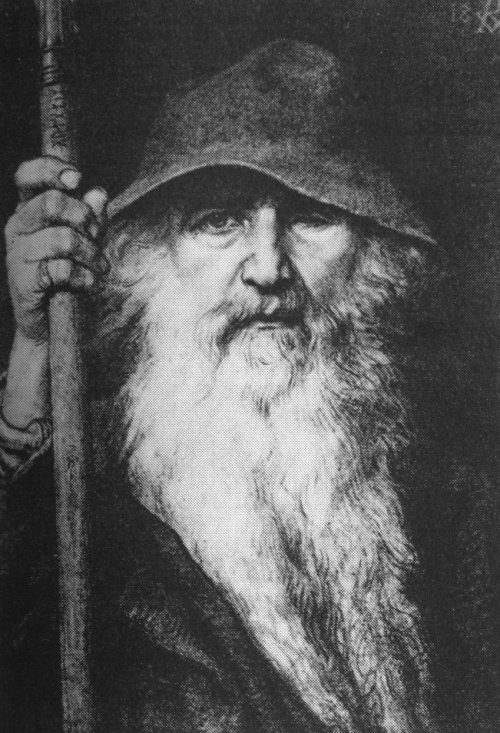
Georg von Rosen paints Odin the Wanderer, the cloaked, one-eyed traveller who became the god's standard modern portrait.
- 1962
Odin enters Marvel Comics' Journey into Mystery series, beginning his second life in comics and film.
- 2011
Marvel Studios' film Thor brings Odin, played by Anthony Hopkins, to a global cinema audience.
Significance
Odin matters to history less as a god than as evidence. Because Christian Icelanders wrote him down, northern Europe is the one region of the pagan Germanic world whose mythology survives in bulk - names, stories and kennings - and historians can set it against the archaeology of picture stones, ornaments and place names. The comparison is instructive: the texts crown Odin, but the ground gives Thor the louder cult, a reminder that surviving literature reflects the tastes of those who made it. Odin was the god of the skalds, and the skalds wrote the sources.
Myths and disputes
Was Odin always chief god? Perhaps not. Scholars such as Jens Peter Schjodt argue that his position at the top of the hierarchy may be a later addition, and his title 'Allfather' looks like a later literary theme, possibly influenced by Christian names for God, rather than a reflection of Viking-Age society. Place names formed from Odin's name are absent from Iceland and rare in southern Norway, though they occur in southern Sweden and Denmark - a patchy map for a supposed universal chief.
Two popular claims also need correcting. In the old sources Odin did not adopt Loki: Britannica notes that, contrary to the Marvel films, Odin and Loki were fellow gods, in some stories even represented as brothers - it is the comics that made Loki Odin's foster son. And Adam of Bremen's Uppsala sacrifices, with their grove of hanged victims, come from a Christian author writing about a religion his church was displacing; the temple is accepted, the details remain debated.
Legacy
Odin's afterlife has been continuous. Wednesday carries him into every week. Nineteenth-century romanticism repainted him - von Rosen's wanderer of 1886 is still the default Odin - and Wagner put Wotan on the opera stage. The twentieth century moved him into comics, novels and games, and the Marvel films made the wanderer a king in golden armour. Yet the core image survives every adaptation: an old god who would pay any price, even an eye, to know.
Sources
- Encyclopaedia Britannica - Odin
- World History Encyclopedia - Odin
- Swedish History Museum - Odin, leader of the gods
- Encyclopaedia Britannica - Thor
The facts on this page were checked against these sources on 19 November 2026. The History Trail's permanent pages are researched and written for this site; the live profiles elsewhere on The History Trail are assembled automatically from Wikipedia and Wikidata.
About the Author
Researched and written by the The History Trail Editorial Team — the accountable editorial function behind this site's permanent story pages. The team works from the published sources cited on each page; it does not invent historians, reviewers or credentials, and it corrects errors openly.
Fact Check
Every load-bearing fact on this page traces to one of the sources listed above, and significant claims link to their source in the text. Our checking method is described on the methodology page; errors can be reported via the corrections page.
Sources & Citations
Cite this page as: The History Trail Editorial Team, The History Trail — this article's title, publication and update dates are shown beneath its headline. The full source list appears under Sources above; the site's source standards are on the sources page.