
Years
1986 in History
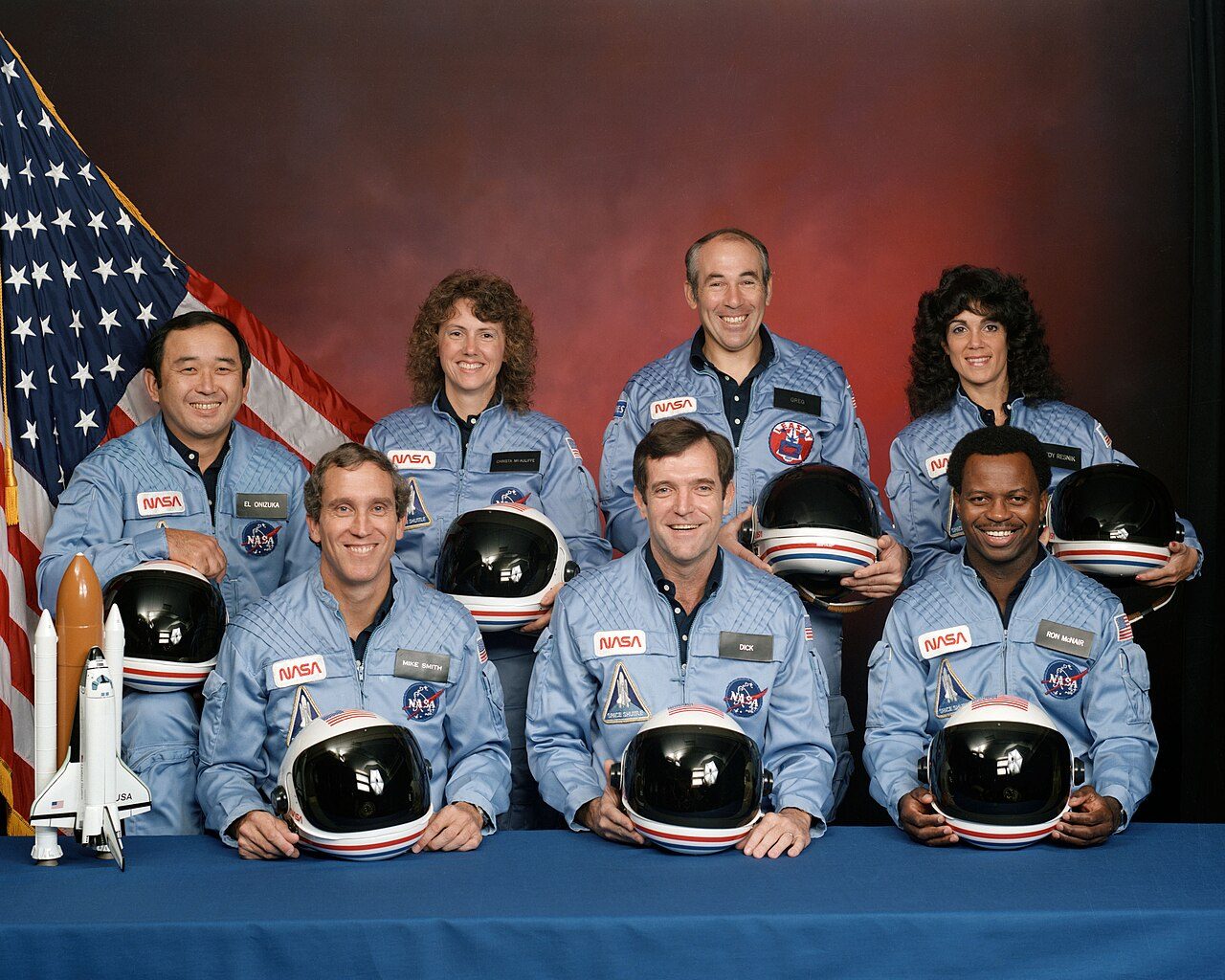
1986 is defined by two technological disasters three months apart: on 28 January the space shuttle Challenger broke apart 73 seconds after launch, killing all seven crew members, and on 26 April Reactor 4 at Chernobyl exploded during a safety test, in the worst nuclear accident in history. Between them, People Power drove Ferdinand Marcos from the Philippines.
At a Glance
- Defining events
- Challenger lost after liftoff, 28 January; Chernobyl Reactor 4 explodes, 26 April
- Challenger crew
- Seven killed, including Christa McAuliffe, the first teacher in space
- Cause found
- The Rogers Commission blames the failure of the booster rocket's O-ring seals, 9 June
- Chernobyl
- Reactor 4 explodes during a safety test; Pripyat is evacuated and fallout spreads across Europe
- People Power
- Ferdinand Marcos flees the Philippines, 25 February; Corazon Aquino becomes president
- Assassination
- Swedish prime minister Olof Palme is shot dead in Stockholm, 28 February
The defining story: two disasters of the machine age
At 11:39 on a freezing Florida morning, 28 January 1986, the space shuttle Challenger lifted off from Cape Canaveral on its tenth mission, STS-51-L. The morning was the coldest in shuttle history, with ice on the launch pad, and engineers at Morton Thiokol, the company that built the shuttle's solid rocket boosters, had argued the night before against launching in such cold: the rubber O-ring seals in the booster joints, they warned, lost their resilience at low temperatures and might not seal. Under pressure the company's managers reversed their recommendation, and NASA proceeded. Seventy-three seconds later, watched live by millions — among them schoolchildren, because the crew included Christa McAuliffe, a New Hampshire schoolteacher chosen to be the first teacher in space — the shuttle broke apart over the Atlantic. All seven crew members were killed.
The inquiry that followed gave the year its second defining image: a failed seal. On 9 June the Rogers Commission published its report on the disaster, blaming the failure of the booster rocket's O-ring seals — the precise failure the engineers had predicted the night before the launch. The lesson of Challenger was not that the technology was beyond its makers, but that a warning, clearly given, had been overruled inside the machine's own organisation.
Three months after Challenger, the other superpower supplied the matching catastrophe. At Chernobyl in Soviet Ukraine, Reactor 4 was running a test meant to make the plant safer: engineers wanted to prove that a turbine coasting to a stop after a power cut could power the coolant pumps until the diesel generators started. The test ran after midnight with an inexperienced night shift, a reactor idled far below its intended power and safety systems switched off. At 01:23 on 26 April the emergency shutdown button was pressed; within seconds the core surged beyond control, steam explosions tore the reactor apart and lifted its thousand-ton upper shield, and the exposed graphite core caught fire.
Two plant workers were killed that night, and 28 firefighters and plant staff died of acute radiation syndrome over the following weeks, after fighting an ordinary-looking fire on a roof scattered with radioactive debris. The burning core threw radioactive material into the atmosphere for ten days, and the wind carried it across Ukraine, Belarus and Europe; the city of Pripyat was evacuated, and Moscow admitted the accident only after radiation alarms sounded in Sweden. Challenger and Chernobyl, three months apart, became the twin emblems of 1986: complex systems, warnings unheeded, and institutions that could not say stop.
Timeline of 1986
- 24 January
The Voyager 2 spacecraft makes its closest approach to Uranus, still the only visit to the planet by a probe from Earth.
- 28 January
The space shuttle Challenger breaks apart 73 seconds after launch, killing all seven crew members.
- 7 February
Haiti's president Jean-Claude 'Baby Doc' Duvalier flees into exile in France as unrest topples his regime.
- 20 February
The Soviet Union launches the core module of Mir, the space station assembled in orbit over the following decade.
- 25 February
Ferdinand Marcos flees the Philippines after the People Power uprising, and Corazon Aquino becomes president.
- 28 February
Swedish prime minister Olof Palme is shot dead on a Stockholm street as he walks home from the cinema.
- 14 April
American aircraft bomb targets in Libya in retaliation for a Berlin discotheque bombing blamed on Muammar al-Qaddafi's regime.
- 26 April
Reactor 4 at the Chernobyl Nuclear Power Plant explodes during a safety test.
- 9 June
The Rogers Commission publishes its report on the Challenger disaster, blaming the failure of the booster rocket's O-ring seals.
- 22 June
Diego Maradona scores both the 'Hand of God' goal and the 'Goal of the Century' as Argentina beat England in the World Cup quarter-final.
- 21 August
A burst of carbon dioxide from Lake Nyos in Cameroon suffocates villagers in their sleep; Britannica puts the toll at more than 1,700 people.
- 22 November
Mike Tyson, aged 20, knocks out Trevor Berbick to become the youngest heavyweight boxing champion in history.
- 25 November
Attorney General Edwin Meese reveals that profits from secret arms sales to Iran were diverted to the Contra rebels — the heart of the Iran-Contra scandal.
- 23 December
Dick Rutan and Jeana Yeager land the aircraft Voyager in California, completing the first nonstop, unrefuelled flight around the world.
Why 1986 still matters
Challenger and Chernobyl changed how the world thought about technological risk. Both disasters were traced not to unknown physics but to known weaknesses — a seal that stiffened in cold, a reactor unstable at low power — compounded by organisations that pressed ahead anyway. The Rogers Commission's report became a founding text of safety culture, and Chernobyl's fallout, measured on instruments across Europe, made the Soviet system's secrecy itself a casualty: a state that could not hide an accident from Swedish radiation monitors could not hide much else for long.
The year's politics ran in two directions at once. In February, unarmed crowds in Manila ended the Marcos era and made Corazon Aquino president, while Haiti's Duvalier fled into exile — people power as a method. Against that, Stockholm lost Olof Palme to an assassin whose crime was never definitively solved, American jets bombed Libya in April, and in November the Iran-Contra revelation showed the Reagan administration secretly selling arms to Iran and diverting the profits to rebels in Nicaragua.
Even the year's wonders carried the double edge. Voyager 2 made its closest approach to Uranus in January, still the only visit to that planet by a probe from Earth, and the Soviet Union launched the core module of the Mir station in February. In December Rutan and Yeager completed the first nonstop, unrefuelled flight around the world. 1986 remains the year the machine age audited itself — and published the findings.
1986 on The History Trail
Challenger and Chernobyl dominate this year on The History Trail.
- January 28 in History — Space shuttle Challenger is lost after liftoff — a featured story of 1986.
- April 26 in History — The Chernobyl disaster — Reactor 4 explodes during a safety test.
- June 9 in History — The Rogers Commission publishes its report on the Challenger disaster.
- February 25 in History — Marcos flees the Philippines and Corazon Aquino becomes president.
- January 24 in History — Voyager 2 makes its closest approach to Uranus.
- Halley's Comet — The famous comet whose 1986 return the world's probes went out to meet.
Sources
- Encyclopaedia Britannica — On This Day: January 28
- Encyclopaedia Britannica — On This Day: April 26
- Encyclopaedia Britannica — On This Day: June 9
- Encyclopaedia Britannica — On This Day: February 25
The facts on this page were checked against these sources on 19 November 2026. The History Trail's permanent pages are researched and written for this site; the live profiles elsewhere on The History Trail are assembled automatically from Wikipedia and Wikidata.
About the Author
Researched and written by the The History Trail Editorial Team — the accountable editorial function behind this site's permanent story pages. The team works from the published sources cited on each page; it does not invent historians, reviewers or credentials, and it corrects errors openly.
Fact Check
Every load-bearing fact on this page traces to one of the sources listed above, and significant claims link to their source in the text. Our checking method is described on the methodology page; errors can be reported via the corrections page.
Sources & Citations
Cite this page as: The History Trail Editorial Team, The History Trail — this article's title, publication and update dates are shown beneath its headline. The full source list appears under Sources above; the site's source standards are on the sources page.