
Years
1981 in History
1981 is remembered for the machine that standardised the future. On 12 August IBM introduced its Personal Computer, the Model 5150, and computing moved from the hobbyist's workshop to the office desk. The same year inaugurated Ronald Reagan as the hostages came home from Tehran, survived an assassin's bullet in March, launched the first space shuttle in April, and put a royal wedding and a music-video channel on the world's televisions.
At a Glance
- Defining event
- IBM introduces its Personal Computer, the Model 5150, on 12 August 1981
- New president
- Ronald Reagan sworn in 20 January; Iran releases the 52 hostages minutes later
- Assassination attempt
- Reagan is shot in Washington on 30 March and survives surgery
- Space first
- Columbia flies STS-1, the first space shuttle mission, 12 April
- Television turns
- MTV goes on the air 1 August, opening with Video Killed the Radio Star
- Warning sign
- The CDC publishes the first recognised report of the epidemic later named AIDS, 5 June
The defining story: the IBM Personal Computer
By 1981 the personal computer already existed, but business did not take it seriously. Machines from Apple, Commodore and Tandy were bought by hobbyists and enthusiasts, while the world's offices ran on paper, typewriters and the big mainframe computers of IBM itself. When IBM — the most powerful company in computing — decided it wanted a small machine of its own, it could not afford to spend the usual years developing one. Instead it handed the job to a small team at Boca Raton, Florida, led by Don Estridge, gave them about a year, and let them break IBM's own rules: instead of building everything in-house, they would assemble the machine largely from other firms' parts.
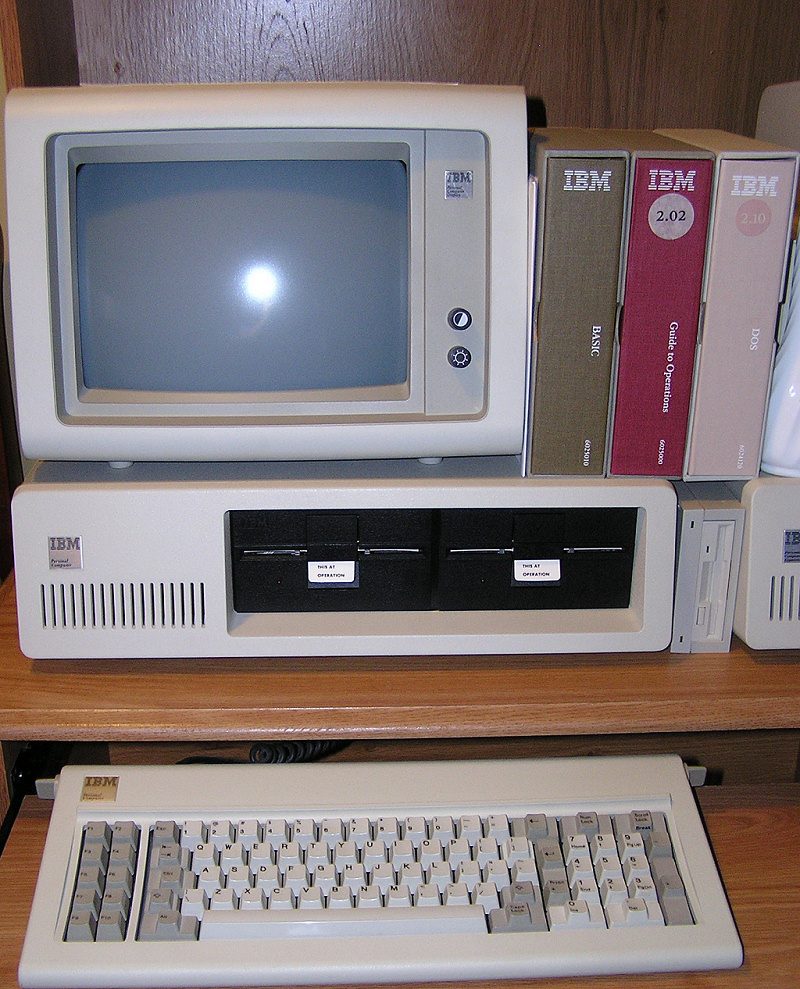
The result was unveiled on 12 August 1981 at the Waldorf Astoria hotel in New York: the IBM Personal Computer, model number 5150 — the machine photographed on this page. It was built around an Intel 8088 processor, and the basic machine cost 1,565 dollars in a configuration with just 16 kilobytes of memory. There was no hard disk: programs and data lived on cassette tapes or on optional floppy disks. What it did have was five expansion slots in the back, an open invitation for other firms to make add-on cards that would give the machine new abilities, from better graphics to extra memory.
The Smithsonian's National Museum of American History, which holds the machine in its collection, calls it a milestone in personal computing, and the reason is the name as much as the hardware. Because it was an IBM, company purchasing departments that would never have risked an unknown hobbyist brand ordered it in quantity; because the design was open, an entire industry of software writers and accessory makers grew up around it, and rival manufacturers soon built machines that could run the same programs. The personal computer stopped being a hobby and became standard office equipment — and the initials PC, which IBM used almost casually, became the generic name for the species.
IBM kept the 5150 in production until 2 April 1987, by which time it had been joined and overtaken by a crowd of faster descendants and imitators. The pattern set that August — a standard design, built from widely available parts, improved by an army of outside suppliers — dominated desktop computing for decades. Around the machine, 1981 was a year of televised thresholds: Reagan took the oath on 20 January as Iran released the 52 American hostages held for 444 days, survived being shot on 30 March, and watched Columbia lift off on 12 April on the first shuttle mission, exactly twenty years after Gagarin's flight. On 29 July an estimated 750 million viewers watched Charles marry Diana at St Paul's Cathedral; three days later MTV went on the air.
Timeline of 1981
- 20 January
Ronald Reagan is sworn in as the 40th president; minutes later Iran releases the 52 American hostages held for 444 days.
- 30 March
President Reagan is shot in the chest outside a Washington hotel by John Hinckley Jr.; he survives surgery.
- 12 April
NASA launches Columbia on STS-1, the first space shuttle mission — exactly twenty years after Gagarin's flight.
- 5 May
Bobby Sands, IRA prisoner and elected MP, dies on the 66th day of his hunger strike in the Maze Prison.
- 13 May
Pope John Paul II is shot and wounded in St Peter's Square; he survives.
- 5 June
The CDC publishes the first report of a rare pneumonia in five Los Angeles patients — the first recognised report of the epidemic later named AIDS.
- 7 July
President Reagan nominates Sandra Day O'Connor to the Supreme Court; she becomes its first woman justice.
- 29 July
Charles, Prince of Wales marries Lady Diana Spencer at St Paul's Cathedral, watched by an estimated 750 million viewers.
- 1 August
MTV goes on the air in the United States, opening with Video Killed the Radio Star.
- 5 August
President Reagan fires 11,359 striking air-traffic controllers who had defied his order to return to work.
- 12 August
IBM introduces its Personal Computer, the Model 5150, at a press conference in New York.
- 10 September
Picasso's Guernica is displayed in Spain for the first time, forty years after it was painted.
- 6 October
Anwar Sadat, president of Egypt, is assassinated at a Cairo parade by Islamist soldiers.
- 28 December
Elizabeth Jordan Carr, the first American baby conceived by IVF, is born in Norfolk, Virginia.
Why 1981 still matters
The IBM PC's legacy is industrial rather than technical: the day is remembered not for a breakthrough but for a standard. The open design that let rivals build compatible machines eventually escaped IBM's own control, but it fixed the architecture of the desktop era — and the two-letter name the whole category still answers to. Every office that filled with beige boxes in the 1980s, and every home that followed, was arranged around the fact established on 12 August 1981: the biggest name in computing had declared the future would sit on a desk.
The year's other firsts compounded at different speeds. The space shuttle made orbit reusable in principle and flew for thirty years; Sandra Day O'Connor, sworn in on 25 September, opened the Supreme Court to women a generation after Thurgood Marshall had opened it to Black Americans; and MTV rebuilt popular music around the video. The royal wedding's 750 million viewers marked the high point of the shared-television age that cable channels like MTV were about to fragment.
Two 1981 entries carried the longest shadows. The CDC's short report of 5 June — a rare pneumonia in five Los Angeles patients — was the first recognised notice of the epidemic later named AIDS, whose story the site's HIV/AIDS record tells in full. And on 28 December, Elizabeth Jordan Carr was born in Norfolk, Virginia, the first American IVF baby, three years after Louise Brown: 1978's laboratory miracle had become, by 1981, a transatlantic routine. The decade that the PC would define had begun with its defining machine, its defining epidemic and its defining president all arriving in the same twelve months.
1981 on The History Trail
The IBM Personal Computer carries this year's featured story on The History Trail.
- August 12 in History — IBM introduces its Personal Computer, the Model 5150.
- April 12 in History — Columbia flies the first space shuttle mission.
- January 20 in History — Reagan is sworn in as the Iran hostages are released.
- March 30 in History — President Reagan is shot in Washington and survives.
- August 1 in History — MTV goes on the air in the United States.
- Microsoft — The software company whose fortunes rose with the IBM PC.
- HIV/AIDS — The epidemic first reported in June 1981.
Sources
- Encyclopaedia Britannica — On This Day: August 12
- Encyclopaedia Britannica — On This Day: April 12
- HISTORY — What Happened on January 20
- Encyclopaedia Britannica — On This Day: March 30
- Encyclopaedia Britannica — On This Day: June 5
- HISTORY — What Happened on August 1
- Encyclopaedia Britannica — On This Day: October 6
- Encyclopaedia Britannica — On This Day: December 28
The facts on this page were checked against these sources on 19 November 2026. The History Trail's permanent pages are researched and written for this site; the live profiles elsewhere on The History Trail are assembled automatically from Wikipedia and Wikidata.
About the Author
Researched and written by the The History Trail Editorial Team — the accountable editorial function behind this site's permanent story pages. The team works from the published sources cited on each page; it does not invent historians, reviewers or credentials, and it corrects errors openly.
Fact Check
Every load-bearing fact on this page traces to one of the sources listed above, and significant claims link to their source in the text. Our checking method is described on the methodology page; errors can be reported via the corrections page.
Sources & Citations
Cite this page as: The History Trail Editorial Team, The History Trail — this article's title, publication and update dates are shown beneath its headline. The full source list appears under Sources above; the site's source standards are on the sources page.