
On This Day
January 20 in History
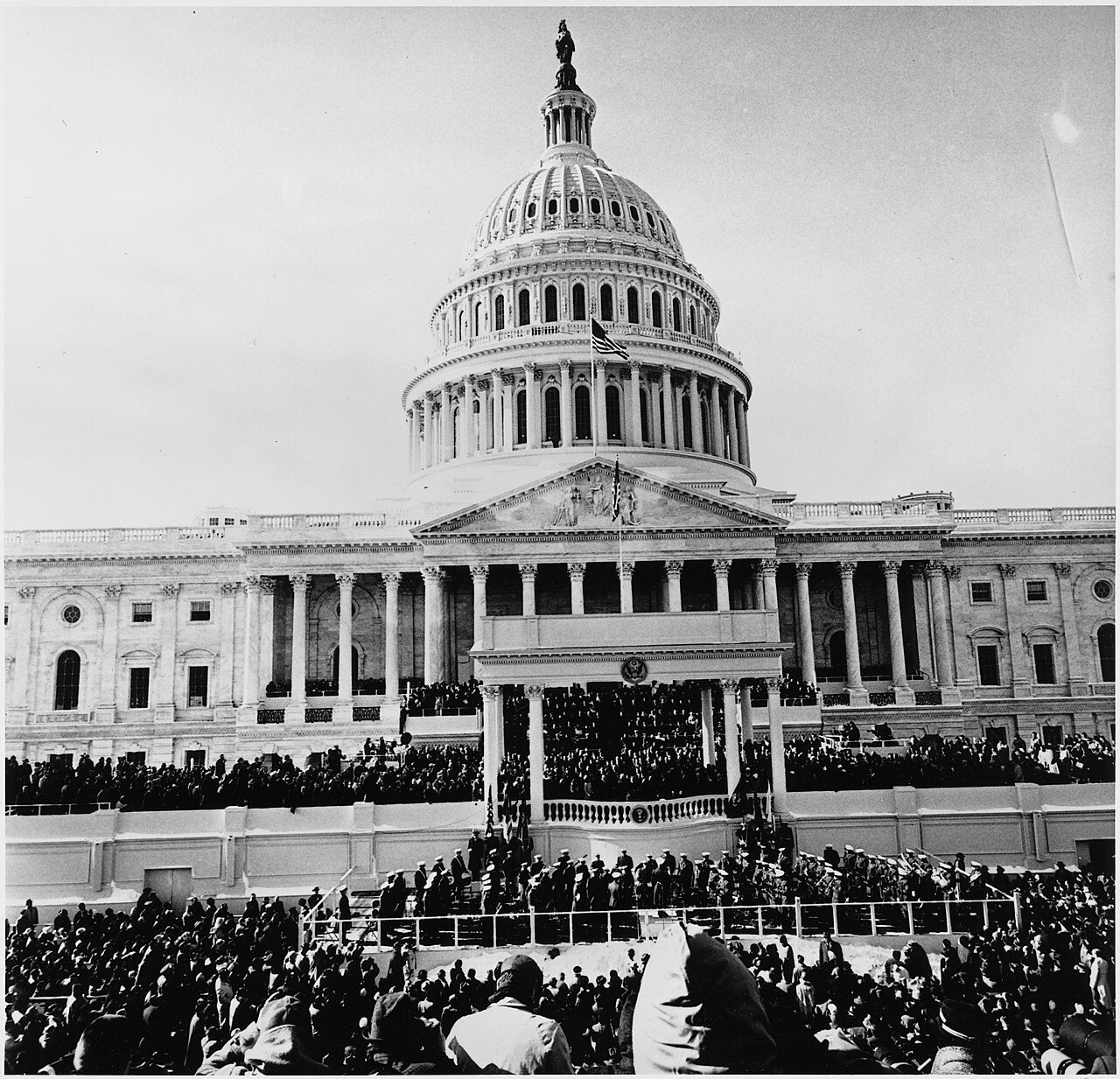
On 20 January 1961 John F. Kennedy, at 43 the youngest man ever elected president of the United States, took the oath on the snow-dusted east front of the Capitol and told his countrymen: 'Ask not what your country can do for you — ask what you can do for your country.' January 20, fixed as Inauguration Day since 1937, is also the day of the Wannsee Conference and of England's first parliament with commoners.
Choose another date: open the On This Day calendar to browse events, births and deaths for any day of the year.
At a Glance
- When and where
- 20 January 1961, on the east front of the U.S. Capitol, Washington
- The oath
- Administered by Chief Justice Earl Warren
- The president
- John F. Kennedy, 43 — the youngest elected president and the first Roman Catholic
- The line
- 'Ask not what your country can do for you — ask what you can do for your country'
- The audience
- Nearly a million people stood in the cold in Washington; millions more watched on television
- The day before and after
- A snowstorm had blanketed the capital overnight; the 80-year-old poet Robert Frost read at the ceremony, the first poet to do so
Events on this day
- 1265Simon de Montfort's parliament meets at Westminster — the first English parliament to include elected representatives of towns and counties.
- 1841Hong Kong Island is ceded to Britain by China, beginning 156 years of British rule.
- 1863Union general Ambrose Burnside begins the 'Mud March', a winter offensive in Virginia that dissolves into rain-soaked failure.
- 1937Franklin D. Roosevelt is inaugurated for a second term — the first inauguration held on January 20, under the new 20th Amendment.
- 1942Nazi officials meet at the Wannsee Conference in Berlin to coordinate the 'Final Solution' — the machinery of the Holocaust.
- 1945Roosevelt is inaugurated to a fourth term, a wartime ceremony at the White House; he dies within three months.
- 1961John F. Kennedy is inaugurated as the 35th president and delivers the 'ask not' address — the featured story above.
- 1969Richard Nixon takes office, promising an 'era of negotiation' after a period of confrontation.
- 1981Ronald Reagan is sworn in as the 40th president; minutes later Iran releases the 52 American hostages held for 444 days.
- 2001Philippine president Joseph Estrada is ousted by a nonviolent popular uprising and replaced by Gloria Macapagal Arroyo.
- 2009Barack Obama is inaugurated as the first African American president of the United States.
- 2020The first confirmed case of COVID-19 in the United States is reported, in Washington state.
- 2021Kamala Harris is sworn in as the first woman — and first Black and Asian American — vice president of the United States.
Born on this day
- 1896George Burns — American comedian whose career ran from vaudeville to a late-life Oscar.
- 1920Federico Fellini — Italian director of La Dolce Vita and 8½, cinema's great dreamer.
- 1920DeForest Kelley — American actor, Dr Leonard 'Bones' McCoy in Star Trek.
- 1930Buzz Aldrin — American astronaut, the second person to walk on the Moon, on Apollo 11.
- 1934Tom Baker — English actor, the fourth and longest-serving Doctor Who of the classic era.
Died on this day
- 1875Jean-François Millet — French painter of The Gleaners and The Angelus, poet of peasant labour.
- 1891Kalākaua — the last king of Hawaii, dead in San Francisco two years before his kingdom fell.
- 1900John Ruskin — English art critic and social thinker, the Victorian age's arbiter of beauty.
- 1993Audrey Hepburn — Belgian-born actress of Roman Holiday and Breakfast at Tiffany's, dead at 63.
The featured story: John F. Kennedy is inaugurated, 20 January 1961
Washington woke on 20 January 1961 to a city dug out of snow. A storm had closed the capital the night before; the army cleared the inaugural route with flamethrowers and thousands of troops, and by noon the sun was out, bitterly cold and bright. On the east front of the Capitol, before a crowd Britannica puts at nearly a million, Chief Justice Earl Warren administered the oath to John Fitzgerald Kennedy — at 43 the youngest man ever elected to the presidency, and its first Roman Catholic. Beside him stood the outgoing president, Dwight Eisenhower, who had warned the nation three days earlier about the military-industrial complex; the old general and the young president bookended a transfer of power between generations.
Kennedy's address, preserved in full by the Kennedy Library, lasted about fourteen minutes and was built to be remembered. 'We observe today not a victory of party but a celebration of freedom,' he began, 'symbolizing an end as well as a beginning.' He pledged that America would 'pay any price, bear any burden, meet any hardship, support any friend, oppose any foe' to assure liberty's survival, summoned a new generation 'born in this century, tempered by war, disciplined by a hard and bitter peace', and closed the argument with the sentence that outlived the century: 'Ask not what your country can do for you — ask what you can do for your country.'
The ceremony itself broke new ground: Robert Frost, at 80, became the first poet to read at an inauguration, and when the glare of the winter sun blinded him to his printed text, he recited an older poem from memory instead. The speech's call to service was not left as rhetoric — within months Kennedy had created the Peace Corps, and within the year he had committed America to landing a man on the Moon before the decade was out. The inaugural's optimism was the Kennedy administration's founding document.
The presidency it launched lasted 1,036 days, ended by an assassin in Dallas in November 1963. But the address endures in a way few policy records do: it is still quoted at graduations and naturalisation ceremonies, still the standard against which inaugural speeches are measured. On a freezing noon in 1961, January 20 — the date the 20th Amendment had fixed for inaugurations only a generation earlier — acquired its most famous occupant.
Why this date matters
January 20 is the most ceremonial date in the American calendar — since 1937 the fixed hinge on which presidencies turn — and its list is dominated by oaths: Roosevelt twice, Kennedy, Nixon, Reagan, Obama. Yet the same date carries Wannsee's bureaucrats planning genocide in 1942 and commoners first sitting in an English parliament in 1265. It is a day about who holds power and on what terms, stretching from de Montfort's knights and burgesses to a vice president breaking three barriers at once in 2021.
Sources
- Encyclopaedia Britannica — On This Day: January 20
- HISTORY — What Happened on January 20
- John F. Kennedy Presidential Library — Inaugural Address, 20 January 1961
- National Archives — President John F. Kennedy's Inaugural Address
The facts on this page were checked against these sources on 19 November 2026. The History Trail's permanent pages are researched and written for this site; the live profiles elsewhere on The History Trail are assembled automatically from Wikipedia and Wikidata.
About the Author
Researched and written by the The History Trail Editorial Team — the accountable editorial function behind this site's permanent story pages. The team works from the published sources cited on each page; it does not invent historians, reviewers or credentials, and it corrects errors openly.
Fact Check
Every load-bearing fact on this page traces to one of the sources listed above, and significant claims link to their source in the text. Our checking method is described on the methodology page; errors can be reported via the corrections page.
Sources & Citations
Cite this page as: The History Trail Editorial Team, The History Trail — this article's title, publication and update dates are shown beneath its headline. The full source list appears under Sources above; the site's source standards are on the sources page.