
Years
1974 in History
1974 is remembered above all for 8 August, when Richard Nixon announced he would resign the presidency — the first, and still the only, American president to give up the office, brought down by Watergate. The same year gave farmers digging a well near Xi'an an army of clay, gave Hank Aaron Babe Ruth's home-run record, and gave India its first nuclear test.
At a Glance
- Defining event
- Nixon announces his resignation on 8 August 1974; Gerald Ford is sworn in at noon on 9 August
- Discovery
- Farmers digging a well near Xi'an discover the Terracotta Army, 29 March
- Sporting record
- Hank Aaron hits his 715th home run, breaking Babe Ruth's record, 8 April
- Nuclear first
- India detonates its first nuclear device, Smiling Buddha, 18 May
- Pardon
- President Ford grants Nixon a full and unconditional pardon, 8 September
- Closed the year
- Nelson Rockefeller is sworn in as vice president, 19 December
The defining story: the resignation of Richard Nixon
The scandal that ended Richard Nixon's presidency began with a burglary in June 1972, when five men working for the president's re-election campaign were caught inside the Democratic Party's headquarters in the Watergate building in Washington. For two years the affair unspooled — through Senate hearings, the revelation that Nixon had secretly recorded his Oval Office conversations, a constitutional battle over the tapes, and the dismissal of the special prosecutor investigating him. Nixon survived each stage by narrowing margins, insisting he was not a crook, while the machinery of investigation closed in.
The end came through the courts. On 24 July 1974 the United States Supreme Court ruled unanimously that Nixon must surrender the Watergate tapes. On 5 August the released recording from 23 June 1972 — days after the break-in, with Nixon approving the use of the CIA to block the FBI's investigation — destroyed what remained of his support. His own party's elders told him the arithmetic: impeachment in the House was certain, and in the Senate he could count on perhaps fourteen votes against conviction, far short of the third he needed to survive. Resignation, unthinkable for two years, became the only door left open.
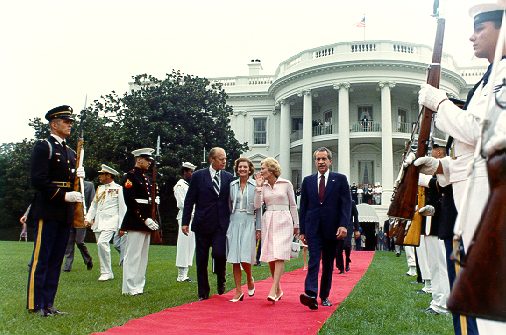
On the evening of 8 August, at 9:01 p.m. Eastern Time, Nixon addressed the nation from the Oval Office. He had never been a quitter, he said, but the interests of the nation had to come first: he would resign at noon the following day. It was the first resignation of an American president in the republic's history — the only one there has ever been. The photograph on this page shows Gerald and Betty Ford escorting Richard and Pat Nixon across the White House lawn to a waiting helicopter the next morning. At noon on 9 August Ford was sworn in as the 38th president, declaring that the long national nightmare was over; a month later, on 8 September, he granted Nixon a full and unconditional pardon, closing Watergate's legal story while opening an argument that has never entirely ended.
The resignation shared its year with discoveries and records of a different kind. On 29 March, farmers sinking a well in a drought near Xi'an struck the head of a life-size clay soldier four metres down — the buried guard of Qin Shi Huang, first emperor of China, an army now estimated at more than 8,000 soldiers that had waited underground for more than 2,100 years. On 8 April in Atlanta, Hank Aaron hit his 715th career home run, passing Babe Ruth's 714, a record that had stood since 1935, after a chase conducted under floods of racist hate mail and death threats. And on 18 May India detonated its first nuclear device at Pokhran, codenamed Smiling Buddha.
Timeline of 1974
- 2 January
President Nixon signs a national 55 mph speed limit into law, to save fuel during the oil embargo.
- 29 March
Farmers digging a well near Xi'an discover the Terracotta Army, the buried guard of China's first emperor.
- 6 April
ABBA wins the Eurovision Song Contest in Brighton with Waterloo, launching Sweden's conquest of pop music.
- 8 April
Hank Aaron hits his 715th career home run, breaking Babe Ruth's record of 714.
- 18 May
India detonates its first nuclear device at Pokhran in the Rajasthan desert, codenamed Smiling Buddha.
- 26 June
A pack of Wrigley's chewing gum in Troy, Ohio, becomes the first item ever scanned by a UPC barcode.
- 24 July
The United States Supreme Court rules unanimously that President Nixon must surrender the Watergate tapes.
- 7 August
Philippe Petit walks a tightrope between the twin towers of the World Trade Center in New York.
- 8 August
President Richard Nixon announces on live television that he will resign.
- 9 August
Nixon's resignation takes effect at noon; Gerald Ford is sworn in as the 38th president.
- 8 September
President Ford grants former president Nixon a full and unconditional pardon for crimes connected with Watergate.
- 12 September
Emperor Haile Selassie of Ethiopia is deposed by a military committee, the Derg.
- 30 October
In the Rumble in the Jungle in Kinshasa, Muhammad Ali knocks out George Foreman to regain the world heavyweight title.
- 16 November
The Arecibo message, a radio transmission describing humanity, is beamed toward the star cluster M13.
Why 1974 still matters
Watergate permanently changed the American presidency — in its relationship with Congress, with the press, and with the public that had watched a president brought down by his own tapes. The unanimous Supreme Court ruling of 24 July established that no president is above a court's order, and the suffix the scandal left behind still attaches itself to every later controversy. Ford's pardon remains the era's unresolved argument: it spared the country a former president's trial, and it ensured the full legal accounting never happened.
The year's other legacies are measured in millennia and in numbers. The Terracotta Army is often called the greatest archaeological discovery of the twentieth century; the emperor's tomb mound itself has never been opened, and soil tests over it show mercury concentrations far above the surrounding countryside — suggesting the ancient historian Sima Qian's strangest detail, rivers of mercury in a model empire, may be true, even though Sima Qian never mentioned the clay army at all. Aaron's 715th broke a monument of a segregated game: he finished with 755 home runs, a record he held for 33 years, and his runs-batted-in and total-bases marks outlasted it.
Quieter firsts pointed at the future ordinary life would inhabit: the first barcode scan in an Ohio supermarket on 26 June began the automation of every checkout, and the Arecibo message beamed a description of humanity toward the stars on 16 November. 1974 thus holds a fall and three kinds of endurance — an army that waited two thousand years, a record that stood for thirty-nine, and a constitution that held.
1974 on The History Trail
Nixon's resignation, the Terracotta Army and Hank Aaron's record carry featured stories on The History Trail.
- August 8 in History — Nixon announces his resignation from the Oval Office.
- March 29 in History — Well-diggers near Xi'an find the Terracotta Army.
- April 8 in History — Hank Aaron hits his 715th home run.
- August 9 in History — Ford is sworn in as Nixon's resignation takes effect.
- Rubik's Cube: The Teaching Aid That Became a Craze — The puzzle invented in 1974 that became a worldwide craze.
- Post-it Note — The everyday invention whose story begins in this decade.
Sources
- HISTORY — What Happened on August 8
- HISTORY — This Day in History: March 29
- HISTORY — What Happened on April 8
- Encyclopaedia Britannica — On This Day: May 18
- Encyclopaedia Britannica — On This Day: July 24
- HISTORY — What Happened on August 9
- Encyclopaedia Britannica — On This Day: September 8
- Encyclopaedia Britannica — On This Day: June 26
The facts on this page were checked against these sources on 19 November 2026. The History Trail's permanent pages are researched and written for this site; the live profiles elsewhere on The History Trail are assembled automatically from Wikipedia and Wikidata.
About the Author
Researched and written by the The History Trail Editorial Team — the accountable editorial function behind this site's permanent story pages. The team works from the published sources cited on each page; it does not invent historians, reviewers or credentials, and it corrects errors openly.
Fact Check
Every load-bearing fact on this page traces to one of the sources listed above, and significant claims link to their source in the text. Our checking method is described on the methodology page; errors can be reported via the corrections page.
Sources & Citations
Cite this page as: The History Trail Editorial Team, The History Trail — this article's title, publication and update dates are shown beneath its headline. The full source list appears under Sources above; the site's source standards are on the sources page.