
On This Day
March 29 in History
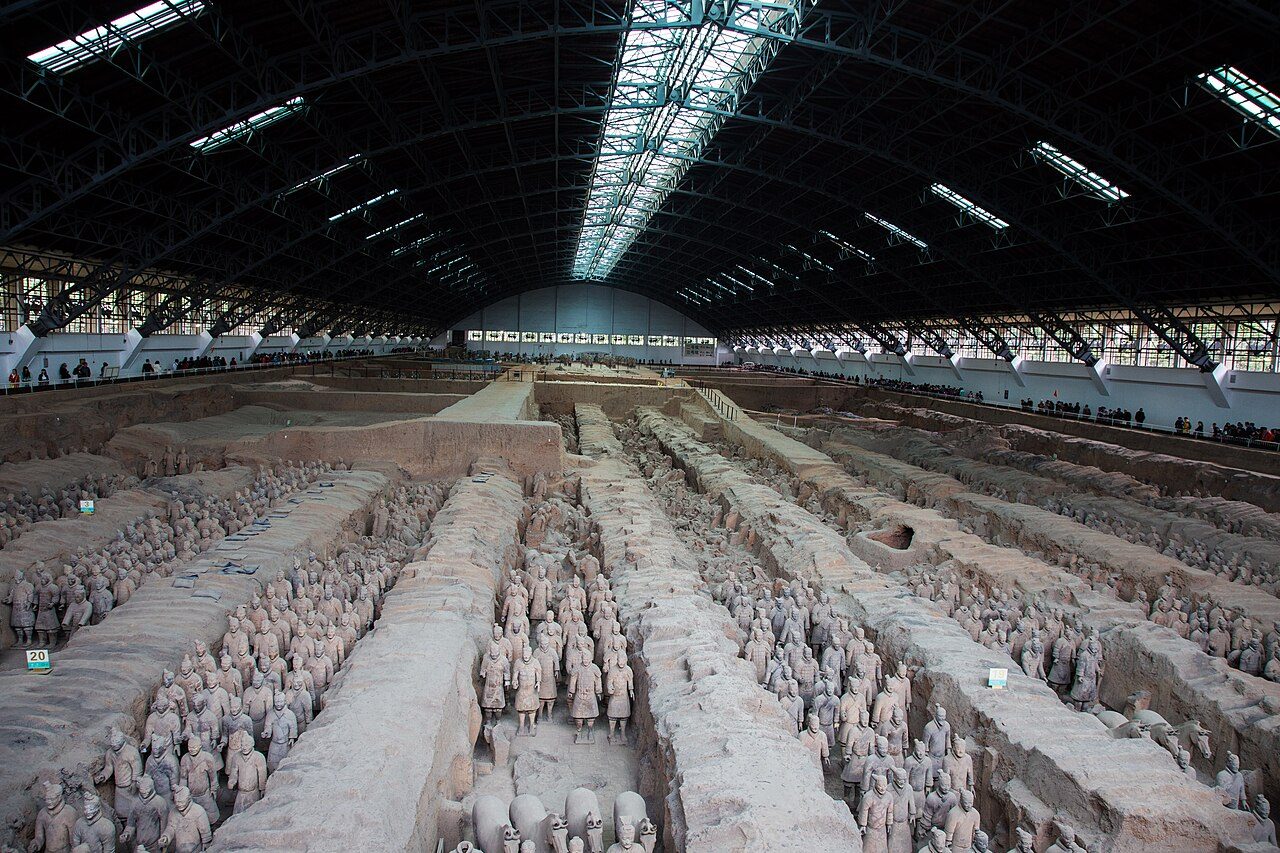
On 29 March 1974, in a drought-stricken village near Xi'an in China, a group of farmers sinking a well four metres down struck something that was not rock: the head of a life-size clay soldier. Yang Zhifa, his five brothers and their neighbour Wang Puzhi had broken into the buried guard of Qin Shi Huang, the first emperor of China — an army of thousands of terracotta warriors that had waited underground for more than 2,100 years. It is often called the greatest archaeological discovery of the twentieth century. March 29 is also the day the last American combat troops left Vietnam.
Choose another date: open the On This Day calendar to browse events, births and deaths for any day of the year.
At a Glance
- The finders
- Yang Zhifa, his five brothers and neighbour Wang Puzhi, digging a well during a drought at Xiyang village, Lintong, about 1.5 km east of the emperor's tomb mound
- The moment
- 29 March 1974 — terracotta fragments, a brick floor, bronze arrowheads and crossbow parts, about four metres down
- The recognition
- Local archaeologist Zhao Kangmin, called in weeks later, reassembled the first figures and grasped what the fragments meant
- The army
- Estimates from the excavated pits: more than 8,000 soldiers, 130 chariots with 520 horses and 150 cavalry horses, in battle formation across three great pits
- The emperor
- Qin Shi Huang, who unified China in 221 BC and died in 210 BC; the figures were buried in 210–209 BC to guard him in the afterlife
- The honours
- A museum opened over the pits in 1979; UNESCO inscribed the mausoleum as a World Heritage Site in 1987; the emperor's own tomb mound remains unexcavated
Events on this day
- 1806Congress authorises construction of the National Road, the first federally funded highway in the United States, running west from Maryland.
- 1871Queen Victoria opens the Royal Albert Hall in London, the concert hall built as a memorial to her husband Prince Albert.
- 1886Atlanta druggist John Pemberton brews the first batch of the syrup that becomes Coca-Cola.
- 1951Julius and Ethel Rosenberg are convicted in New York of conspiring to pass atomic secrets to the Soviet Union; both are executed in 1953.
- 1961The Twenty-third Amendment is ratified, giving residents of Washington, DC, the vote in US presidential elections for the first time.
- 1971Charles Manson and three followers are sentenced to death in Los Angeles for the Tate–LaBianca murders; the sentences are later commuted to life.
- 1973The last US combat troops leave South Vietnam under the Paris Peace Accords, and Hanoi releases the last of its acknowledged American prisoners — America's direct war in Vietnam ends.
- 1974Farmers digging a well near Xi'an discover the Terracotta Army — the featured story above.
- 2004Ireland becomes the first country in the world to ban smoking in all enclosed workplaces, including pubs.
- 2017The United Kingdom formally triggers Article 50, beginning the two-year process of leaving the European Union.
Born on this day
- 1790John Tyler — tenth president of the United States, the first vice president to succeed to the office on a president's death.
- 1867Cy Young — American baseball pitcher whose 511 career wins remain the record, and whose name is on the annual pitching award.
- 1918Pearl Bailey — American singer and actress, a Tony winner and later a US delegate to the United Nations.
- 1943John Major — British Conservative politician, prime minister from 1990 to 1997.
- 1945Walt Frazier — American basketball guard, the stylish floor leader of the champion New York Knicks teams of the 1970s.
Died on this day
- 1772Emanuel Swedenborg — Swedish scientist turned mystic whose theological writings founded a new church, dead in London at 84.
- 1891Georges Seurat — French painter who invented pointillism, dead at 31, five years after A Sunday Afternoon.
- 1912Robert Falcon Scott — British naval officer and explorer, dead in his tent on the return from the South Pole, his last diary entry dated this day.
- 1982Carl Orff — German composer of Carmina Burana, dead in Munich at 86.
- 2016Patty Duke — American actress, an Academy Award winner at 16 for The Miracle Worker, dead at 69.
The featured story: the discovery of the Terracotta Army, 29 March 1974
The spring of 1974 was dry in Lintong county, and the commune of Xiyang village, east of Xi'an, sent a team to sink a new well in a persimmon grove near the foot of Mount Li. The spot lay about a kilometre and a half east of a huge, grassed-over burial mound that everyone knew was the tomb of Qin Shi Huang. On 29 March the diggers — Yang Zhifa, five of his brothers, and a neighbour, Wang Puzhi — hit a layer of hard red earth about four metres down, and then pieces: fragments of terracotta, a paved brick floor, bronze arrowheads, parts of a crossbow. The men, who had found old kilns before, at first thought they had broken into a temple or a pottery works, and some of the fragments were thrown aside or taken home.
What saved the find was a local archaeologist. When word and pieces reached the district cultural centre, Zhao Kangmin came to look, began piecing a figure back together, and understood that the farmers had opened something immense. Official excavation began that summer. Under the grove lay Pit 1 — a hangar of earth 230 metres long holding the army's main body, thousands of life-size infantry in eleven corridors. Two smaller pits followed: one with cavalry, charioteers and archers in battle array, one, apparently unfinished, meant for a headquarters. The current estimates put the buried force at more than 8,000 soldiers, 130 chariots with 520 horses, and 150 cavalry horses, each figure modelled with individual features, hairstyles and rank insignia, and once painted in full colour.
The army had been made for a single spectator. Qin Shi Huang, the king of Qin who conquered the warring states and proclaimed himself China's first emperor in 221 BC, began his mausoleum soon after taking the throne; the historian Sima Qian, writing a century later, described 700,000 conscripts at work on a tomb chamber with a model empire, mercury rivers and a jewelled sky. The terracotta regiments were its outer guard, buried in 210–209 BC and then forgotten so completely that not even Sima Qian mentions them. The emperor's tomb mound itself, a kilometre and a half west of the pits, has never been opened — soil samples show mercury levels far above normal, an eerie footnote to the ancient account — and Chinese archaeologists intend to leave it sealed until preservation science can do it justice.
The well was never finished, and its diggers became famous: Yang Zhifa spent years at the museum site signing books for visitors as the man who found the army. A great arched museum opened over Pit 1 in 1979, and in 1987 UNESCO placed the Mausoleum of the First Qin Emperor on the World Heritage List. Of all the wonders archaeology produced in the twentieth century — Tutankhamun's tomb, the Dead Sea Scrolls — none matches this one for scale: an entire army, conjured by accident, out of a hole dug for water.
Why this date matters
March 29 is a day of endings that turn into beginnings. An army buried to serve a dead emperor becomes, 2,100 years later, a nation's gift to the world's imagination; a war that consumed a generation of Americans formally ends on a Saigon airfield in 1973; a capital city that had been denied a vote receives one in 1961; a soft drink and a concert hall begin their long lives. The date's deepest pattern is excavation — of clay soldiers, of consciences, of futures — things dug up and made to speak.
Sources
- Encyclopaedia Britannica — On This Day: March 29
- HISTORY — This Day in History: March 29
- HISTORY — U.S. troops withdraw from Vietnam
- UNESCO World Heritage Centre — Mausoleum of the First Qin Emperor
The facts on this page were checked against these sources on 19 November 2026. The History Trail's permanent pages are researched and written for this site; the live profiles elsewhere on The History Trail are assembled automatically from Wikipedia and Wikidata.
About the Author
Researched and written by the The History Trail Editorial Team — the accountable editorial function behind this site's permanent story pages. The team works from the published sources cited on each page; it does not invent historians, reviewers or credentials, and it corrects errors openly.
Fact Check
Every load-bearing fact on this page traces to one of the sources listed above, and significant claims link to their source in the text. Our checking method is described on the methodology page; errors can be reported via the corrections page.
Sources & Citations
Cite this page as: The History Trail Editorial Team, The History Trail — this article's title, publication and update dates are shown beneath its headline. The full source list appears under Sources above; the site's source standards are on the sources page.